Alan and John operated two actinic traps and then two similarly socially distanced ringing sessions either side of the track between the western and central marshes at Middleton NR
Moths included another Agonopterix conterminella, Eudonia pallida and another wainscot species making an appearance - Bulrush. Still Silky Wainscot around along with a few Southern
Birds saw a decent selection of early migrants including the first Garden Warbler of the autumn, 10 new Sedge Warbler, 11 new Whitethroat and five each of Willow Warbler and Chiffchaff. A new juvenile Cetti's Warbler was caught in the central marsh suggesting that four successfully fledged from the territory there
Brief coastal birding saw nothing of interest
Wednesday, 22 July 2020

Tuesday, 21 July 2020
Insects active
Calm in the morning, when the gentle westerly returned, it was more to south and warmer. So it got quite hot as the sun shone for most of the day.
No Mediterranean gulls on the beach near jetty as it became uncovered in the evening, but these two were flying out from north wall, providing nice views of the Cumbrian coast.
A check of the beach near the jetty in the morning found only two Mediterranean gulls. A 3rd calendar year and a 2nd calendar year - this bird had a white darvic, which remains unread. Neither bird was feeding and both flew off as the incoming tide reached them
Great White Egret 1 flying west from the direction of the Lune estuary
Rock Pipits 3 on Red Nab plus 1 near lighthouse
Grey seal 1
Middleton Nature Reserve mid afternoon
Wildfowl as yesterday
Lots of insects
Butterflies 10 species seen:
Red Admiral
Large White
Small White
Speckled Wood
Gatekeeper
Meadow Brown
Ringlet
Comma
Small Skipper
Brimstone
 |
| Female Brimstone |
Dragonflies - these were particularly active, making identification of some difficult - but at least 6 species:
Emperor
Brown Hawker
Hawker sp medium sized, probably Southern
Common Darter
Four-spotted Chaser
Black-tailed Skimmer
 |
| One of two pairs of Black-tailed Skimmers, taking advantage of the warm spell. |
 |
| Adult |
 |
| 3rd calendar year |
Monday, 20 July 2020
Little Egret puzzler
The cool westerly wind continues, mainly sunny.


Beach near wooden jetty
Mediterranean gull - Two checks, morning (MD) and evening (JR).
08:00 adult 11, 3cy 2, 2cy 1
18:00 adult 17, juvenile 1
All the birds on both occasions were just resting, none feeding.
Middleton Nature Reserve late afternoon (MD)
Mute swan. Two pairs with 3 and 4 cygnet, plus 5 additional adult
Coot 6
Moorhen 6
Mallard 21
Little Grebe 3
Little egret 1
House Martin 5
Swallow feeding all over the reserve at least 16
Swift 4 in afternoon at least 6 in a brief evening check
Darter 1 mature male - too brief to confirm species.
I saw the Little Egret on the other side of the main pond. The coot family passing in front of it, so took this snap.

Just after this it flew off. I then noticed on the pictures that its legs were yellow

My first thoughts were Cattle Egret but Pete and Dan confirmed that it was a juvenile Little Egret. I didn't know that juveniles had yellow legs (I do now MD). Anyway, it's the first one I've seen.
Sunday, 19 July 2020
Misunderstood Meds
Sunny for most of day wind more northerly than recent, but from west.
Pete Crooks did a thorough check of the south shore on this morning's rising tide:
Heysham Stage 2 outfall
1 juvenile Mediterranean Gull (flew off towards Wooden Pier and later seen off harbour mouth),
3 Rock Pipit
Heysham Wooden Pier
Heysham Wooden Pier
40 Cormorant,
10 Turnstone,
1 Common Sandpiper,
1 Sandwich Tern
Red Nab (incoming tide)
Red Nab (incoming tide)
14 Mediterranean Gull (11 adults, 3 x 3rd CY),
5 Whimbrel,
1 Greenshank,
1 colour-ringed Curlew (Red right above 'left knee', Dark ring with pale line / code above 'right knee'),
1 juvenile Peregrine
Beach near wooden jetty (MD)
Todays title refers to my misunderstanding regarding the Mediterranean gulls feeding yesterday. On Friday they were all easily catching sand mason worms, last night they were all either sat on rocks or beach. Not feeding, I presumed because they were full. I went down early this morning, expecting to see another feeding frenzy - at 06:00 the beach was deserted, no gull of any description was there. By 07:00 6 Meds had turned up, but no attempt at feeding. The sand mason worms could not have been available, and the Gulls knew in advance!
Dunlin - a nice flock of 28 summer plumaged adults did stop off to feed ( they were, and continued heading south)
 |
| Adult Med gull watching the Dunlin and Redshank feeding. |
 |
| There was a family of five Linnet feeding on the wall where the solitary Rock Pipit normally sits. |
 |
| After failing to chase them off, it skulked to a hole in the wall - This is not the nesting hole. |
By evening it was a completely different story at 19:00 the beach was full of feeding gulls. All managing to catch some sand mason worms, albeit not as easily as Friday (this all needs some further Thought and observations).
Mediterranean gull 40+ including 3 juvenile, 2 2cy. I didn't notice any 3cy, but there probably were some. There must be quite a turnover of Meds. There was a new darvic bird today and the previous two not seen.

A few of the remaining Meds + BHG as the tide cleared the last of them
Saturday, 18 July 2020
More, fed up, Meds
Rain in the morning eventually cleared and resulted in a nice sunny evening with light SW wind.


There was also a white darvic ringed 3cy bird, presumably the one read yesterday.
So far all I have is from my two visits to south shore, hopefully more to come. (MD).
Went down at 14:30 to see if many Mediterranean gulls went to beach near to jetty as it became exposed.
Rock Pipits 2 on Red Nab
Whimbrel 1
Grey seal 1
Just after the beach near jetty became exposed 4 adult and 1 3cy Meds started feeding. None were ringed. The birds would have had a chance to feed here earlier, up to 07:15, otherwise I would have expected more to turn up this afternoon.
Went back at 18:00. There were at least 16 Meds on beach plus a number on the rocks on seaward side of beach. It's hard to see looking out into the sun, but I estimated 13 of these were Meds, there might have been more.

None were feeding, even the birds on the beach were either sat or stood still, many, frustratingly, on one leg. They had obviously eaten enough sand mason worms for one day! No darvic rings visible, I walked down to No.2 outflow. A further 3 adult and a 3cy Meds were on mud here. I didn't check Red Nab but minimum totals:
Mediterranean gull 33 including 2 juvenile, 2 2cy and at least 5 3cy.
I went back to wooden jetty and watched the tide flush the birds from rocks, some landed on beach.

This white darvic adult was ringed as a nesting in the Netherlands in 2010. It has been recorded in Heysham in 2013, 2018 and 2019
There was also a white darvic ringed 3cy bird, presumably the one read yesterday.
 |
| This is one of the juveniles |
Friday, 17 July 2020
Meds start to feast!
Another dreary day with some showers. SW wind.


Middleton Nature Reserve late afternoon (MD)
Wildfowl unchanged
House Martin two feeding groups 5 & 3
Swift 3 feeding, but drifting south.
Stock dove 1
The only dragonfly was a single Common Darter.
Only butterflies: Meadow Brown and Gatekeeper (I did say it was a dreary day!)
Wooden Jetty area - Afternoon and evening (KE, MD)
The solitary Rock Pipit is still hanging around.

The gulls, including 16 Mediterranean Gull (12 adult plus 4 3rd calendar year) were easily catching sand mason worms today. The picture below clearly shows the worm tubes showing above the mud on the beach between the wooden jetty and No.1 outflow.

Both the above pictures from Kevin.
I (MD) believe that the availability of the worms is linked to their breeding cycle, which I also believe is linked to the phases of the moon. New moon is on Tuesday.

This adult has a worm, hope you can make it out. They are thin, but long and protein packed!

This 3cy with a darvic ring is a Belgian ringed bird - details awaited.
The next few days could be good, about 3.5 hours before high water, probably better in mornings.
Thursday, 16 July 2020
Great White Egret
Wind more to SW mainly overcast, but warmer.


 This handsome racing pigeon was either resting, or sorting its bearing out. Either way, it was fine and quickly flew off north. Hopefully in its home coop by now.
Morning high water check from OE (PM)
Great White Egret 1 distant - it isn't long since a GWE really was headline news. The first record at Heysham was only 2017!
Mediterranean gull - visibility not good, just 7 located.
Heysham skeer - low water (MD)
The only waders, apart from Curlew and Oystercatchers were two Turnstone.
Little Egret - at least 13

There are five here catching shrimps in the flooding channels
Great Crested Grebe 3

This one, in not quite, summer plumage, looked like it was practicing for next year
South wall (MD)
Two quick checks
Morning - ebbing tide
Whimbrel 3
Rock pipits - 2 on Red Nab plus 1 near lighthouse nest site (not been seen here for a week)
Early evening - flooding tide
Mediterranean gull 5 adult plus 3 x 3cy (none with darvic rings)

One of the 3cy Meds

Wednesday, 15 July 2020
Terns turn up on time
A pretty dreary day, rain on and off till evening. Westerly wind.

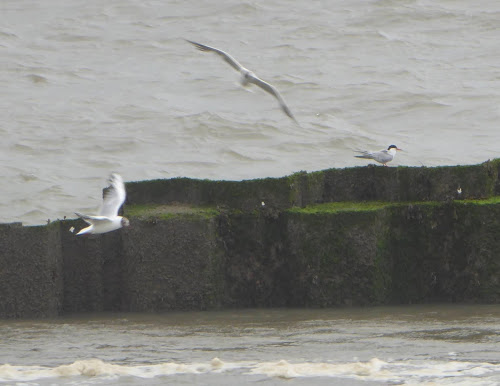
The only records so far are from the south wall in the evening.
Kevin watched the tide cover the beach near wooden jetty. There were four Mediterranean gulls taking advantage of the sand mason worms.

This adult Med and a BHG were the last to leave. You can see the sand mason worm tubes protruding out of the mud.
At that time there were no terns on the outflows.
I (MD) arrived at the outflows at 17:15, still no terns.
Checked the Mediterranean gulls on beach and Red Nab.
Adult 4
3cy 3
ad/3cy 1
2cy 2
I got back to No.1 outflow at 17:45, still no terns. The water level was about 0.5m below the outflow edge. At 17:50 Common Terns started feeding, I didn’t see from which direction, but not from north or west.
There were quickly at least 5. They looked to be the same birds as yesterday, based on plumage variation distribution. They obviously have a favoured water height in the outflow. I left at 18:00 there were still at least 3 feeding.

One had time for a rest and preen.
Hopefully more later
Tuesday, 14 July 2020
Four ages of Meds
After a wet start, the rain pretty much, held off for the rest of the day. Westerly wind and overcast.


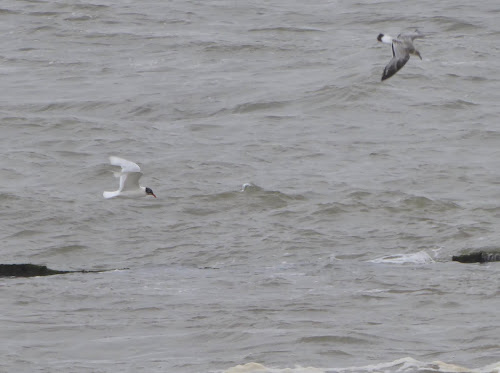

South wall (MD)
Mid morning, tide almost out
No terns on outflows
Whimbrel 1
Mediterranean gull:
One adult on beach near No.2 outflow.
Two adult and 3 x 3rd calendar year on Red Nab.

The two adult and 3 x 3cy Meds decided it was feeding time and flew from Red Nab to the sand mason worm bed on beach near wooden jetty.
When I got to the beach near wooden jetty, the third adult and 2 x 2nd calendar year birds were also on the sand mason worm bed. Unfortunately, this year, the densest area of worms is near the water’s edge - not good for ring reading, although none of today’s birds had darvic rings.
Evening, an hour before high water.
Common Tern - At 18:10 there were 5 adult on No.1 outflow.
At 18:20 they were joined by a sixth adult which came from No.2 outflow direction.
A quick look at No.2 outflow found no more, and by the time I returned to No.1. All the terns were gone. It looks like timing is critical, they disappeared just after the tide was higher than the outflow sides.

Three of the Common Tern.
Mediterranean gull
There was an adult and juvenile feeding together on No.1 outflow


Detail of the juvenile
So the day’s total:
Juvenile 1
2cy 2
3cy 3
Adult 4 (assuming this evening’s bird was different to this morning’s)
Monday, 13 July 2020
More signs of autum
Gentle westerlies, rain early on then mainly overcast


South shore - mid afternoon - flooding tide (MD)
Whimbrel - at least 1 calling from Red Nab - roosting with 100+ Curlew
Arctic Tern 1 2nd calendar year on seaward side of No.1 outflow.
Common Tern - at least 4 adults, more if they were not alternating between the two outflows.

This picture nicely shows the classic plumage features.
Mediterranean gull - some roosting on beach, some on Red Nab. I normally woefully undercount this species, but even I managed 5 adult (or 3cy) plus 7 x 2nd calendar year.

Some have started their autumn moult.
Middleton Nature Reserve overnight moth trap (PM)
Notable species included:

Grass emerald

Crescent
Subscribe to:
Posts (Atom)