Thursday, 3 September 2020

Still little moving along/over shoreline

 Quite brisk WSW winds, feeling cool. A couple of hours of sunshine in afternoon.

South shore (PM. MD)
Wheatear 1
Rock Pipit 3
Mediterranean gull - 15 out from Ocean Edge and on Red Nab, almost half (7) were juvenile c3 hours before high water.
Later there were two juvenile Meds on No.2 outflow
There were just 3 adult resting, not feeding, on the beach near the wooden jetty in the evening.

Heliport roost included 87 Turnstone

Middleton Nature Reserve (MD)
The sun came out for a couple of hours in the afternoon, still coolish though, but I thought I would see how the insects were faring.
The wildfowl was the same as yesterday, with the, unexpected, exception of one of the missing cygnets turning up on the "no swimming" pond with the single adult. Still one adult plus one cygnet unaccounted for.

Butterflies - amazingly the only species seen was Speckled Wood (quite a lot of them though). Amazing because there are plenty of Small Tortoiseshell and Small White on the shore.

Dragonflies - two species seen.
Common Darter 9
The population is looking aged though.
Migrant Hawker 3 male
Looking fresh!

Wednesday, 2 September 2020

Not much moving through

Strengthening wind, starting from SSE later it moved more SE. The rain started just before lunch and continued for the rest of the day.

Middleton Nature Reserve- ringing report from Alan
A very low key ringing session this this morning captured just six birds between 05:45 and 09:30. 
Only two Grey Wagtails were trapped and colour ringed (out of six individuals seen). The SSE wind was not strong, but sufficient to cause the mist net to billow out and alert the birds to its presence.
Singles of Robin, Willow Warbler, Common Whitethroat and Dunnock were the only other captures plus one retrapped Sedge Warbler from the previous morning. Lack of birds and increasing wind strength caused the session to be cut short.

South shore (MD)
Rock Pipit 3 on Red Nab in the morning, 2 near wooden jetty in the evening.
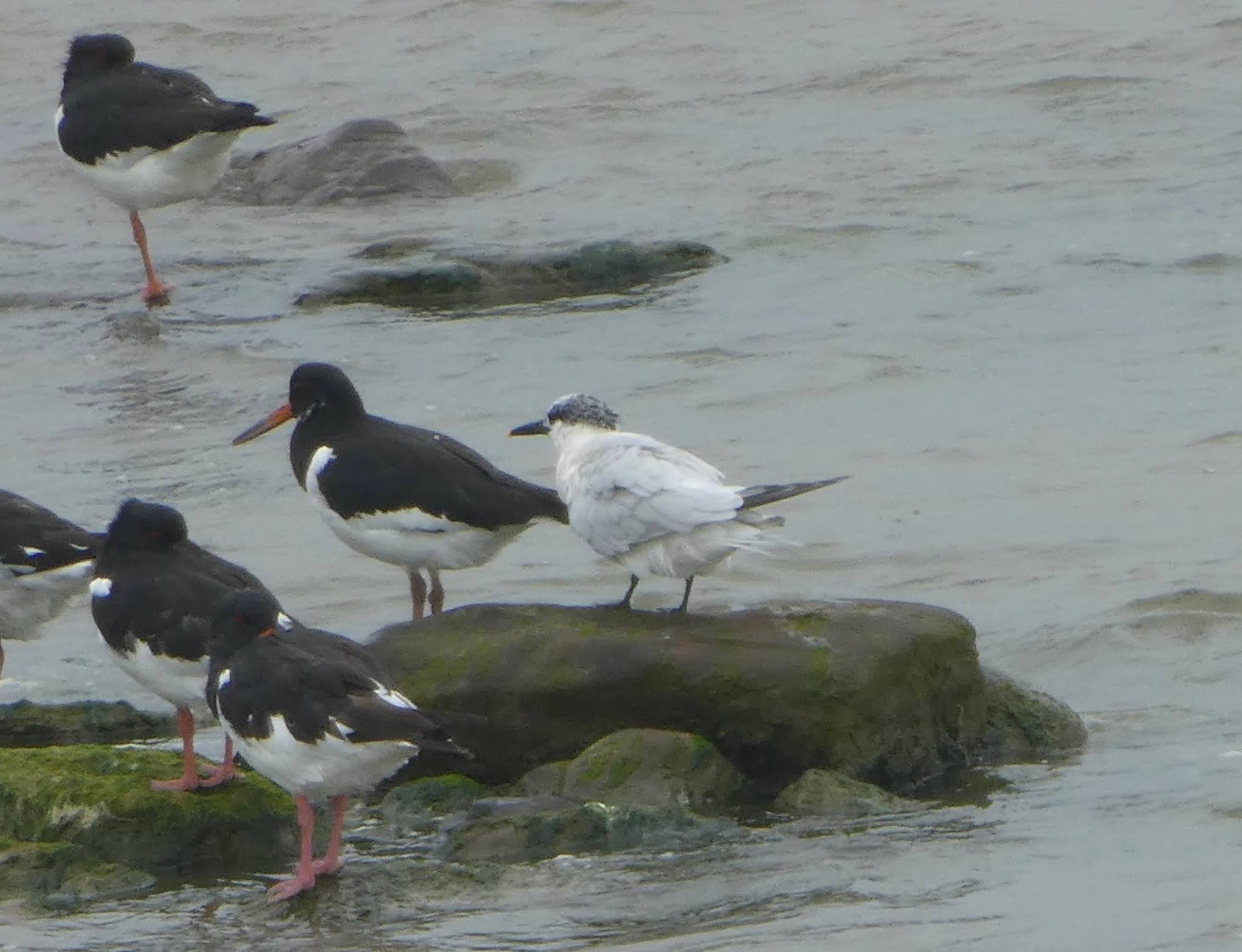
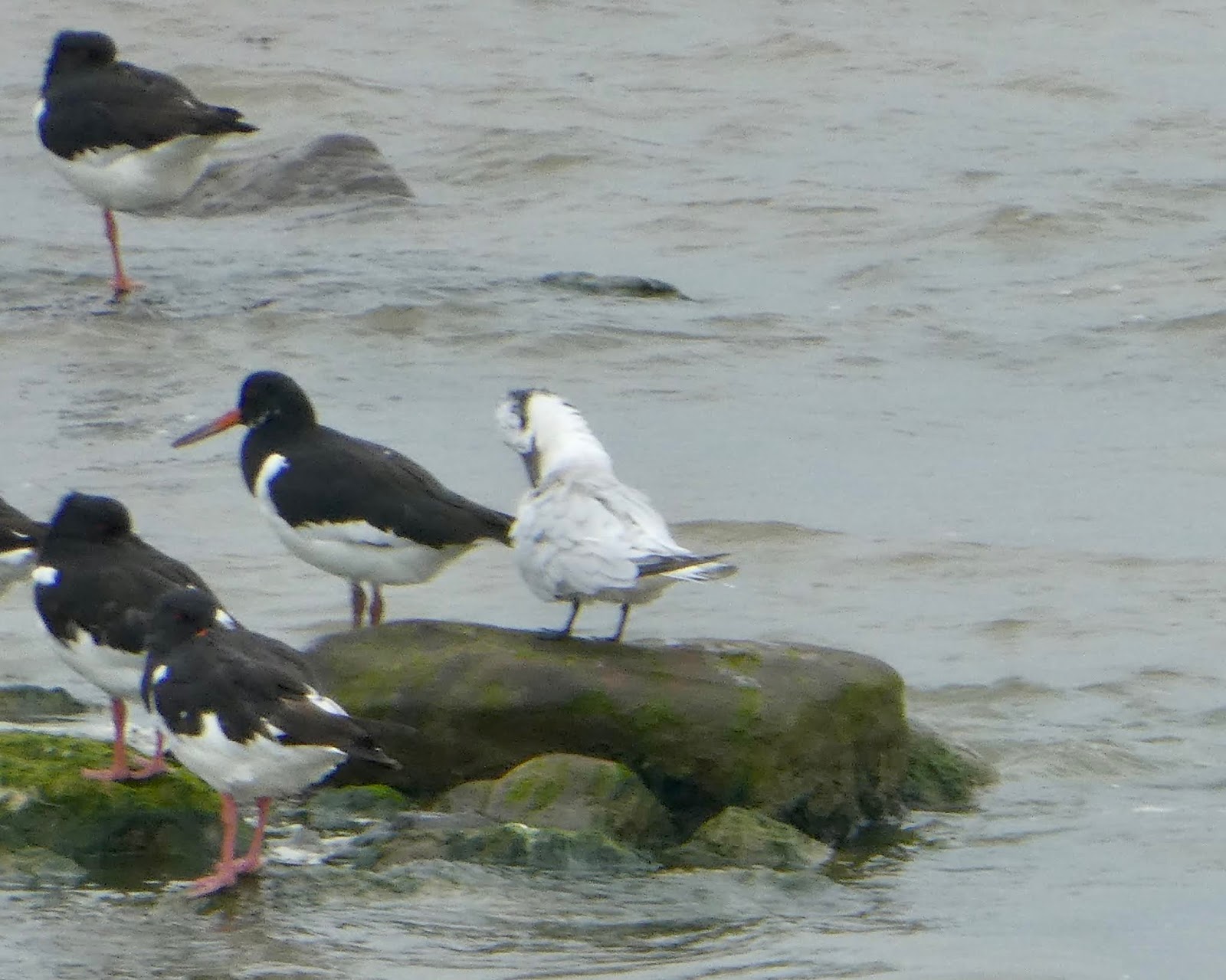
Sandwich Tern 1 adult on Red Nab in morning

This time of year they remind me of Max Wall.
But much more entertaining!


Mediterranean gull - I was a bit late getting to Red Nab this morning, any Meds that may have been roosting there were long gone. The were two juveniles flying south from No.2 outflow.
Analysis of long term feeding trends plus the recent decline in the number of feeding birds near the wooden jetty, suggested that today would be the first, in this cycle, when the sand mason worms would not be available. It was teeming down in the evening, but I donned waterproofs and went to check. The irony wasn't lost on me to be delighted to find the beach deserted (just two Oystercatchers). I am not expecting the worms to be readily available again till about the 11th September. I'll keep an eye on the beach, but perhaps not in the pouring rain!
1 juvenile on No.2 outflow in the evening.


Tuesday, 1 September 2020

September!

How did we get to September? This year seems to have had no structure and has just trickled away.
Another sunny day with light breezes.

Possibly more to come

Heysham Nature Reserve- just an hour watching/listening from car park (PM)
Good variety including:
Willow Warbler 5 plus,
Chiffchaff 2,
Whitethroat 4,
Lesser whitethroat 1-2,
Garden Warbler 1,
Blackcap 3,
Goldfinch c70
And the first Goldcrest of the autumn

Wooden jetty beach evening (MD)
Wheatear 1
Mediterranean gull- just three adult feeding

Middleton Nature Reserve evening ((MD)
Just a quick check of the two main ponds. Fortunately the water level of the "no swimming" pond has returned to normal, it's overflow pipe must have freed.
Mute Swan - the pair with three cygnet, originally from the "no swimming" pond are now the sole proprietors of the main pond. The only other bird seen was an adult, skulking, on the "no swimming" pond. It doesn't bode well for the missing, un fledged, cygnets.
Coot 4
Moorhen just 1 juvenile
Mallard 3
Gadwall 7
Tufted 1
Eclipse male Tufted with male and female Gadwall 


Monday, 31 August 2020

Another visitor from the east.

Light breezes all day starting from the east then moving to west, then stopped altogether In the evening. Light cloud and plenty of sunshine.

Middleton Nature Reserve early morning - ringing (JR.PM)
Visible migration:
Swallow 3
Meadow Pipit 2
Siskin 2
Tree Pipit 2
Linnet 3

Snipe 3 on the ground.

Twelve birds ringed including 9 warbler (almost double figures - a Willow Warbler escaped)
Lesser Whitethroat 2
Common Whitethroat 2
Blackcap 2
Willow Warbler 3

Another Grey Wagtail was colour ringed

South Shore (MD)
Morning rising tide
Wheatear 1 on saltmarsh 
I was giving it one more try from the mud in front of Ocean Edge. As I was walking out, this juvenile Peregrine was stood just where I was planning to stand.

I'm not sure if it was waiting to be fed, or already fending for itself. 
Unsurprisingly, the bulk of the waders were much further south in front of Potts Corner. When the microlights started at 09:30, it was obviously time to call it a day and leave the beach to the holiday makers. 

Wooden Jetty area - evening.
What a beautiful evening! Pleasantly warm, no breeze and surprisingly quiet.
Mediterranean gull - 12 adult feeding on the beach next to wooden jetty. Joined briefly by a juvenile.
The only darvic ringed bird today, was the regular German bird. The low sun making viewing difficult, but quite striking images.

Yesterday's white ringed bird was first ringed in Belgium as an adult - details:
E948521
Ringed with white 3AH1 as Adult on 11/5/19 at the colony at Total, Antwerp, Belgium 51 15N 4 19E

Re-ringed with white 34ET on 12/5/20 at the Total colony. Presumably the original darvic was damaged.
Today's title refers to this handsome moth from Kevin's trap this morning.
Palpita vitrealis
It's a migrant from mainland Europe
and mainly occurs in the South of the UK. It's quite rare this far North
.


Sunday, 30 August 2020

Overhead disturbance, but not a bad day

It started cold with light northerly winds which quickly drifted to the east, before swinging round to SW by evening. Dry with some prolonged sunshine.

Middleton Nature Reserve early am - ringing report from Alan.
Almost a Grass Frost !!
The temperature was 4 degrees at 05.30 this morning and I was expecting the guy cords and poles to be frozen, but fortunately they weren't.

The catch was very low with almost no warblers. Five more Grey Wagtails caught and colour ringed however - three further birds were seen but did not end up in the nets. Two of these did perch on the top of a net but decided to fly away again.

The only other captures in four hours were singles of Chaffinch, Blue Tit, Common Whitethroat, Reed Warbler, Lesser Whitethroat and a retrapped Cettis Warbler.

South shore (MD)
Early to mid morning on rising tide
Merlin 1 juvenile must have been resting on Ocean Edge foreshore rocks, it flew low (below me) towards Red Nab. I tried to relocate but it must have carried on or gone into the Power Station.
Wheatear 1
Rock Pipit 1
Linnet c30
Little Egret 12
Grey Seal 1
There were Mediterranean Gulls on Red Nab, but I didn't attempt to count them.

Waders:
Again, the plan was to let the tide bring the waders close as I waited on the mud out from the saltmarsh. At 8.1m the tide was a perfect height for this viewing technique.
There was some sort of gathering on the mud out from Potts Corner, this involved flying microlights around. This had two effects on the waders. It had herded between 5,000 to 7,000 to the corner out from Ocean Edge, which was good. But it also made them very flighty, which wasn't.
Unfortunately, before I was close enough to check them out in detail a Peregrine came hunting. It lifted everything, and they flew off towards the estuary (later the Peregrine returned with a godwit sized capture).
This is just a small fraction of the fleeing birds
The bulk were Knot and Grey Plover. But there were also Bar-Tailed Godwit, Curlew, Dunlin, Golden and Ringed Plover, Redshank and Oystercatcher (not all on this frame)
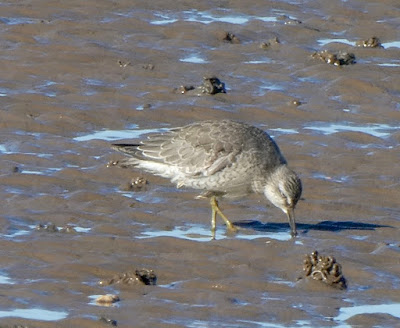
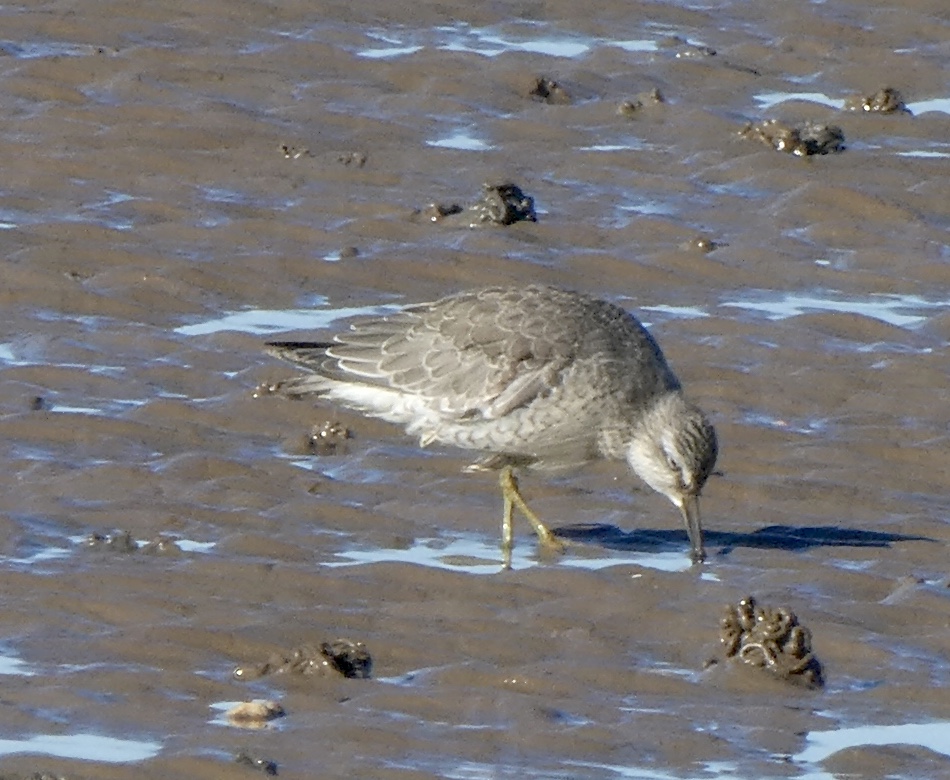
I say the Peregrine lifted everything - this Knot seemed oblivious to the mass departure!
Where did everyone go??
Still plenty of food around 

Fortunately a few wader that were feeding nearer the saltmarsh hung around.
Some of the Grey Plover still almost in full summer plumage.

This Golden Plover on the left is a juvenile, based on its constant peeping to be fed.
The bird on the right was silent. Winter Plumage adult? (MD)

Evening check of wooden jetty area
Rock Pipit 1
Mediterranean gull - 19 adult feeding on sand mason worms. Including the green ringed German bird, and a new white ringed bird.
Details awaited 


Saturday, 29 August 2020

A touch of west in the wind helped

The northerly wind was still quite fresh, but more to west today. The sun was out early but cool in the wind. It clouded over by lunchtime with just a few sunny spells later.

South shore ((MD)
07:15 - 08:45 just before high water.
Wheatear- initial walk from Red Nab to the saltmarsh located 7, return walk 45 minutes later found 12. They seemed to be moving through quickly but could have included some of the same birds. One near lighthouse in the evening brings day minimum to 13.
This juvenile provided a good shot of its flight feathers.

Rock Pipit 1 on saltmarsh, 3 Red Nab plus 1 near lighthouse in the evening.
Rock Pipit
Meadow Pipit 1 - grounded on Red Nab
Meadow Pipit
Mediterranean gulls - I managed to confirm 12 on Red Nab, almost certainly woefully undercounted. Pete counted 36 yesterday. Probably similar today.

Waders:
These neap tides do not cover the mud out from the saltmarsh at high water. With the low sun behind you,  it is ideal to view the feeding waders from the mud in front of the saltmarsh. Unfortunately today's tide was a bit too low (7.7m) so the waders remained a long way off. Even so there were c2000 on the water's edge nearest to Ocean Edge. Comprising, in order of abundance, Knot, Grey Plover, Curlew, Bar-Tailed Godwit and Dunlin.
This small group were resting closer in.
Mainly Grey Plover with a couple of Knot and Dunlin in the middle.
Little Egret 13 - including this group of 9 on the saltmarsh. At least 4 of these, and probably 5 were juvenile (by absence of plume). All 9 were constantly preening with their heads buried, so it wasn't easy to check.


The juvenile far left still has yellow/greenish legs.
The juvenile far right looks particularly waifish.

Evening check of Jetty area and outflows
Common gull 1 juvenile on No.2 outflow
Mediterranean gulls - 46 feeding on the beach next to jetty, including 1 juvenile

Juvenile Common gull

Juvenile Med gull

Hopefully more records to come.

Friday, 28 August 2020

Nothing new - so far

Quite strong winds from the north, mainly NNE. Some showers.

So far all I have is from a quick check of jetty area and outflows - early evening (MD)
Arctic Tern 1 juvenile on No.2 outflow
Mediterranean gulls - 27 feeding on the beach near the wooden jetty. None on the outflows and no juvenile birds seen.

Hopefully more to come

Thursday, 27 August 2020

Of clouds, potatoes and salvage - oh.......and a few birds

Light variable winds and the constant threat of rain that rarely materialised.

Middleton Nature Reserve 
Ringing report provided by Alan:
The ringing session this morning at Middleton began early, at 05.45 with the expectation of rain by 10.00 - the rain never came. After a quiet start a reasonable total of 26 of birds was caught, including a nice treat in the from of the first Grey Wagtails. Three of this species were trapped and colour ringed as part of our on-going project (see scheme details on side bar, right)

Warbler species trapped were:
Whitethroat 5
Garden Warbler 1
Blackcap 3
Lesser Whitethroat 1
Willow Warbler 4

Also caught were singles of Blue Tit, Robin, Goldfinch, Chaffinch, Wren and two each of Long Tailed Tit and Great Tit.

Jean managed to photograph this Kelvin-Helmholtz cloud (no, I hadn't heard of them before either, but I found it interesting (MD))
A Kelvin-Helmholtz cloud looks like waves. I was a bit slow to take the picture, so it had started losing its shape. It indicates a turbulent flow which causes ripples of air within an otherwise stable flow of air.

South shore
Early morning (PM)
Arctic Tern 1 juvenile on No.2 outflow. Looking restless, with at least one foray to the shipping lane and back.

Early afternoon (MD)
No sign of the Arctic tern
Wheatear 1
Rock Pipit 2 + 1 + 1
Mediterranean gulls:
5 juvenile feeding on No.2 outflow
3 adult on beach next to the outflow
36 including 1 juvenile feeding on the sand mason worms on beach next to jetty.
This juvenile Med, was practicing its walking on water skills.
But the Arctic Tern hadn't moved on ( unless a new bird). Kevin photographed it on No.2 outflow later in the afternoon. Presumably the prospect of easy pickings is currently outweighing the instinct to move on.


North shore (JP)
Rock Pipits 3 including at least one juvenile bird, below the Heysham Head cliffs. That takes the minimum number in the observatory area today to seven.
One of Janet's juvenile Rock Pipits

This is the remains of an Heart Urchin - commonly known as a "Sea Potato".
They are a generally quite a common urchin, but not regularly seen in the bay. They live in burrows under the sand and can be washed out by heavy seas. I think the heavy mud of the bay and the large tidal reach makes it unsuitable for them - I could be wrong (MD)

Finally, Janet managed to photograph the demise of the green marker post (4/08/20). I had presumed that it was just due to storm damage, and perhaps it was.
This is a salvage vessel removing the post. Perhaps it had been damaged and was being removed for repair. The supporting structure is still in place on the pipeline, I'll have a look at its condition during the next spring tides. You would think that they wouldn't go to the expense of removing it, if they weren't going to replace it. Let's hope so, as it's a handy marker for locating distant birds and feeding areas.


Wednesday, 26 August 2020

Arctic best of a poor bunch!.....at least so far

Light winds from the west. Mainly dry with some sunshine.

Only my stuff so far, and not much at that - hopefully more later (MD)

Arctic Tern - 1 juvenile feeding on No.2 outflow. At least during mid afternoon

Heysham skeer low water (12:20)
Not much!
Little Egret 8
Great-Crested Grebe 5
Red-Breasted Merganser 2
Eider 5

An area of mussel beds on the north side of the skeer was cleared by early summer storms. This area is now being colonised by Honeycomb worms.
At the moment they are just a few centimetres high.
But this is a potential foundation for a reef, which can reach almost 2 metres.
They are very similar to sand mason worms,
But instead of building their tubes in the mud,
they form colonises on anything solid.
This is a different area on the south side, first colonised last year.
The clumps are getting larger and the reef starting to form.
Over the last 20 years or so there has been a constant conflict on the skeer between the mussel beds and Honeycomb worm reefs. The dominance dictated by the tides and weather each year, at the moment the Honeycomb worm is winning. It wasn't always so, I'd never seen a Honeycomb worm till about the 1980's. They are a warm water species, previously restricted to the south west in England plus the Scottish Western Isles, warmed by the Gulf Stream.
I've never seen anything trying to eat them. You would think that the worm tubes at the edges would be relatively easy pickings.

By the way if any of you use the green marker post at the end of the old pipeline out from Heysham Head - It's gone. Hopefully it will be replaced.

Tuesday, 25 August 2020

Francis doesn't really provide

The wind from storm Francis started strongly enough but had a touch of east in it. By the time it had swung round to the west, it had eased. Heavy rain on and off all day.

South Shore (MD. PM)
Wheatear 5 (2 on saltmarsh, 2 on Red Nab and 1 near lighthouse)
Rock pipit 2 + 1 + 1
Rock Pipit in yesterday's sunshine 

Common Tern, 1 adult briefly on No.2 outflow 15:00
Arctic Tern, 1 juvenile on No.2 outflow at least 14:30 to 15:30


I know these pictures of the juvenile Arctic, are no better than Sunday's, but they were difficult in today's conditions so I decided to use them anyway (MD)

Just received these excellent pictures from Howard. Roosting waders on the Heliport wall yesterday.

The brown four legged individual, scurrying below the Redshank,
is a Brown Rat. They don't look pleased!

Just two Knot