Monday, 7 September 2020

Shelduck top the bill.......oh dear

The southwesterly winds continue, but with little venom. Long periods of heavy rain.

South shore early afternoon (MD)
Very little!
Mediterranean gull just one juvenile seen on No.1 outflow
Rock Pipit - 2 on saltmarsh plus 2 on Red Nab
Shelduck - there were at least 58 grazing on the mud out from the saltmarsh. First large gathering seen this autumn, some appeared to be juvenile, but it was difficult viewing through the driving rain.
A few of the Shelduck. Looking enigmatic through the rain.

Middleton Nature Reserve 
Just a brief check of the two main ponds was disappointing.
Mute - 2 adult with 3 cygnet were the only wildfowl on the main pond. 1 adult plus 1 cygnet on "no swimming" pond.
Also on "no swimming" pond
Coot 1
Gadwall 6

Swallow 1 south

Sunday, 6 September 2020

The Pinkfoot have started moving over

Wind still from SW, but not strong. A few light showers and sunny spells.

Pink-Footed Goose - several reports of flocks flying south. Probably c400 in total over the recording area.

Heysham skeer - low water (09:15) (MD)
Great Crested Grebe 7
Eider 23
Little Egret 10
Lots of Oystercatcher and  Curlew
No Knot
Redshank c50
Turnstone c60
Turnstone are well camouflaged in this terrain.
They sometimes don't fly off till you almost stand on them.
This juvenile is typical.

The honeycomb worms are quickly taking over the north side of the inner skeer. Apart from making walking difficult (it's like walking over wet egg cartons, it doesn't harm the worms, they just need to repair the damaged tube), the main significance is to the wintering diving birds that rely on the mussels (e.g. Eider)
The dark finger towards the top is the only area of mussels in this section.
The honeycomb reef goes right up to the first channel (Noah's dyke).
It wasn't possible to cross the channel on this height tide, but the outer skeer, starting on the other side of the channel, appears to be mainly mussel beds.

Wooden jetty area 11:00 (MD)
Just a quick check of the Meds on the beach - none.

This Lesser Black-Backed gull had caught a Common Blenny. Blenny are happy to remain in the shallowest of pools, particularly if covered by wrack. The gull probably foraged for it at the bottom of wall next to the lighthouse.
They look dangerous, but are perfectly harmless.
The fish, not the gull!
A quick tap on the head to subdue it
Then down it goes


Kevin had another excellent and interesting capture in his overnight "moth" trap.
Hornet Hoverfly
They are a huge hoverfly, and according to the NBN atlas there don't appear to be any Lancashire records North of the Manchester/Liverpool area. 

A migrant which has been occurring more frequently in the UK in recent years, 
the largest hoverfly to be found in the British isles.


Saturday, 5 September 2020

Osprey - almost got away again

The wind pretty much due west all day, blustery early on, but easing slightly by evening.

South shore (PM. MD)
Osprey 1 - 12:15 out from Red Nab. The last observatory sighting of an Osprey, the bird managed to avoid being photographed. Today Pete, just, managed a few record shots.
Not easy with a phone camera.

Mediterranean gull - Red Nab had been flushed by holidaymakers on the rising tide. There were 5 feeding on beach near the wooden jetty before the tide flushed them.
Nice reference shot of an adult Med
sandwiched between a juvenile and adult Black-headed gull.
Checked the beach again in the evening. 8 Meds feeding plus 9 resting on the rocks.

Kittiwake 1 juvenile in the harbour mouth 18:45


Before flying off to the west


Kevin managed some nice detail shots of a Common Darter sunning itself on Heysham Nature Reserve.


Migrant Hawker 4 around the entrance to Ocean Edge.


Friday, 4 September 2020

Ah well...back to the spreadsheet!

The southwesterly didn't reach the force originally forecast. Some sunshine.

South shore - evening low water (MD)
Rock pipit 2
Pied Wagtail c40
Mediterranean gulls - there was a scattering all along the shore
This one on mud out from Ocean Edge foreshore.
With a Little Egret and Lesser-black Backed gulls.

There were c250 small gulls on the beach on west side of No.2 outflow. The sun made it difficult to check them, but there were 2 adult and a juvenile Med with the closer gulls.
Unusually, they were all lifted by a Peregrine. They just did a circle around then landed again. It still wasn't possible to identify species against the light.

When I got to the beach next to the wooden jetty there were at least 20 Meds. My first thought was that they had just landed here to roost, from the earlier spooked birds. But these birds were looking for and catching sand mason worms. I have been plotting feeding Meds here against moon phase, based on my suspicion that the availability of the sand mason worms is linked to their breeding cycle. Up to now there has been some interesting correlations, but this is supposed to be a quiet period. Perhaps the weather is also an influence, so next year I'll include temperature, wind direction, and strength. I don't really need to know when the worms will be available, I just don't like being outthought by a bird!


Bizarrely, both outflows pointed directly at the setting sun this evening.
This is No.1 outflow. If this area is excavated in the distant future, they will assume that whatever "civilisation" created these features, aligned them with the setting sun at the Autumn Equinox. Obviously sun worshipers.

Thursday, 3 September 2020

Still little moving along/over shoreline

 Quite brisk WSW winds, feeling cool. A couple of hours of sunshine in afternoon.

South shore (PM. MD)
Wheatear 1
Rock Pipit 3
Mediterranean gull - 15 out from Ocean Edge and on Red Nab, almost half (7) were juvenile c3 hours before high water.
Later there were two juvenile Meds on No.2 outflow
There were just 3 adult resting, not feeding, on the beach near the wooden jetty in the evening.

Heliport roost included 87 Turnstone

Middleton Nature Reserve (MD)
The sun came out for a couple of hours in the afternoon, still coolish though, but I thought I would see how the insects were faring.
The wildfowl was the same as yesterday, with the, unexpected, exception of one of the missing cygnets turning up on the "no swimming" pond with the single adult. Still one adult plus one cygnet unaccounted for.

Butterflies - amazingly the only species seen was Speckled Wood (quite a lot of them though). Amazing because there are plenty of Small Tortoiseshell and Small White on the shore.

Dragonflies - two species seen.
Common Darter 9
The population is looking aged though.
Migrant Hawker 3 male
Looking fresh!

Wednesday, 2 September 2020

Not much moving through

Strengthening wind, starting from SSE later it moved more SE. The rain started just before lunch and continued for the rest of the day.

Middleton Nature Reserve- ringing report from Alan
A very low key ringing session this this morning captured just six birds between 05:45 and 09:30. 
Only two Grey Wagtails were trapped and colour ringed (out of six individuals seen). The SSE wind was not strong, but sufficient to cause the mist net to billow out and alert the birds to its presence.
Singles of Robin, Willow Warbler, Common Whitethroat and Dunnock were the only other captures plus one retrapped Sedge Warbler from the previous morning. Lack of birds and increasing wind strength caused the session to be cut short.

South shore (MD)
Rock Pipit 3 on Red Nab in the morning, 2 near wooden jetty in the evening.
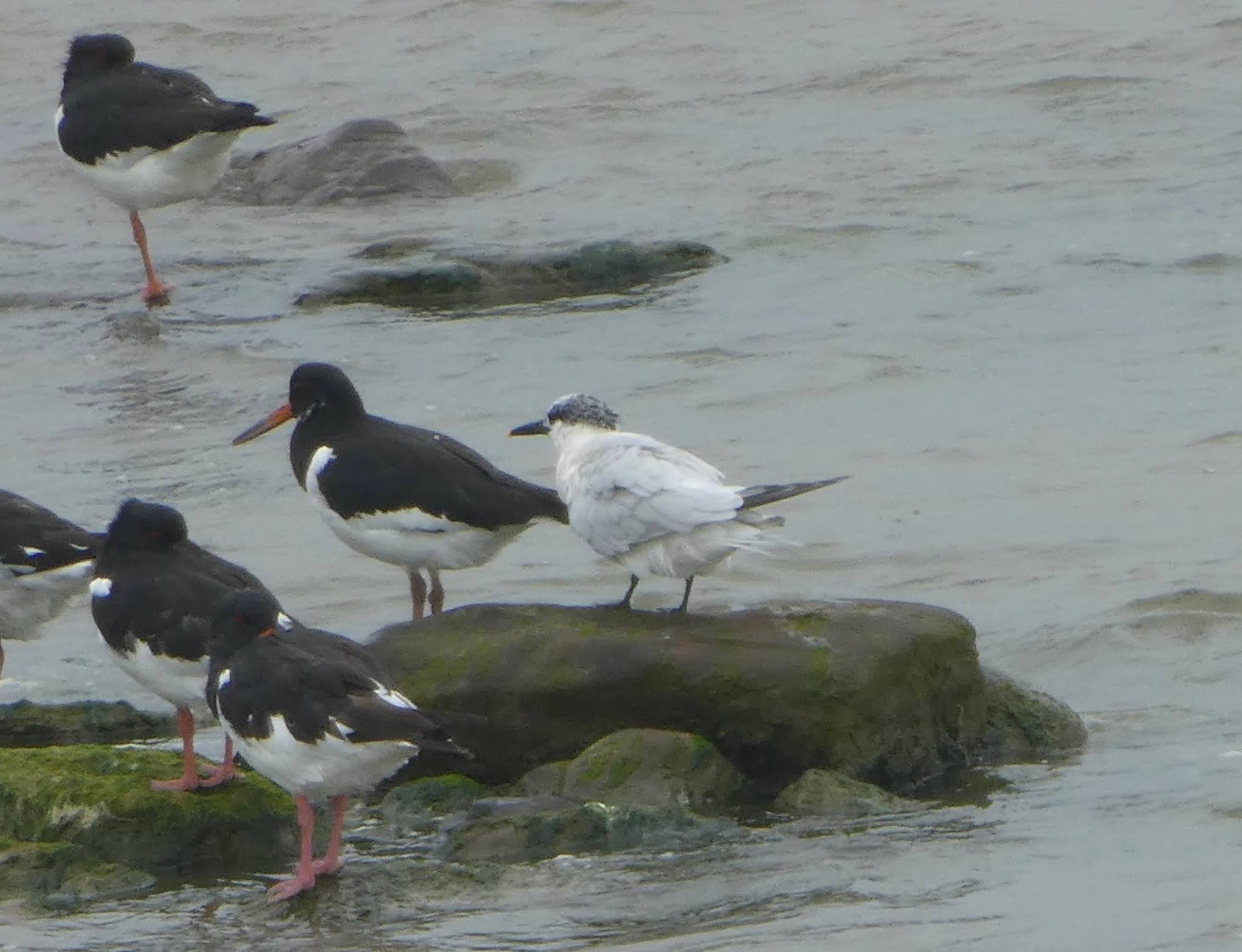
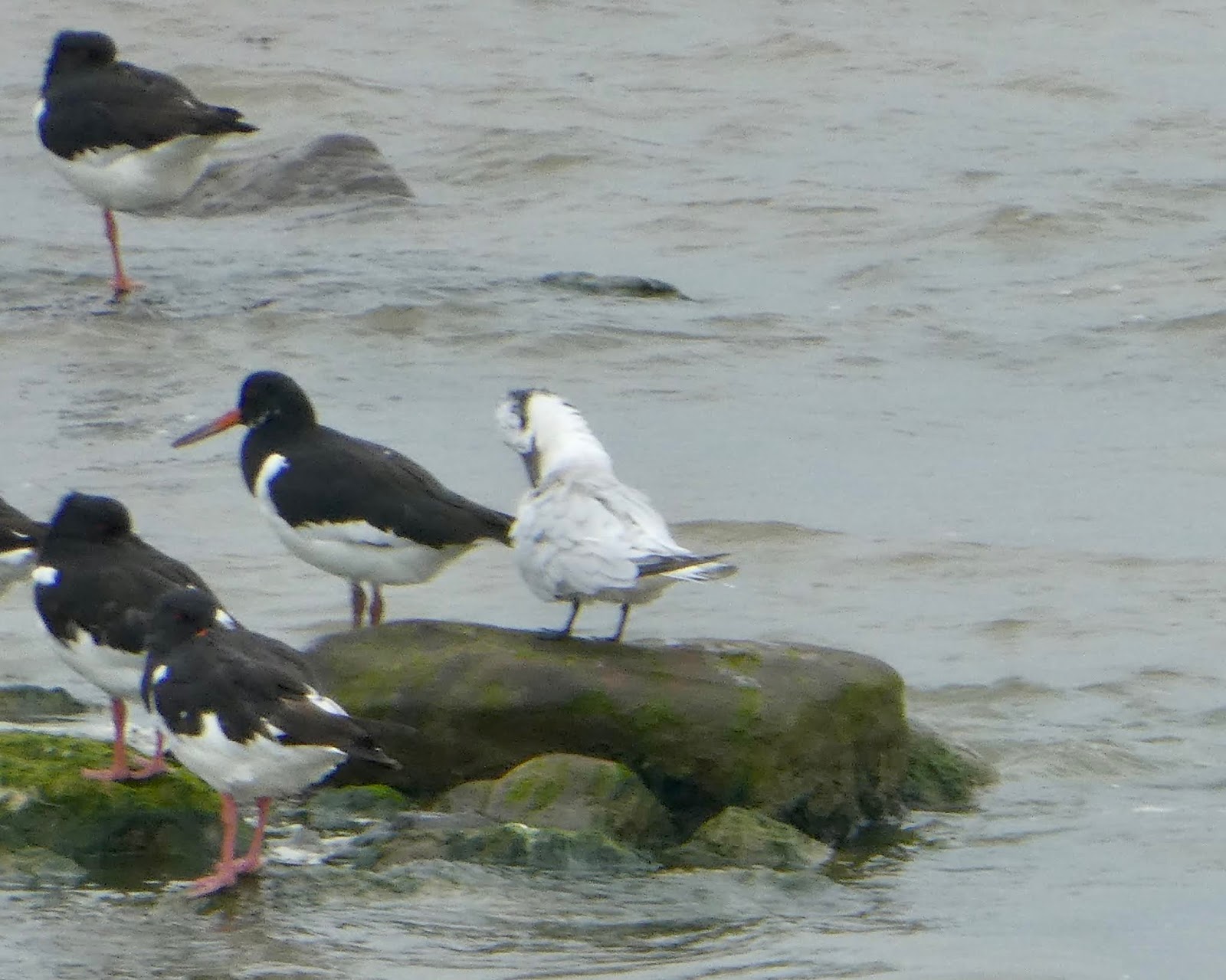
Sandwich Tern 1 adult on Red Nab in morning

This time of year they remind me of Max Wall.
But much more entertaining!


Mediterranean gull - I was a bit late getting to Red Nab this morning, any Meds that may have been roosting there were long gone. The were two juveniles flying south from No.2 outflow.
Analysis of long term feeding trends plus the recent decline in the number of feeding birds near the wooden jetty, suggested that today would be the first, in this cycle, when the sand mason worms would not be available. It was teeming down in the evening, but I donned waterproofs and went to check. The irony wasn't lost on me to be delighted to find the beach deserted (just two Oystercatchers). I am not expecting the worms to be readily available again till about the 11th September. I'll keep an eye on the beach, but perhaps not in the pouring rain!
1 juvenile on No.2 outflow in the evening.


Tuesday, 1 September 2020

September!

How did we get to September? This year seems to have had no structure and has just trickled away.
Another sunny day with light breezes.

Possibly more to come

Heysham Nature Reserve- just an hour watching/listening from car park (PM)
Good variety including:
Willow Warbler 5 plus,
Chiffchaff 2,
Whitethroat 4,
Lesser whitethroat 1-2,
Garden Warbler 1,
Blackcap 3,
Goldfinch c70
And the first Goldcrest of the autumn

Wooden jetty beach evening (MD)
Wheatear 1
Mediterranean gull- just three adult feeding

Middleton Nature Reserve evening ((MD)
Just a quick check of the two main ponds. Fortunately the water level of the "no swimming" pond has returned to normal, it's overflow pipe must have freed.
Mute Swan - the pair with three cygnet, originally from the "no swimming" pond are now the sole proprietors of the main pond. The only other bird seen was an adult, skulking, on the "no swimming" pond. It doesn't bode well for the missing, un fledged, cygnets.
Coot 4
Moorhen just 1 juvenile
Mallard 3
Gadwall 7
Tufted 1
Eclipse male Tufted with male and female Gadwall 


Monday, 31 August 2020

Another visitor from the east.

Light breezes all day starting from the east then moving to west, then stopped altogether In the evening. Light cloud and plenty of sunshine.

Middleton Nature Reserve early morning - ringing (JR.PM)
Visible migration:
Swallow 3
Meadow Pipit 2
Siskin 2
Tree Pipit 2
Linnet 3

Snipe 3 on the ground.

Twelve birds ringed including 9 warbler (almost double figures - a Willow Warbler escaped)
Lesser Whitethroat 2
Common Whitethroat 2
Blackcap 2
Willow Warbler 3

Another Grey Wagtail was colour ringed

South Shore (MD)
Morning rising tide
Wheatear 1 on saltmarsh 
I was giving it one more try from the mud in front of Ocean Edge. As I was walking out, this juvenile Peregrine was stood just where I was planning to stand.

I'm not sure if it was waiting to be fed, or already fending for itself. 
Unsurprisingly, the bulk of the waders were much further south in front of Potts Corner. When the microlights started at 09:30, it was obviously time to call it a day and leave the beach to the holiday makers. 

Wooden Jetty area - evening.
What a beautiful evening! Pleasantly warm, no breeze and surprisingly quiet.
Mediterranean gull - 12 adult feeding on the beach next to wooden jetty. Joined briefly by a juvenile.
The only darvic ringed bird today, was the regular German bird. The low sun making viewing difficult, but quite striking images.

Yesterday's white ringed bird was first ringed in Belgium as an adult - details:
E948521
Ringed with white 3AH1 as Adult on 11/5/19 at the colony at Total, Antwerp, Belgium 51 15N 4 19E

Re-ringed with white 34ET on 12/5/20 at the Total colony. Presumably the original darvic was damaged.
Today's title refers to this handsome moth from Kevin's trap this morning.
Palpita vitrealis
It's a migrant from mainland Europe
and mainly occurs in the South of the UK. It's quite rare this far North
.


Sunday, 30 August 2020

Overhead disturbance, but not a bad day

It started cold with light northerly winds which quickly drifted to the east, before swinging round to SW by evening. Dry with some prolonged sunshine.

Middleton Nature Reserve early am - ringing report from Alan.
Almost a Grass Frost !!
The temperature was 4 degrees at 05.30 this morning and I was expecting the guy cords and poles to be frozen, but fortunately they weren't.

The catch was very low with almost no warblers. Five more Grey Wagtails caught and colour ringed however - three further birds were seen but did not end up in the nets. Two of these did perch on the top of a net but decided to fly away again.

The only other captures in four hours were singles of Chaffinch, Blue Tit, Common Whitethroat, Reed Warbler, Lesser Whitethroat and a retrapped Cettis Warbler.

South shore (MD)
Early to mid morning on rising tide
Merlin 1 juvenile must have been resting on Ocean Edge foreshore rocks, it flew low (below me) towards Red Nab. I tried to relocate but it must have carried on or gone into the Power Station.
Wheatear 1
Rock Pipit 1
Linnet c30
Little Egret 12
Grey Seal 1
There were Mediterranean Gulls on Red Nab, but I didn't attempt to count them.

Waders:
Again, the plan was to let the tide bring the waders close as I waited on the mud out from the saltmarsh. At 8.1m the tide was a perfect height for this viewing technique.
There was some sort of gathering on the mud out from Potts Corner, this involved flying microlights around. This had two effects on the waders. It had herded between 5,000 to 7,000 to the corner out from Ocean Edge, which was good. But it also made them very flighty, which wasn't.
Unfortunately, before I was close enough to check them out in detail a Peregrine came hunting. It lifted everything, and they flew off towards the estuary (later the Peregrine returned with a godwit sized capture).
This is just a small fraction of the fleeing birds
The bulk were Knot and Grey Plover. But there were also Bar-Tailed Godwit, Curlew, Dunlin, Golden and Ringed Plover, Redshank and Oystercatcher (not all on this frame)
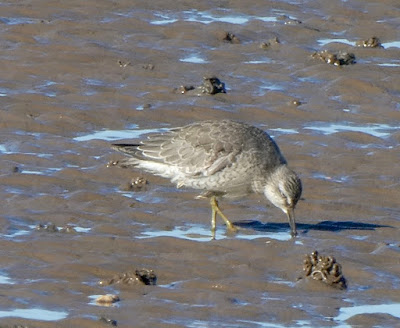
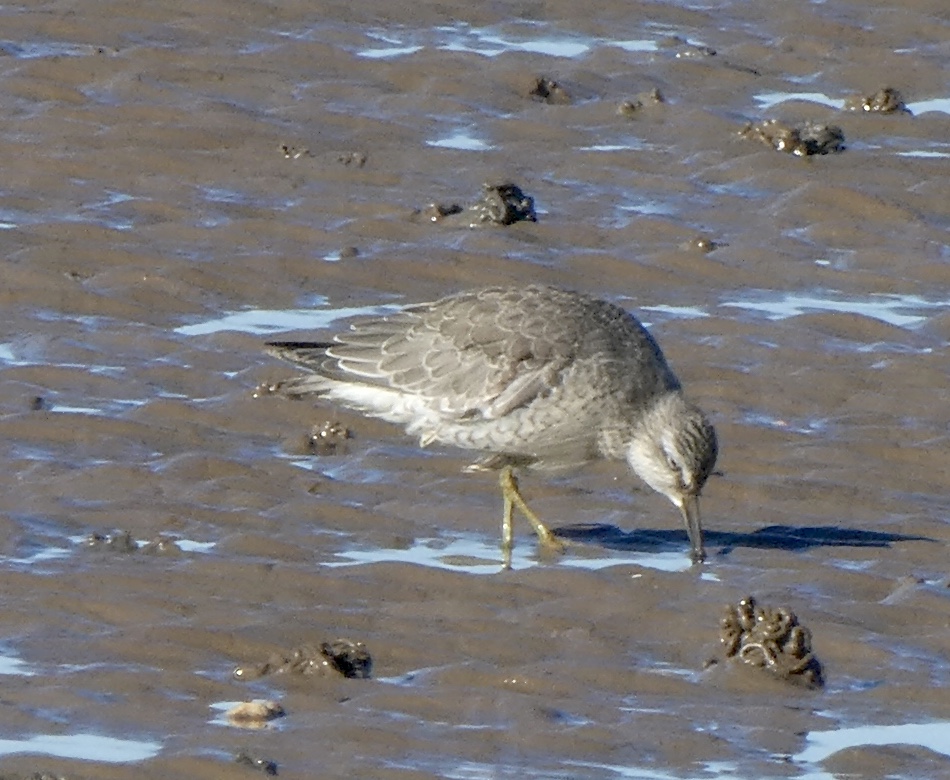
I say the Peregrine lifted everything - this Knot seemed oblivious to the mass departure!
Where did everyone go??
Still plenty of food around 

Fortunately a few wader that were feeding nearer the saltmarsh hung around.
Some of the Grey Plover still almost in full summer plumage.

This Golden Plover on the left is a juvenile, based on its constant peeping to be fed.
The bird on the right was silent. Winter Plumage adult? (MD)

Evening check of wooden jetty area
Rock Pipit 1
Mediterranean gull - 19 adult feeding on sand mason worms. Including the green ringed German bird, and a new white ringed bird.
Details awaited 


Saturday, 29 August 2020

A touch of west in the wind helped

The northerly wind was still quite fresh, but more to west today. The sun was out early but cool in the wind. It clouded over by lunchtime with just a few sunny spells later.

South shore ((MD)
07:15 - 08:45 just before high water.
Wheatear- initial walk from Red Nab to the saltmarsh located 7, return walk 45 minutes later found 12. They seemed to be moving through quickly but could have included some of the same birds. One near lighthouse in the evening brings day minimum to 13.
This juvenile provided a good shot of its flight feathers.

Rock Pipit 1 on saltmarsh, 3 Red Nab plus 1 near lighthouse in the evening.
Rock Pipit
Meadow Pipit 1 - grounded on Red Nab
Meadow Pipit
Mediterranean gulls - I managed to confirm 12 on Red Nab, almost certainly woefully undercounted. Pete counted 36 yesterday. Probably similar today.

Waders:
These neap tides do not cover the mud out from the saltmarsh at high water. With the low sun behind you,  it is ideal to view the feeding waders from the mud in front of the saltmarsh. Unfortunately today's tide was a bit too low (7.7m) so the waders remained a long way off. Even so there were c2000 on the water's edge nearest to Ocean Edge. Comprising, in order of abundance, Knot, Grey Plover, Curlew, Bar-Tailed Godwit and Dunlin.
This small group were resting closer in.
Mainly Grey Plover with a couple of Knot and Dunlin in the middle.
Little Egret 13 - including this group of 9 on the saltmarsh. At least 4 of these, and probably 5 were juvenile (by absence of plume). All 9 were constantly preening with their heads buried, so it wasn't easy to check.


The juvenile far left still has yellow/greenish legs.
The juvenile far right looks particularly waifish.

Evening check of Jetty area and outflows
Common gull 1 juvenile on No.2 outflow
Mediterranean gulls - 46 feeding on the beach next to jetty, including 1 juvenile

Juvenile Common gull

Juvenile Med gull

Hopefully more records to come.