Wednesday, 8 December 2021

It rained....so a bit of erosion "news"

Very heavy overnight rain continued all day driven by a strong west wind which only started to ease by late afternoon.

I tried a walk along the south shore, but there was little to see in difficult viewing conditions (MD).
Shelduck 11 braced against the wind on the mud. The rain had eased slightly and I thought at the time, this might be my only photo opportunity today - I was right!
Shelduck 
Wigeon 95 on the lee side of No.1 outflow on the way out, there seemed more on the way back, but the rain was particularly harsh then, so not counting weather.
Rock Pipit 1 on saltmarsh 
Greenfinch 3 on Red Nab
Shag - a small pot bellied bird flying out of the harbour was almost certainly a shag, but didn't get a good enough look to be sure.

Blackbirds 5 particularly plump birds were catching worms on the water logged grass in the Nature Park. They were briefly joined by a 
Redwing, don't know if it was also after worms or just seeing what was going on.

That's the end of the bird news, unless someone else was daft enough to be out today. The rest of this post is just a bit of skear history. I've been saving the pictures for this article for a rainy day, not done bad, it's over a year!
On 12th October 2020 I explained how the skears were once two tree covered islands on top of boulder clay, left from the last ice age (if you want to read any historic posts there is a date selection option on the side bar to the right). The islands were still there in the late 17th century, possibly lasting as late as the great storm of 1703. 
Today, I want to demonstrate, that without any historic records, it is still easy to deduce that the islands have not been gone for long.
Boulder clay as the name suggests is a collection of rocks and clay amassed together by a glacier. When the islands were destroyed the surface clay would have been washed away, leaving the rocks and boulders to rest on the current surface. This first shot is of the inner skear, you can see a range of size and shaped boulders resting where they settled.
Boulders on the inner skeer
Although the inner skear is covered by the sea twice a day, and is subjected to weathering due to rough seas, it is a slow and pretty much a random process.
It's a different story on the outer skear, there are no large rocks present at all. The difference is the speed and power of the, particularly ebbing, tides has completely eroded any large rocks. But, to me, the interesting area is the middle skear, where the erosion can be seen in progress. 
There are still a lot of large rocks on the middle skear, but at they all appear to be a similar shape, triangular. This is a typical middle skear rock, when it's not encrusted with honeycomb worms or mussels.
Middle skear rock, the clue to its shape can be seen at its base where it is eroding
This is not the shape of the rock that first settled here. You can see at its base the fast tides are driving stones and mussels against it and undermining the rock. This has already happened to it at least once, the peak at the top was once its side. This next picture shows one that has just toppled over.
Recently toppled middle skear rock
You can see how the undermining has caused it to be top heavy and it has fallen on its side. The process begins again immediately. 
Sometimes the base gets so thin that they end up, upside down, as these three.
Three recently toppled middle skear rocks, now upside down
The process is surprisingly quick, I have walked on the skear for many years and have watched them erode and topple (although you never actually see them topple, the currents do that). I'm not talking months, but definitely decades not centuries. It is easy to see that in a few hundred years there will be very few large rocks on the middle skear, as is the case now on the much harsher environment of the outer skear.
There are exceptions of course, the rocks above are sandstone, there are also limestone rocks whose erosion is somewhat more erratic. A few granite rocks showing no obvious sign of erosion and the largest rock of all Conger. This is also sandstone, I think, but its huge size makes the process relatively slower. Even so, you can see the undermining process at the base of conger, but I'll not see it topple!
Conger rock, not ready to topple yet.

Hopefully a bit more wildlife news tomorrow 


Tuesday, 7 December 2021

Sheltered from the storm

It was wild today with very strong SE winds, but winds in this direction do not have the same impact in Heysham as those coming in off the sea. Occasional showers.

South shore
Saying we are somewhat sheltered from SE gales doesn't mean the going was easy, although the battling against the wind was for walking back along the wall, not heading out.
I had a quick look on the rising tide mid morning (MD)
Wigeon 100+
Still no Shelduck seen
Rock Pipit 1 on Red Nab
Kingfisher 1 - it looked like it had been fishing in the pool directly below the sea wall at Red Nab. Plenty of small fish get trapped there on spring tides. But it flew off when I became visible to it.
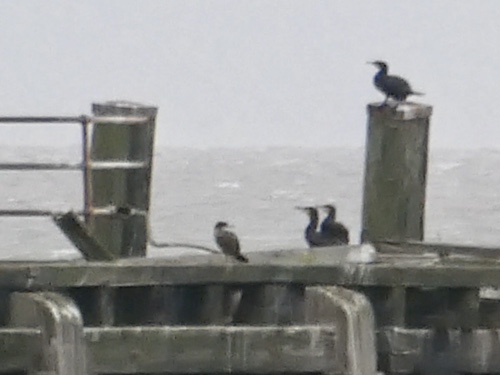
Shag 1 juvenile preening on the wooden Jetty
Juvenile Shag centre, with Cormorants on wooden jetty 

It's a little easier to see in this clip, sorry about the rolling, but it was quite blustery on the round head.

Janet had a quick look this afternoon and took these shots:
Male Wigeon battling against the wind

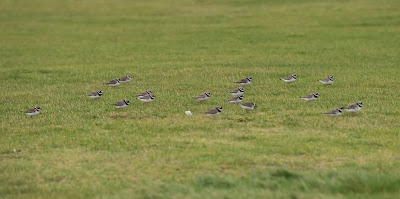
These Ringed Plover sheltering behind the foreshore,
add a nice bit of colour to an otherwise grey day.


Monday, 6 December 2021

And then there were two.

The wind started from the south before moving to west by the afternoon. The morning rain eased to showers in the afternoon, with the occasional sunny spell.

Heysham Nature Reserve 
Just a quick circuit mid afternoon 
Goldfinch c30
Bullfinch 4
Small mixed tit flock, mainly Long-tailed and Blue.
Chiffchaff 1 possibly 2 - not with the tits
Sparrowhawk 1
Moorhen 2

South shore 
Shag 2 juvenile - Pete saw one in the harbour mouth at 14:20. I was heading down the wall next anyway, so kept an eye out for it - turns out that I didn't need to (MD)
15:30 One was stood on the harbour wall near the lighthouse, unfortunately chased off by a Herring Gull (this is its resting spot!) before I could get the Shag into proper focus. Still, too good not to share:

By the time I could see the water in the harbour mouth there were two together, unfortunately not feeding.

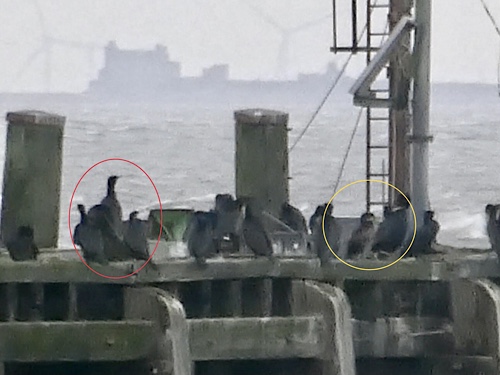
It was 15:40 and getting quite dark, both birds flew to the end of the wooden jetty, presumably to roost overnight. This is where they landed, not overly elegantly!

I thought they would roost close together, and they probably did end up together. The outer bird moved a little closer to the other bird. The outer bird is circled in yellow. The other is behind the group in the red circle, possibly the head poking out on the right.
Juvenile Shag roosting with the Cormorants at the end of the wooden jetty 

I scanned the other birds on the jetty, but my optics are not very powerful. Even so, there was at least one other possible Shag, so perhaps there are more than two in the harbour area.

Wigeon 11
Shelduck none seen again
Greenfinch 2 Red Nab
Rock Pipit 2 - one on foreshore plus this one on Red Nab. Following the current trend of feeding in the company of a different species, today a Turnstone. Watch the Turnstone's reactions. It doesn't react at all to the Rock Pipit itself, but does react when it mistakes the Rock Pipit's movements as alarm. 


Kingfisher 0 - I checked both known feeding areas, Red Nab and Dog Walk pond, plus no sign on Heysham Nature Reserve. 


Sunday, 5 December 2021

The lull......after the storm

Cold NW wind drifted to north by the afternoon. Mainly overcast with some very light showers and occasional sunny spells.

It seemed deathly quiet today, mainly because the wind wasn't so thundering, but also the birds seemed subdued, possibly concentrating on catching up after what, for most, would have been a lean day yesterday. Only stuff from my two short walks so far (MD).

Red Nab and saltmarsh towards high water
Wigeon 100+ on Red Nab, 54 moved to saltmarsh 
Shelduck none seen
Lapwing just 5
Greenfinch 14 Red Nab + 3 on saltmarsh 
Rock Pipit 2 (Red Nab and saltmarsh)
Reed Bunting 1 on saltmarsh 
One of the effects of yesterday's storm and high tide is that everything edible was either blown or swept away, unless it was sheltered behind something. This is a nice clip of a Rock Pipit and a Reed Bunting, both feeding on what has accumulated behind a concrete boulder. The Rock Pipit is finding invertebrates while the bunting seems to be eating pepper seeds.
Common Snipe 4 - I'm confident that this was all of them today, I watched the tide cover the marsh over the period that any would be flushed. The numbers drop over the spring tides, they get fed up of being flushed twice a day.
No Jack snipe seen today, although I did leave a little earlier than normal.

Wren, rarely get a mention, but they are always there in the background, there are at least 3 territories around the saltmarsh. This one today was more amenable than usual. 

Middleton Nature Reserve mid afternoon 
Mute 2 adult 9 cygnets 
Moorhen 14 - including 6 in field to east of Tim Butler pond
Mallard 11
Gadwall 15 (2 on main, 9 "no swimming" and 4 Tim Butler pond)
Teal 4 also on field to the east of Tim Butler pond 

Wood Pigeon 20+ in trees on golf course boundary 
Grey Wagtail 1 over to east, but suspect it had been grounded

Thrushes:
Blackbirds everywhere c40
Redwing c20 two concentrations, one in NW corner near Tradebe, the other in hawthorns just to north of main pond top car park.
Redwing - there are still lots of hawthorn berries available 

Saturday, 4 December 2021

Little gull

 Very strong overnight winds, from the west in the morning but veering more WNW after lunch. Some very heavy rain, hail and sleet showers.

The last time we had a gale I said that I thought of Pintail as the "masochistic duck", today I walked along the south sea wall twice, the first time at the peak of the storm. Mmmmm, I wonder what the Pintail think of me! (MD)

South shore.
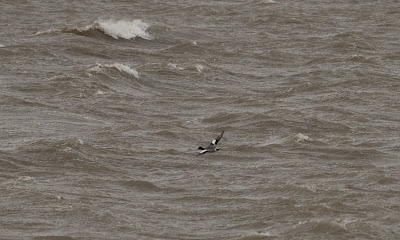
Mid morning towards high, very high, water. Walking out along the seawall, the rain was being driven hard into my face, after a while I think it stopped for a few minutes. I only say think as water was still being driven into my face, but now it tasted salty! The reason I am painting this picture is to put the following clip into prospective, this bird is flying into the wind before hunkering down on the sea wall. See if you can identify it, you may need to watch in slow motion - answer at the end of today's post.

By the time I'd reached the round head it was getting towards high water, it was wild! This is the "view" looking south from behind the lighthouse, a solitary large gull making an appearance, I didn't rush out to identify!

In contrast, this is the view from the same area in the afternoon, the wind was still very strong, but had eased to a point where the large gulls could hang easily on it as it lifted up from the sloping sea wall.

In the background of the above clip you can see No.1 outflow heading out to sea. It was at the very end of that outflow that the Little Gull was feeding. I didn't see it in the morning, but the outflows were not visible then. But it was showing well albeit distantly at 14:20.
Adult Little Gull

This clip clearly shows the Little gull plus the location:

Today's, hard won list:
Little gull 1 adult (Little gulls don't always merit a red highlight, but they have been scarce this year, I think this is only the second record for 2021 (one 29/03/21)).
Wigeon 30 in saltmarsh bay at high water 78 resting on the shore in the afternoon 
Red-breasted Merganser 4 together flying west against the wind at high water
Jack Snipe 1 flushed from behind the earth embankment next to the saltmarsh at high water.
Song Thrush 2 together on foreshore in the afternoon 
Plus this morning's "mystery" bird. This is the sequel to the clip at the top of the post, sorry about the juddering, but at this point I could barely stand!
So, a Kingfisher! When first seen, it was actually flying low over the tumultuous sea at Red Nab, my first thought was a Petrel but a look with binoculars revealed it for what it was. Fortunately I had my back to the wind, so I tried to get my camera out in time to film it, but by then it had returned to the shore and I only managed the brief in flight shot before it hunkered down. Presumably this is the same bird with a nice sheltered pond not 500m away. I've no idea why it was here in the thick of the storm, or why it felt the need to fly out over the sea. I left it where it was and it was still there when I looked back from the foreshore.

Friday, 3 December 2021

Jack Snipe show and go

West wind drifting to WNW later. Overcast all day with some light showers.

Heliport sea wall - high water
The Knot were roosting some distance from the viewing points, still, Howard managed to read one colour ringed bird.
Not all the colour rings visible on this shot, but Howard got
them on other shots, confirming this Norwegian ringed Knot

Saltmarsh high water (MD)
The tide was almost full when I got there so most of the Common Snipe would have already been flushed, still 8 seen.
Jack Snipe 6 - always the last to be flushed, three individuals were on the shingle beach, unfortunately not seen till they took flight. Jack Snipe normally land again somewhere else along the saltmarsh edge when flushed, but not today all six left the immediate area. You get some nice views as they take off but very difficult to get a picture. These were probably my best efforts today.

Jack Snipe record shots

Reed Bunting 2
Rock Pipit 1
Wigeon c90

North Shore towards low water (MD)
I was tempted to say "late afternoon" but it was only 14:00 to 15:45!
Pale-bellied Brent goose 11 - I've had no reports today of any near the children's play area, and there were none there when I walked out to the emerging skear. There were 2 on the mud in the SE skear corner at 14:20. Two lots of two flew west across the bay at 15:00 and 15:20, I presumed one of these pair were the birds from the corner, although a bit surprising as the sea lettuce area would soon be in reach. There were none in the corner as I was leaving, then a flock of 7 landed right over the sea lettuce bed at 15:35 (almost dark!). I left them to it.

Guillemot 1
Great Crested Grebe 9
Red-breasted Merganser 4 (3 male)
Knot c1,000
Peregrine Falcon 1

The tide was draining quickly and the Black-Headed gulls and the Waders were catching small shrimps.  This seems very early, or perhaps I haven't noticed on other years (it is normally dark when this extent of skear is exposed in winter) but I wouldn't expect this sort of activity until the new year. The speed and depth they were pecking at the water implied they were catching lots, and quite shallow. They will have to be the first adult stage for the shrimps.
These are predominantly Black-Headed gulls (BHGs can't feed without making a racket!) but also a Common gull and a Redshank amongst them

Even Curlew and Dunlin were shrimping. Watch the Black-Headed gull mid frame in this clip, it seems to be catching at a rate, faster than one a second.


Thursday, 2 December 2021

Sea lettuce trumps gut weed

A light overnight frost, fresh NW wind, mainly overcast, but some sunny spells.

Middleton Nature Reserve 
Just a brief check of main pond wildfowl 
Mute 2 adult 9 cygnets 
Moorhen 8
Mallard 12
Gadwall 34 (28 on "no swimming" pond)

Plus this interesting ringing recovery:

Lesser Redpoll - ringed as adult female

ALL5574 4F 15/10/2021 Middleton

Retrapped 4F 21/11/2021 Hut Wood (Hampshire) 345 kmSSE 37 days

Only our second Lesser Redpoll from Hampshire


Red Nab and saltmarsh 
Again, just a quick look at high water
Wigeon 100+
Rock Pipit 1 on Red Nab
Greenfinch 25 on Red Nab

Dog walk pond
Kingfisher 1 - this was very satisfying (MD). Last night I was thinking about the occasional sightings on Red Nab, and reasoned that it must be based somewhere nearby. I then remembered the small pond along the dog walking track (between Heysham Nature Reserve and the nature park behind Red Nab) had plenty of small Rudd/goldfish hybrids with low branches over the water. So I had a look this morning, and there it was, waiting for me!
Kingfisher 

This track is very popular with dog walkers, and the Kingfisher has become somewhat tolerant of people in the vicinity, and so allowed me good views. Unfortunately the overnight frost meant the fish were deep and it didn't catch anything whilst I was watching.

It will only be easy to catch fish on Red Nab when the tide is of such a height as to make the freshwater stream sufficiently saline as to allow sea fish to venture along it, but not so high as to have no feeding perches available. So presumably it only goes there when conditions are favourable or if the dog walk pond freezes over. Hopefully it will hang around for the rest of the winter, at least.

North shore
Pale-bellied Brent goose 33 (same maximum for three consecutive days)
I walked out to the skear from Knowlys Rd and passed the children's play area on the seaward side, there were at least 17 in the same area as yesterday at 13:30. I didn't go near as someone was photographing them, it later transpired that it was Kevin Singleton who provided these excellent shots of the two Canadian ringed birds:

The two Canadian ringed Brent with a juvenile to the  right of centre
Detail is best viewed by opening these

There were another 11 in the skear corner at 13:40, but they quickly headed back to the play area.
But by 14:40 today's higher tide had gone out far enough to allow the area of sea lettuce to be shallow enough to feed on. All 33 Brent were on the water in the skear corner and upending to feed on the lettuce. There isn't a great deal here, but still obviously preferable to gut weed. This is a group shot to show location, but the shore is much further away than it appears.

This clip shows the closer in birds feeding, while the others are waiting for the tide to drop a little further.
The tide still had 90 minutes to ebb, so this sea lettuce bed would be fully exposed. It is quite sparse already, and not very extensive, but will probably be enough to feed the Brent for this set of spring tides. So the likelihood is that they will continue feeding near the play area, but will leave as this area becomes available. Fortunately for shore based observation, but not the Brent, most of the time that this area is exposed in this set of tides will be in the dark.

Eider 150+ 
Red-breasted Merganser 3
Great Crested grebe 7
Knot c350
Shag 1 juvenile - it was sharing a rock with a Cormorant 

The Shag left, not long after the Cormorant and flew quite a way to feed with a group of cormorant to the NW of the skear. This clip isn't really up to much, as it is a poor angle, but might help those of you not familiar with a Shag in flight (including me! (MD))
You can see the typical "pot belly" and the low flight with steady wing beats , not the regular glides like a Cormorant.

Finally Kevin Singleton also sent me these shots, they are "only" Carrion Crow, but nice to see them in such detail. 

.......plus a woman feeding crows they followed her right out of sight


So, if you want a pet crow, you know where to go!

Wednesday, 1 December 2021

Brents behaving.......for a change!

A fresh WNW wind gradually made its way round to north by evening. Mainly bright with occasional light showers.

South shore morning ebbing tide
From Shaun:
Kingfisher showing well and feeding on Red Nab
Wigeon  136
Also:
Shelduck c50
Lapwing 31
Grey Heron 1
Little Egret 4
Little Egret, looking particularly Gandalf like
Rock Pipit 1 on foreshore

North shore
Pale-bellied Brent goose 33
I just had a quick look in passing from Knowlys Rd at 10:30. Only 4 visible near the children's play area.
Later, when Shaun checked there were 28, none with colour rings.
I walked passed the children's play area at 14:15, initially the Brent were spread around the rocks further out from the area that I showed yesterday (MD). The good news is that there is also plenty of gut weed there too, but not ideal for the Brent when the tide is out as most of it is on the rocks and mud (i.e. not floating in pools which makes for easy grazing). They must have been recently spooked as they quickly made their way back to the same area as yesterday, where there are plenty of pools. So, even more good news, they are now not leaving the general area when spooked by walkers, although I suppose a particularly tenacious dog would force them further.
This clip shows one small group heading back, you can see one of the Canadian ringed birds already feeding  (only one showing here, but both were there and the first to return - these are obviously very experienced birds for the area)

A dog walker had already passed without bothering them, so I knew I was ok on the beach near the sea wall. Yesterday, I said this is the area where ground water seeps out, perhaps an understatement at the moment. This clip shows just one of several "springs" of ground water, feeding the gut weed and ultimately the Brent with essential minerals.

As I left the area, 26 Brent were feeding, there were four additional birds on the water in the skear corner. They had gone on my return and by 15:45 there were 33 feeding at the children's play area. 
One of today's birds was the first juvenile that I have noticed this year, you can see it in the middle of the shot below.
First winter Pale-bellied Brent centre, with the pale wing bars.

Other stuff:
From Shaun
Shag 1 juvenile feeding off Heysham Head
Red-breasted Merganser 14
Eider 154
Also
Great Crested grebe 3
There was a flock of feeding Knot today c500


Tuesday, 30 November 2021

Emboldened Brent

A fresh warm(ish) west wind, overcast all day but only the occasional light shower.

Middleton Nature Reserve 
Just a quick early check of the main ponds to check the gulls for rings, before the ice melted......to late, all the ice had already completely gone,
Mute 2 adult 9 cygnet 
Mallard 9
Gadwall 34 (30 back on "no swimming" pond)
Moorhen 5

North shore
Pete and Jean had a look from Knowlys Rd in the morning's ebbing tide.
Pale-bellied Brent goose 30 - none with colour rings
Shag 1 juvenile 
Eider 167
Pintail 1 out
Single figures Great Crested grebe and Red-breasted Merganser 

I had a check at low water in the afternoon (MD)
Didn't see anything on the sea, not covered above. 
Waders were mainly Oystercatcher, Curlew and Redshank with a few Turnstone but no Knot.
Pale-bellied Brent goose now 33, but it wasn't obvious what was going on. As I was walking out they were all in the skear corner, but looking agitated. Then, without being spooked they flew towards the children's play area, this group of 12 first then the others in smaller groups.
The above clip was 13:45, it was 14:40 by the time I was heading back. Still no Brent in the corner, so I scanned the rocks around the children's play area, the Brent were feeding just out from the promenade on the north side of the play area. This despite dog walkers regularly passing by. As I walked a bit closer three different dog walkers passed. The geese stopped feeding but stayed where they were. This clip is really is just to show the location, n.b. I don't think many of these would have been visible from Knowlys Rd, as they were so close in,  but great views from the promenade.
This is the point when they were finally spooked, I saw another dog walker approaching but didn't see exactly what tipped the balance this time, presumably the dog came too close. They all flew back to the skear corner.
By this time it was 15:05, so they had been feeding here for an hour and 20 minutes. At least it gave me an opportunity to have a close look at the feeding area.
This is the lowest point on the land side and lots of ground water seeps out onto the rocks. When I checked this area at the end of autumn there was very little gut weed here, now it was quite lush and lots floating in small pools. Obviously the lack of ground water in late summer had resulted in a dearth of weed, but it is good to see it can still grow in winter conditions.
This is the gut weed growing where the Brent were feeding.

That said, it is a bit of a worry that the Brent are having to feed so close in, so early in the winter, I called them emboldened in the title, I hope it is just that and not just hungry! As I walked away I saw all 33 birds returning to the same feeding area. It has to be a good viewing opportunity here from the promenade, my advise would be to choose a wet weekday when dog walking will be at a minimum.


Monday, 29 November 2021

A fragmented day

Freezing overnight and into mid morning, despite being overcast. But as the east breeze switched to SW it started warming and light rain began after lunch.

Nothing went to plan today, every time I set off for a walk something else cropped up and foreshortened my walk. Still it was very pleasant in the cold dry morning (MD)

Middleton Nature Reserve 
Just a quick check of the main ponds, primarily to see if any of the gulls resting on the ice were ringed....they weren't.
The "no swimming" pond was completely frozen over, but the ducks and swans maintained an open patch in the middle of the main pond. That would be fine for the Mute and Mallard that are happy to waddle over the ice to the bank to be fed by visitors. But the weed here wouldn't support the Gadwall for long. Fortunately, the current freezing temperatures are over for the time being.
Some of the wildfowl maintaining an open area on the main pond.
Meanwhile the gulls are happy to stand on the ice

Gadwall 21
Mallard 11
Moorhen 2
Think they're all on this clip
I hope if we get another cold snap, they do as they did last winter and keep a patch of the "no swimming" pond open, there is so much more weed available there for the Gadwall.

South shore
Just time for a look at Red Nab and foreshore at low water.
Wigeon c100 - it's unusual to see so many on Red Nab at low water. They were feeding in the fresh water run off when something spooked them all, allowing a rough count. They only went to Red Nab rocks, but would have returned to the fresh water soon as the gut weed on the rocks was frozen to them.
Shelduck c130 feeding out from foreshore 
Lapwing 55 resting on the frozen mud
Common Snipe 1 flew from slipway
Greenfinch 2 at Red Nab
Rock Pipit 2 on foreshore 
Song Thrush 1 near slipway 

North shore late afternoon 
I had planned to walk down to waterline, but didn't have time, so just a quick check from the promenade at Four Lane Ends
Pale-bellied Brent goose 5 (at least)
Red-breasted Merganser 5 (at least)

Mild and wet tomorrow, and again I haven't much time, I'll have to plan more carefully!