Friday, 4 March 2022

First Cetti's singing, plus an irregular, albeit symmetrical, visitor.

Lightish west wind drifting to WNW by evening. High cloud all day with plenty of sunshine.

South shore (SC, MD)
Late morning towards high water.
Pale-bellied Brent geese none on this visit and an evening check of the skear. But later on the ebbing tide Shaun saw 31 fly from Sunderland Point towards Red Nab.
Shelduck 19
Wigeon 200+
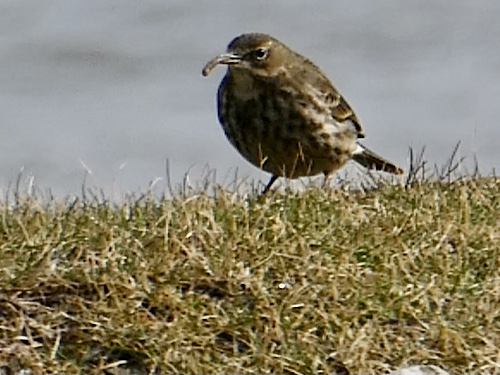
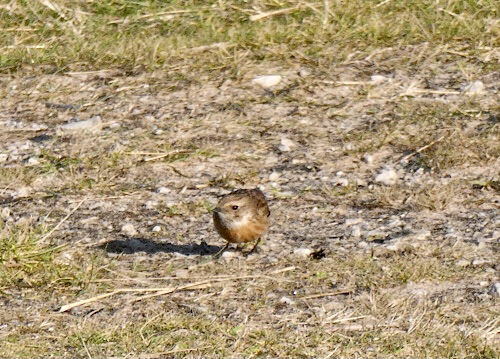
Rock Pipit 7 at least, there were 5 arguing and displaying around the lighthouse, no sign of the ringed male, perhaps his territory is up for grabs. 2 more together on saltmarsh 
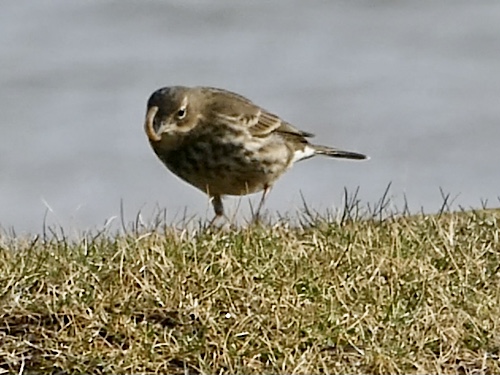
It's amazing how much food they seem to easily find in the narrow strip
of grass before the edge of the harbour wall. This one has a grub.

Turnstone 150 flew from north side to roost on the wooden jetty.
You can just about make out the Turnstone arriving with a couple of Redshank, 
mid frame. The arrow is to show the location of the Shag, see below.

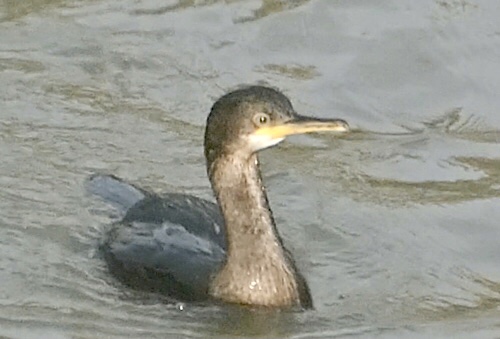
Shag 1 2nd calendar year preening on the wooden jetty (located by Shaun). The picture below is just a record shot, the arrow on the picture above shows it's location on the wooden jetty.
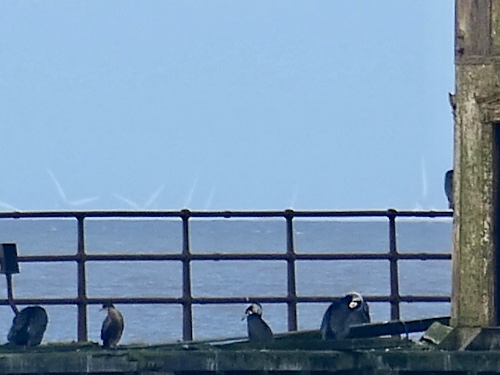
Immature Shag, second from the left

By the time we got to the saltmarsh it was 75% covered. After they have been flushed a couple of times by the spring tides, the Jack Snipe tend to move off when the water reaches them, rather than be pushed to the edges. So we probably missed some. Even so
Common Snipe 2
Jack Snipe 2
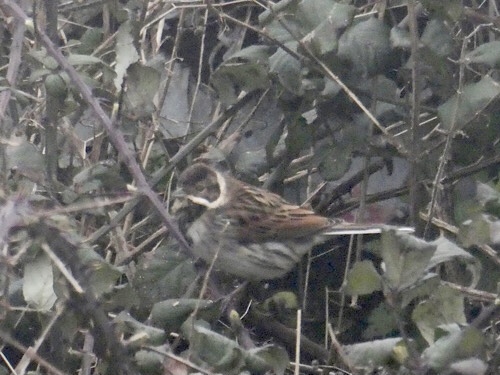
Reed Bunting 4 (2+2)

Middleton Nature Reserve (SC)
Cetti's Warbler 2 singing in the central marshes - first records of them singing this year

Water Rail 1 calling at Tim Butler's pool. 

Adult Mute Swan on Tim Butler's. Plus 2 pairs of adults and a single adult on Boating Lake + 7 juvs

No sign of any ducks


Children's Play area (SC)

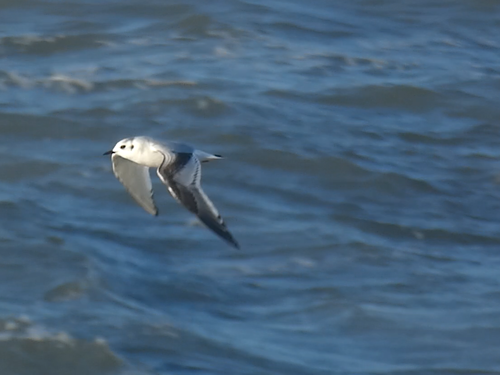
Mediterranean gull 1 adult

Heysham skear late afternoon on ebbing tide (MD)
Eider c350 (almost certainly many more out of sight)
Wigeon 2 (pair)
Pintail 2 (pair)
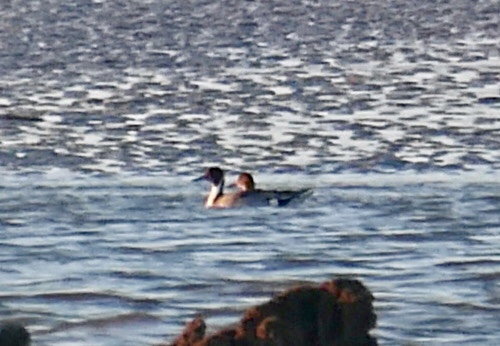
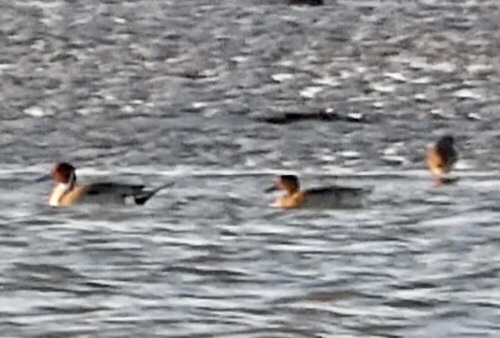
Male and female Pintail, the colours tinged by the setting sun

Red-breasted Merganser 12 (one group of 6 plus 3 x 2)
Great Crested Grebe 2

Finally, the irregular visitor. This is only the third time I've found one at Heysham, and only the second on the skear, but each on an ebbing spring tide.
Curled (lesser) Octopus 1 - not Common Octopus as I originally posted. Linda Renshaw pointed out that the common octopus has double rows of suckers on the tentacles, not a single row that this one has. I would have checked, but hadn't realised that there was more than one UK species - thanks Linda (MD)
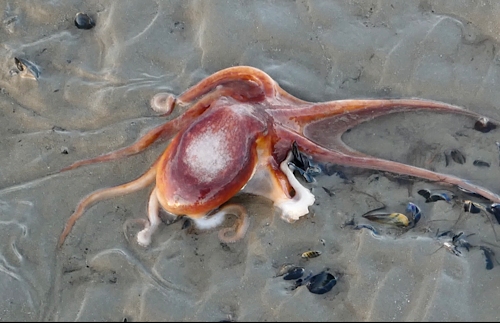
Octopus can become stranded when the tide ebbs quickly, as they do on springtides.
But they can "walk" over the beach. You can see its tracks to the left.

But strangely, its tracks were leading away from the nearest water. I was going to film it "walking", but as soon as I started filming, it became obvious that it was in distress.
So I picked it up to take to a pool deep enough to not to drain before low water. As soon as I picked it up it wrapped its tentacles backwards around my hand. I took this quick clip, hoping to be able to show you its beak, but it was tucked into its mouth.
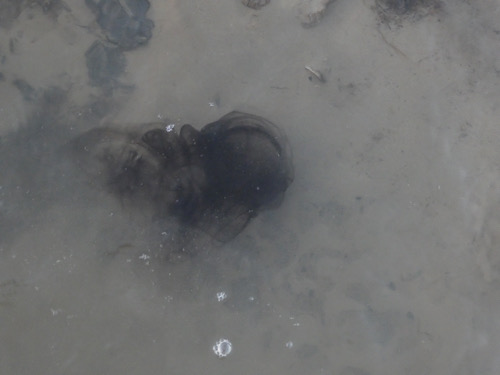
As soon as I placed it in a suitable pool it shot off, leaving me a pool of ink as a thank you.
Pool of black ink (centre) and a puff of mud (left) where it scarpered 

But it didn't go far, in this clip you can see it in a classical rest pose. Its colour changes during this clip to allow a better match to the beach. Don't worry about the pink tendril floating past, I don't know what it was, but it was nothing to do with the Octopus, which escaped intact.
Sorry about the heavy breathing on this clip, but I had to move quickly over 50m before I found this pool that I was sure wouldn't drain before low water.

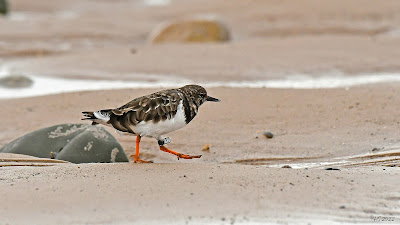
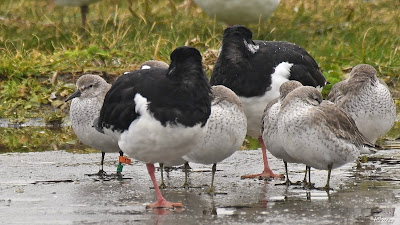
Thursday, 3 March 2022

A Turnstone's tale

SE wind with low cloud/drizzle all day.

I had very little time today and my only walk was hampered by constant light rain. Fortunately, Howard has just received this interesting Turnstone history.

There are good numbers of Turnstone that roost on the Helipad outer wall, I took this image during a visit last week as the birds were feeding on the beach on the receding tide, I noticed one bird was wearing a flag and luckily got close enough to get the snap.


The record was confirmed today by Seumus Eaves of the Fylde Ringing Group, 

re: Turnstone AW was ringed at Fleetwood Marine Lakes on 16.12.12, and was aged as an adult at the time, meaning that it was hatched in 2011 or earlier, so this bird is now at least 11 years old. After ringing in 2012 it wasn't re-sighted again until November 2016 and January 2017, and both sightings were from Fleetwood Marine Lakes. Since then it hasn't been re-sighted until last weeks sighting at Half Moon Bay.


Turnstone AW was one of just 47 birds flagged as part of a project that ran for about year, sadly it had to be abandoned because of disturbance.


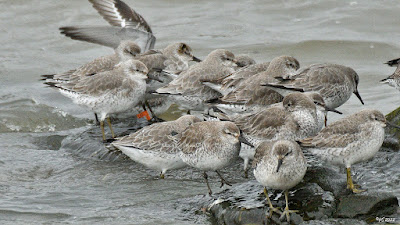
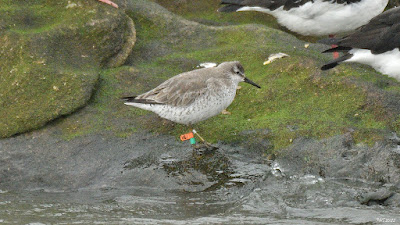
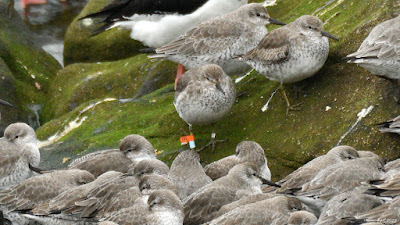
Only one ringed Knot read today, whilst a good tide it was very flat so few Knot were present on the helipad, luckily out of a group of 11 there was this bird.


These colour ringing schemes, for many bird species (see Grey Wagtail scheme on the side bar), provide opportunity for observers to read rings in the field, although Howard is particularly good at it, with reasonable optics they can be located and read. I usually manage a handful every year . It's not about reading them for the sake of it, the information gained increases the knowledge of bird movement and can identify certain environments and locations that need to be preserved to allow the birds to continue to survive (MD).

South shore (MD)
I just managed a very short check of Red Nab and the saltmarsh, but before the saltmarsh was covered.
Pale-bellied Brent goose 31
Shelduck 35
Wigeon c240
Little Egret 2
Rock Pipits 4
Skylark 2
Reed Bunting 3 
Common Snipe 5

Hopefully more tomorrow 

Wednesday, 2 March 2022

A decent Jack Snipe count

ESE wind all day. Rain, mostly light, pretty much all day too.

South shore (MD)
10:00 - 11:00 High water at 11:05
Pale-bellied Brent geese 16 on Red Nab.
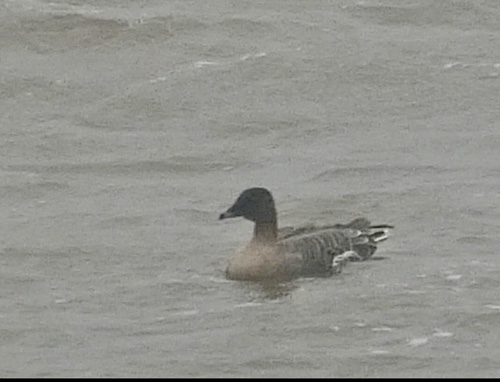
Pink-Footed goose 44 to SE
Goose sp 18 in a line low over the water heading out, possibly Greylag.
Shelduck 13
Wigeon c150
Rock Pipit 4 (2 on Red Nab plus 2 on saltmarsh). This was one of the saltmarsh birds. Sorry about the wobble, but I was balanced precariously and didn't dare move till the pipit did.

Lack of an onshore wind doesn't prevent a 9.6m tide from covering the saltmarsh, whatever the atmospheric pressure. This is what was flushed today:
Skylark 2
Reed Bunting 2
Common Snipe 26
Jack Snipe 6 at least, possibly 8
Unfortunately, it was raining steadily by this time and my few pictures aren't even as "good" as my usual grainy Snipe shots.

I didn't go along the wall in the morning, but had a quick look in the afternoon.
Eider 4 out from the harbour 
Shag, 1 second calendar year feeding at the waterfall, then it, or another in the middle of the harbour. This clip is good to show the comparison between a juvenile Shag and a mature Cormorant in breeding plumage. The Cormorant is the lead bird (apologies to birders, but many post readers are not, and I am often asked how to tell these two species apart MD)

This is why they were swimming together.......they were being chased......

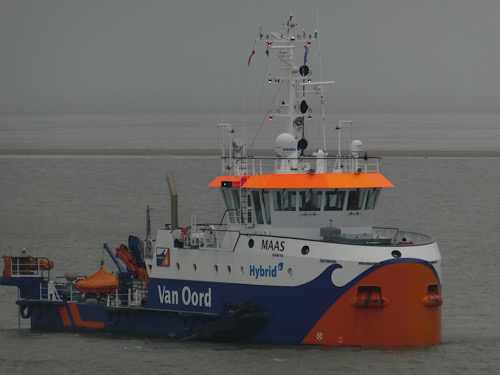
.............by a brand new Dredger (how exciting!). This is the Van Oord MAAS. Introduced 30/06/21, which probably means that it is younger than the Shag. 
So, a 2nd calendar year dredger. It was certainly much quieter than previous models.
It is a water injection dredger, which means the mud is fluidised and should drift off
with the tide, plus some through the outflows at Heysham I expect. Hopefully not too
much will end up on the Sand Mason worm beach next to No.1 outflow. We'll see.


Heliport area
Howard managed to read some colour ringed Knot from the near naze, despite the less than ideal conditions. At least one of today's birds is new to the recording area.
This is from a new ringing area for Heysham - Dundalk Bay Ireland

This one at Ainsdale England


This is from Ynyslas Point Wales


Tuesday, 1 March 2022

Longer days allow return to outer skear

Overnight frost. A very gentle NE breeze freshened slightly and shifted more to the east. Sunshine all day.

South shore - high water 10:20
Pale-bellied Brent goose 50 on Red Nab towards high water (later c25 around the skear at low water). These are just a few of them, I've shared this clip as much for the audio as the video. You can hear the Brent "grunting".
Wigeon 200+
Shelduck 36
Shag 1 2nd calendar year flew out of the harbour 
No sign of the Little gull today
Greenfinch 15 in scrub around Red Nab.
Greenfinch 

Rock Pipits 5 - including this one which, unusually, was perched on a caravan aerial.

Today's high water of 9.1m was 0.6m higher than yesterday, in theory. In practice, the low wind and high atmospheric pressure, meant it only covered the same amount of saltmarsh as yesterday. Still it managed to flush:
Common Snipe 16
Skylark 4 (3 moved off south 1 landed back on the marsh)

Middleton Nature Reserve 
Mute Swan - just one adult on the "no swimming" pond, chasing off two immature birds. The other 5 immature and 5 adult were on the main pond.
Moorhen 6
Mallard 2 male
Gadwall 25
Pochard 1 male

Imperial Road
Just a quick look to see if any Stonechat were around. There wasn't, but there were four Roe deer. Two bucks and two does.
This is the larger of the two bucks, its six point antlers already impressive,
but still growing as they are still covered in velvet.
All four are on this clip, you can hear the bypass traffic passing no more than 60m from the deer.


Heysham skear 
Today's low water of 1.2m at 17:25 meant that I could visit the outer skear for the first time since late autumn. 
I didn't actually go across to the outer skear, but this is the first channel that marks the boundary between the mid and outer skear. There is no doubt that this section of skear will support mussel beds again this year.
Western end of the mid skear with the first channel left of image.

Other areas are definitely in the realm of the honeycomb worms. There is a long reef along both the north and south sides. The southern reef may succumb to storms, but the northern reef will not. Indeed it will almost certainly increase in height through the summer. This clip shows part of the north side honeycomb worm reef.

Other areas fate this year will depend on conditions as the seed mussels develop. This large area of the mid skear could go either way.
Part of the middle skear, currently covered in clumps of honeycomb worm colonies.
Hopefully, these will be covered as the seed mussels arrive and grow.

Eider c150
Male Eider looking fine in the evening sun

Great Crested Grebe 10
Red-breasted Merganser 5
Little Egret 3

Finally, this is nothing to do with nature, but I found it interesting (MD).
This was this morning, the aeroplane appears to flying along a track where it's contrails will later be.
But it is just a coincidence that the angle of the sun casting a shadow of the contrail behind the plane, is exactly the same angle as the plane's flight line


Monday, 28 February 2022

All the regulars on show

SSE fresh wind in the morning swung round more to west in the afternoon. Light showers in the morning, but pretty consistent rain after lunch.

Just my morning check of the south shore so far (MD)
I started at the saltmarsh at high water. Todays 8.45m tide barely reached the saltmarsh, even so it flushed:
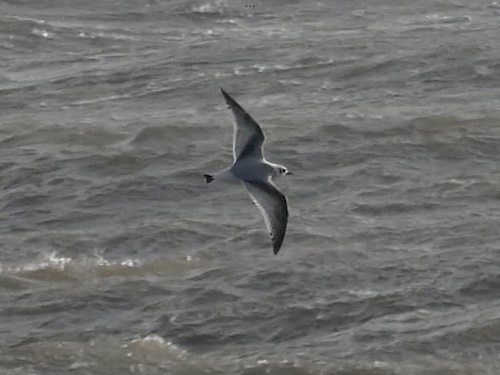
Common Snipe 12
Reed Bunting 2
Male Reed Bunting 

Skylark 1 flew in from the north and flitted around the Ocean Edge grass for a while, before moving off south.

An interesting looking "blob" out from the foreshore proved to be a Pink-Footed goose.
Presumably separated from its flock


Pale-bellied Brent goose 30 - it was quiet this morning with no one walking along the sea wall. The Brent stayed over high water, despite only the rocks near to the wall being still exposed. Most are actually between the rocks and the wall on this clip taken from the foreshore.

Wigeon c100
Shelduck 7
Little gull 1 first winter bird was the only bird feeding over No.1 outflow when the tide was still quite high. Later it had been joined by other gulls.
Shag 1 2nd calendar year - it flew into the harbour from the direction of the wooden jetty, again while the tide was still quite high. Presumably it was waiting till the tide was lower to feed on the waterfall, as it settled on one of the adjacent platforms. The young gulls looked like they were sizing up their gape to see if they could manage a whole Shag. The Great Black-Backed on the right looked like it fancied its chances! (Only joking of course....I think. MD)

Rock Pipit 4 (saltmarsh, sea wall and two between lighthouse and waterfall, again no ringed bird)

Hopefully more tomorrow.

Sunday, 27 February 2022

It's not spring yet..... but it did feel a bit like it today.

A SSE wind with sunshine, pretty much all day.

Short term weather prognosis from Pete:

A minibeast from the east is forecast after a couple of quiet days at beginning of March - possible snow inland at least, so not a clear cut start to the spring by any means.


South shore - high water 08:20 (MD)

Pale-bellied Brent goose - at least 20 on Red Nab (later a similar number were seen scattered around the skear at low water).

Shelduck 57 - most on the water out from Red Nab

Wigeon c150

Rock Pipit 5 (saltmarsh, Red Nab, sea wall 2, and harbour) today's birds didn't include the hopping individual, but I did see that bird yesterday near the lighthouse.

Stonechat 1 female feeding amongst the flotsam on the small beach between Red Nab and the foreshore.


Female Stonechat 

Little gull 1 first winter on No.2 outflow. It was feeding close in at high water, the bright sun made for some nice pictures.

First winter Little gull

Jackdaw 6 came in off the sea near the lighthouse, then continued west
No sign of the Shag on this visit, but the water level was still quite high for the waterfall.
Grey Seal 1 female
Female Grey Seal near No.1 outflow

Imperial Rd 
Just a quick check on my way home
Teal 2
Stonechat 1 female 

Heysham skear low water 15:20
Brent geese - see above
Eider c200 close inshore, many more feeding in long lines further out
Wigeon 26 - these were in a tightly packed raft just resting on the water. They are seldom seen around the skear,
Great Crested Grebe 3 - including one pair displaying 

Saturday, 26 February 2022

Stonechat movement begins!

A very cold SSE wind early on freshened a bit during the day. High cloud with plenty of sunshine.

Pete(M) said this morning that today's conditions looked right for Stonechat movement, an hour later Pete Crooks reported the first sighting for the reporting area this winter.

Full report from Pete Crooks visit this morning:

Red Nab – Heysham Harbour (9.30 – 10.45 am)
1 2nd CY Little Gull – Heysham Stage 2 Outfall (it was still feeding on the wall side of No.2 outflow as it was going dark at 18:00 (MD))
1 2nd CY Shag – Heysham Harbour
4 Rock Pipit – 2 Heysham Harbour, 1 Heysham Stage 1 Outfall, 1 Red Nab
1 male Stonechat – Red Nab – early spring migrant?
90 Pink-footed Geese – high across the bay heading north


Knowlys Road, Heysham
42 Pale-belied Brent Geese – widely spread along the outer edge of the foreshore off Royds Avenue
540 Eider – just offshore, spread along tideline between Heysham Head and Sandylands Promenade


Earlier, the Little Gull was on the seaward end of No.1 outflow. This clip just shows the location, probably favoured when the water level is low.


Janice Sutton also visited the area again today.
2nd calendar year Shag in the Harbour 

2nd calendar year Shag flying out of harbour

1st winter Great Black-Backed gull

Rock Pipit at Half Moon Bay

Middleton Nature Reserve (MD)

A lot of the wildfowl had returned

Mute Swan 3 adult plus 7 immature on main pond, 3 adult on "no swimming" pond.

Moorhen 4

Mallard 3

Gadwall 27 (5 on main pond)

Tufted Duck 1 male

Pochard 1 male 

Male Gadwall with male Pochard 

Pochard with male Tufted Duck on "no swimming" pond


Friday, 25 February 2022

First Winter Little Gull lingers

The SW winds eased overnight, by afternoon is was little more than a SSW breeze.

Please note the 2021 Annual report is now available - see side bar

Heysham skear - low water 12:10
Pale-bellied Brent goose  40 - again spread out around the skear feeding on patches of broken weed from the storms. Most along the southern edge of the skear but 8 along the northern edge.
Eider c360 - there were at least 190 close in to the skear plus a distant feeding group of at least 170.
Great Crested Grebe 1
Red-breasted Merganser 2 male
A better variety of waders today. Oystercatcher the most numerous, plus Knot (c200), Redshank, Turnstone, Curlew and Dunlin

Dog walk path.
Siskin 3 - ref Kevin

South shore late afternoon
This was on the rising tide, but we are back to neap tides now and they don't raise far!
Pale-bellied Brent goose 30  (almost certainly some of this morning's birds). They arrived from the north side at 16:30. They often do not come to Red Nab on this height tide, but these arrived early, before the tide had reached the rocks. It was notable that they landed in the fresh water stream and began drinking. This suggests two things:
1. They had come directly from feeding on broken weed in sea water (as opposed to feeding on the gutweed in the freshwater run offs).
2. The gutweed on Red Nab is now sufficiently lush to allow reasonably easy feeding early in the tide (MD)

Wigeon c150 were waiting in channel before going to Red Nab, almost certainly joined by others later
Shelduck 14
Rock Pipit 3
Shag 1 juvenile feeding at the waterfall.
This is a nice sequence to demonstrate both its size compared to the gulls and its unique diving style.


Juvenile Shag diving
Don't watch the Shag in this clip, watch the two young Lesser Black-Backed gulls top left. They are having a tug of war over a small fish.

Juvenile (2nd calendar year) Shag

Little Gull 1 first winter - yesterday I suggested that they may be gone by today, but Pete advises that it's typical for first winter birds to hang on a day or two after a blow. So just a chance tomorrow?
There was no sign of it when I walked out but it was showing well when I walked back at 16:00. 
A deliberately distant shot of the first winter Little Gull,
really just to demonstrate today's flat sea.

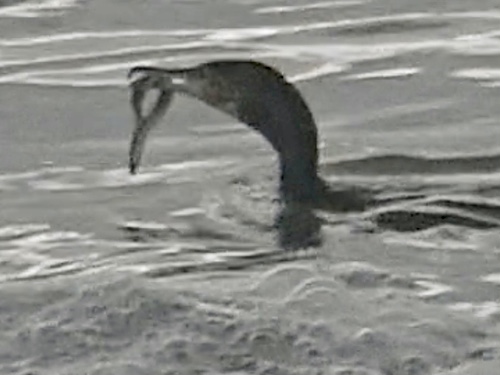
Finally, this was a puzzle. I'm not normally unsure about fish, but this one confused me (MD). This cormorant catches an "eel" in No.2 outflow. Only a short clip I'm afraid.
But it is much too early for eels. Perhaps the warmer Power Station water could explain it, but eels this size are immature and should be both yellow in colour and, at the moment, be hibernating under the mud in fresh or brackish water. I watched the above clip frame by frame and blown up. I decided that not only was the fish not yellow, its back appeared to be covered in dark spots. The only thing I can think of that fits that description is a Lamprey. I've never seen one, and I've never seen signs of them feeding on other fish (they suck blood like a leech). I spoke to Linda Renshaw regarding local populations, she advises that River Lampreys are reasonably common in our local rivers. I've looked into River Lampreys and the size is right, and this is the time of year to expect them to move into rivers to spawn. 
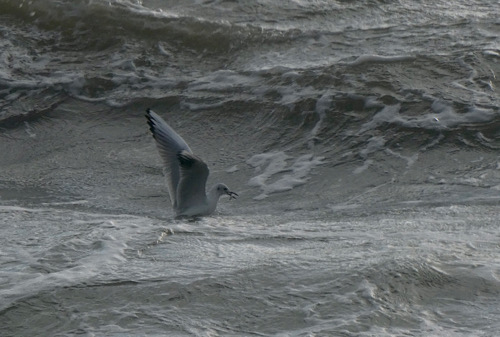
This is a blown up still from the above clip.
Suspected River Lamprey (MD)


Thursday, 24 February 2022

Last Littles for a while?

The strong SW to WSW winds continued all day, but they are forecast to ease overnight and then become variable in direction. Heavy hail showers punctuated the day.

Pete and Jean had a lunchtime check.
Shag 1 juvenile in the harbour - yesterday I made the comment that fishing at the waterfall is easy at the right times. Just to show that we don't just pick glib comments out of a hat, this is a clip I took of a Cormorant feeding at the waterfall earlier in the week. It catches three small fish in just three short dives. The young Shag also makes a brief appearance in this clip (you may need to view in slow motion to see the fish).

Black Redstart - 1 female/immature on the fence in the security sensitive area along the single track to harbour (this bird cannot be searched for here, but it is sometimes seen in transit to or from the harbour).
Little Gull 1 adult
Kittiwake 1 adult
Both the above on the Power Station outflows

Later in the afternoon, towards high water, both myself and Tim had a walk along the south sea wall.
Pale Bellied Brent goose 42 flew from the north side to Red Nab at 15:05
Wigeon c200 - Tim took this short clip with his mobile as a wave of Wigeon approached Red Nab on the rising tide.
Rock Pipit 2
Kittiwake 2 adult at least patrolling the sea wall
Little Gull 1 adult plus 1 first winter on No.2 outflow
In this clip the adult finds a fish, or piece of fish.


Upper and lower views of a first winter Little Gull
This Black-Headed gull also found a fish

Kevin Singleton had a brief look around Half Moon Bay and took these nice shots of a Curlew:

Curlew, neat feathers, but a muddy bill

It was a lot colder than it looks on these shots!


Wednesday, 23 February 2022

Last minute Little Gull

The wind started WSW but moved more to SSW by lunchtime. Mainly overcast with a few light showers and the odd sunny spell.

Heysham skear - low water 10:00 (MD)
Pale-bellied Brent goose 27 (of c45) - Once again they were scattered on and around the skear in small groups, feeding on the broken weed left by the storms. 27 was all that I located, but at 13:40 c45 flew from the north side to Red Nab.
This is typical of the patches of broken weed and grasses etc, left all around the skear. In this patch there are several pieces of sea lettuce, which I know the Brent like, but they probably eat much of the other green stuff as well.
Patches of broken weed like this are strewn around the skear edges.

Eider 171 (counted by Pete from Knowlys, I'd estimated 160+, which is close for me!)
Someone asked me the other day, what the black ducks with a white throat are. The answer was a  2nd calendar year male Eider. This one was just sorting out its feathers (clip actually from yesterday).

No Knot today, but there seemed more than usual Turnstone (80+)

South shore
Once again, excellent and very thorough coverage all day provided by at least 8 observers. Unfortunately, for most of the day there was little to see.
Female Eider in the Harbour seemed to top the bill! But I managed a final check in the fading light an hour after high water and was fortunate enough to be rewarded with:
Little gull 1 adult feeding along the sea wall just west of No.2 outflow. Located at 16:50 and still feeding on my return from the harbour at 17:25.

Today's adult Little Gull


The Pale-bellied Brent geese were already feeding on Red Nab. Perhaps they didn't leave at high water. This clip shows how close they were to the sea wall an hour after high water.
Shag 1 2nd calendar year feeding on the waterfall - sightings of Shag are becoming more erratic, the days are getting longer and, at the right times, fishing at the waterfall is easy, so presumably it quickly finds enough to eat before resting in the many secluded areas around the inner harbour

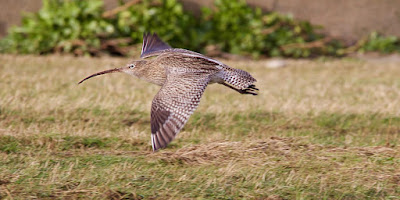
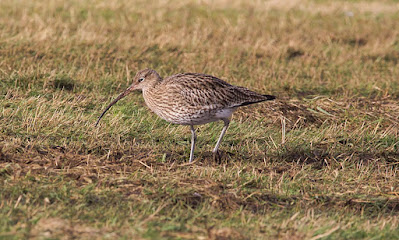
This Curlew was having a bad "hair" day!

Cold strong winds tomorrow, wrap up well!