Tuesday, 14 June 2022

Scoter encore anticipated

Light variable, but mainly westish winds. Cool in the morning but warmed up when the sun came out this afternoon.

South shore (MD)
Common Scoter 1 male - as expected, it followed exactly the same routine as yesterday (and tomorrow?). This first clip is from the saltmarsh slipway, the island is just south of the saltmarsh. It went to this island as soon as the tide reached it. This clip was taken 90 minutes before high water.

A leisurely stroll round to the SE corner of the saltmarsh got me there 5 minutes before the Scoter arrived, after being displaced from its island by the tide. The light was much better for photography today and resolved what was "wrong" with its bill. The outer layer of the upper mandible is shedding off.
Male Common Scoter, shedding the outer layer of its upper mandible 

This is it arriving at the saltmarsh.

As Pete said......moult time
Unless it is seriously disturbed, there is no reason why it shouldn't continue this pattern, at least for the duration of these spring tides, which take us through to Sunday (MD)

Curlew 6 (5+1) to Red Nab from north side
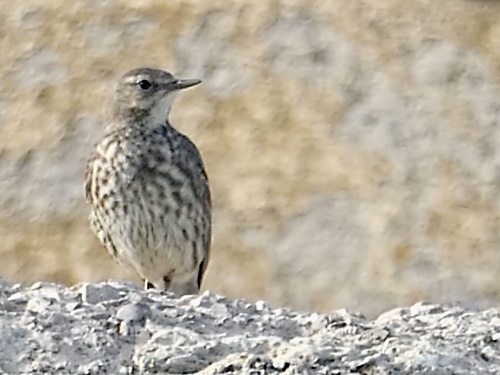
Rock Pipit 2 adults - Red Nab and Waterfall 
Linnet 2 on saltmarsh 10 including at least 4 newly fledged birds between lighthouse and waterfall 
Mediterranean gull 5 x 2nd calendar year at least - 5 seen feeding on the outflows and later, there are five in this clip of them resting on Red Nab.

One of the new birds has a particularly well developed dark head and dark wings. I had a quick check this evening, this is it on No.2 outflow, waiting at the end of the dividing wall for a suitable titbit to float past.

This was encouraging (for when the adult Meds return), there were 50+ gull, mainly Black-Headed gulls feeding on the beach next to the wooden jetty. This is where the Meds feed on the Sandmason worms. You can see the Sandmason worm tubes in this clip, but that's not what these gulls are after today. They are agitating the small pools and catching the small invertebrates they disturb (almost certainly small shrimps).


Middleton Nature Reserve (MD)
Wildfowl pretty much unchanged, except the young Little Grebes are now diving with the adults. Sorry about the shaky nature of this clip.

I didn't check the marsh areas so warbler numbers quite low
Willow Warbler, Chiffchaff, Blackcap and Sedge warbles heard singing

Butterflies:
Not many about, but it has been cool.
Small Heath 
Common Blue 
Large Skipper 
Speckled Wood 
Small Tortoiseshell 
Plus 
Burnet Companion 
Cinnabar 

Dragonflies, again not many but better than of late
Emperor several
Broad-bodied Chaser several
Four-Spotted Chaser several
Black Tailed Skimmer 2 males on main pond
Female Broad-bodied Chaser

A very fresh Four-Spotted Chaser

Male Black-Tailed Skimmer

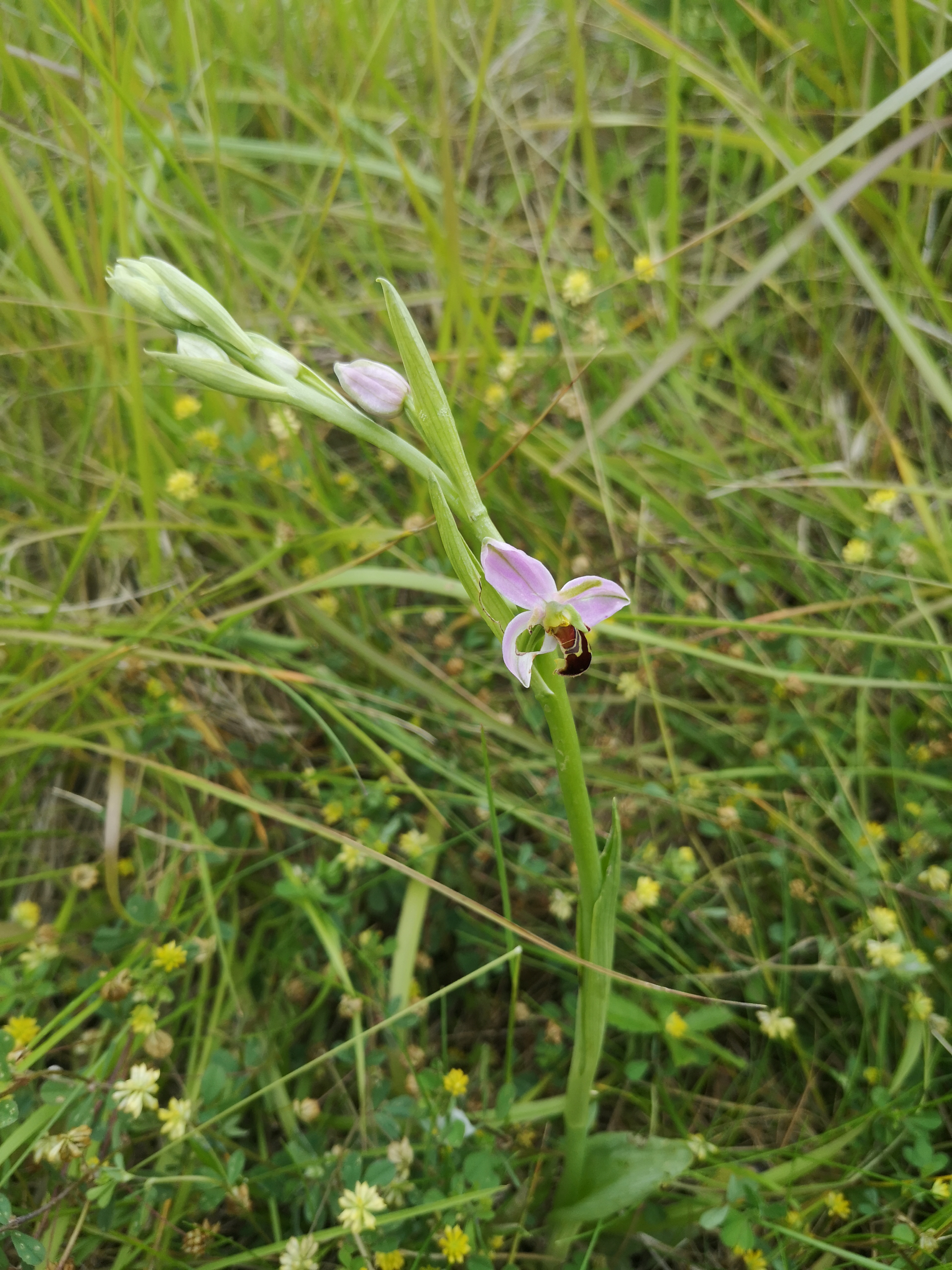
Bee Orchids - I've been asked where is best to find this species. I hadn't looked for any this year, so I did today. There were several areas with one or two spikes, typically in sparsely vegetated regions. I quickly found 20+ spikes on the high plateau between the "no swimming" pond and Tim Butler pond.
Bee Orchid

Having said look in sparsely vegetated areas the above shot is clearly in quite lush vegetation. The shot below shows the location, it is just between the sparse and lush areas. There are probably 10 spikes within the area defined by the red box - good luck if you go to check them out.


Monday, 13 June 2022

Inshore Scoter

The lightish wind was pretty much due west all day. Some extended sunny spells.

Just my check of the south shore so far (MD). Towards high water mid to late morning.
Rock Pipits 3 (2 Red Nab plus 1 near waterfall)
Linnet 2 on saltmarsh plus 5 between lighthouse and waterfall 
Mediterranean gulls 4, possibly 5 2nd calendar year - as I walked out there were 3 feeding on No.2 outflow and 1 feeding on No.1 outflow. Possibly one had moved across, but the bird on No.1 was the one with the broken tail bar, and I hadn't  noticed it on No.2.
2cy Mediterranean gulls weren't the only medium sized gulls with dark primaries today, there were also two 2cy Common gulls. This clip starts with a 2cy Med then switches to a 2cy Common gull.

On the way back, there were 2 feeding on No.2 outflow and 3 on Red Nab, but again, possibly an overlap. But later there were at least 4 on Red Nab. I say "on Red Nab", but by this time the tide was covering Red Nab and the gulls were floating on the sea in rafts. This clip shows a section of a raft containing  3 x 2cy Mediterranean gull, but also includes; Common Gull 2 adult plus 2 x 2cy. Black-Headed gulls 18 adult plus 1 x 2cy and a Lesser Black-backed gull.

Eider 3 female near saltmarsh 
Common Scoter 1 male - I was pleased with this, on my way out along the foreshore I spotted a distant dark speck to the south. It was in the water but not out far and it seemed to be moving along with the tide and waves. I thought "duck", and dark ducks here tend to be Eider, but something didn't look right. I decided that if it continued moving as it was, it would end up in the far corner of the saltmarsh. So on my return I went back to the saltmarsh and walked around till I reached the SE corner. And there it was. It's nice when a plan comes together!
It drew quite a bit of attention. First a couple of Black Headed-gulls

It swam closer to me, before moving on to the saltmarsh to preen.

I couldn't work out why I couldn't get a clear shot of its bill, but when I got home and checked my pictures I realised the reason was that it had wart like growths on its bill.
Male Common Scoter with some sort of growths on its bill

The Eider came to check it out and eventually sat on the saltmarsh near it. A Lesser Black-Backed gull also came for a look. Perhaps the interest was just for something "different", but I did wonder if the presence of Scoters normally suggests the presence of a nearby food source (MD).
Female Eider checking out the Common Scoter

The Carrion Crow have fledged two young, they are still at the "testing everything to see if its food" stage. The closer two birds are the young ones.


Sunday, 12 June 2022

An interesting seawatch

West to WSW wind all day, still quite fresh, but not as strong as the last two days. Mainly overcast with some light showers.

Three observers this morning: Pete Crooks, plus Pete Marsh and Jean Roberts 
Report from Pete (M)
Just single flurry of 26 inbound Gannets with five distantly out possibly different
flock of 20 plus singleton Kittiwake
3 Guillemot
7 Razorbill/Guillemot 
1 Common Scoter
3 Greylag geese
11 Sanderling
3-4 2cy  Mediterranean gulls outfalls area

I just had a quick check of the outflows on the ebbing tide at lunchtime (MD)
3 2nd calendar year Mediterranean gulls feeding on No.2 outflow (same birds included in Pete's report above). One has a distinctive break in the tail bar, as did yesterday's and Friday's bird. Fortunately the light was more conducive to photography today.
2cy Mediterranean gull (top) with 2cy Black-Headed gull
You can see the distinctive break in the Meds tail bar

This is a clip of it feeding, it seemed to be finding plenty.

Curlew 6 - 4+2 flew north
Rock Pipit 1 on Red Nab
Emperor Dragonfly 1 male patrolling newt pond

Heysham skear (MD)
Just a quick check on the ebbing tide in the afternoon 
Eider 11 - 1 lone male plus 3 and 7 females
Great Crested Grebe just 1 seen
Great Crested Grebe battling against the tide and wind
The Herring gulls can't feed here the mussels are now too big, they are
waiting to get further out where there are newer seed mussels.

Little Egret 5
Curlew 5  plus the Oystercatchers

Saturday, 11 June 2022

More Meds

SW winds pretty much all day. Some sunny spells, but cool when overcast.

Report from Pete:
Bit too southerly on the sea with just 2 Gannet and two Razorbill/Guillemot in 30 mins 
but 3 x 2cy Mediterranean gulls -  Red Nab (2) and Heysham 2 outfall (1)

I had a walk along the south wall just after high water (09:10), probably should have left it till a bit later (MD)
No small gulls on Red Nab
Mediterranean gull 1 2nd calendar year flew along the sea wall. Another sighting of one briefly on the sea out from the harbour mouth could have been the same bird.
Mediterranean gull (top) with Black-Headed gull

Mediterranean gull 2cy out from the harbour mouth

Rock Pipits 5 - three together along sea wall, one in scrub near lighthouse and this one sat above the waterfall.
Young Rock Pipit on inner harbour wall above the waterfall 

Linnet 5 between lighthouse and waterfall 

A walk back through the Nature Park found that the Goldfinch young have fledged. They seemed to be everywhere. It's always worth a look at the newt pond. This clip shows one of the young Goldfinch and a female Blackbird having a bath.
You'll note the Song Thrush singing in the above clips. Be warned, it includes a very respectable Little Grebe trilling in its repertoire, possibly a Little Grebe does visit this pond when it is quiet. While I'm talking Song Thrush song, the one near the white barrier where the cars park, includes at least two different car alarms in its song. I keep trying to record it, but it is busy here and someone invariably talks or shouts. I'll keep trying!

Angela spotted this orchid amongst the grass next to Half Moon Bay cafe. There is usually something interesting to see, if you keep a look out.
Orchids are notoriously variable and prone to hybridisation 
but this looks like an Early Purple (MD)

Friday, 10 June 2022

Better than expected seawatch

A fresh SW wind all day. Mainly sunny.

Report from Pete:
Sample 35 mins seawatch in clear conditions Heysham - better than expected:
flock 5 Guillemot in then presumably the same out
Puffin a ‘probable’ in and out of wave troughs and distant 
5 Gannet out
2 Manx Shearwater out
2 Canada goose in 
Mediterranean gull 1 2cy red Nab
Incidentally 10 per cent of the usual annual LDBWS species total of c205 comes exclusively from spring seawatching.  Partly but not completely due to autumn seawatching being dreadful this last few years with September equinox gales from the right direction consigned to mythology!  

Middleton Nature Reserve (MD)
Wildfowl as yesterday plus additional Little Grebe adult on "no swimming" pond
Swift feeding over main pond
Warblers heard/seen:
Willow Warbler, Chiffchaff, Common Whitethroat, Blackcap, Reed Warbler, Sedge Warbler (no Cetti's today).
The main interest were insects.
Dragonflies:
The strong SW wind focused a few in the Sheltered SW corner of "no swimming" pond. Difficult to see here, but at least:
Emperor 2 (Male and female) - another female Emperor seen near central marsh (first records here this year)
Four-Spotted Chaser 2

On the small ponds on the western marsh
Broad-bodied Chaser 2 male and an ovipositoring female (a male hovering above her for protection). Two points of interest in this clip. First, if you listen closely you can hear her wings "rattle" against the stems as she moves forward. Second, watch closely and you can see clusters of eggs floating down, especially the last few deposits towards the end of the clip.

These Azure Blue Damselflies were also on the small ponds
Azure Blue Damselflies 

Butterflies:
Speckled Wood 8
Small Heath 5
Red Admiral 4 - all showing some signs of wear, this one especially so.
Worn Red Admiral

Large Skipper 2 - first records this year
Large Skipper 

Moths:
Cinnabar 3
Burnet Companion 3

South shore (MD)
I had a pleasant evening stroll along the south sea wall.
Rock Pipits 3 - adult with two young in tow, feeding along the sea wall between the outflows. These could either be the Red Nab or Lighthouse breeding birds.
Canada goose 6 in
Shag 1 2nd calendar year flew to wooden jetty
Mediterranean gull  - almost certainly this morning's 2nd calendar year bird, now feeding on No.2 outflow.
2nd calendar year Mediterranean gull

The lowering sun meant looking along the outflow wasn't practical, so I had to walk a way along the wall and look back. It just means this clip is more distant than I would have liked.


Thursday, 9 June 2022

15 minutes nature walk

 The wind started from west then swung round through south ending SE. Some sunny spells early on, then overcast with light showers.

I went to check the north side Rock Pipits (MD)
None found at the Near Naze or the cafe end of Half Moon Bay.
There were two adult and at least two young birds just north of the rocky outcrop at the north end of Half Moon Bay.
One of the young Rock Pipit

There was another adult below the high cliffs, unfortunately a hiker passed and flushed it and two other birds away, although I couldn't be certain the other two were Rock Pipits as there were lots of House Sparrows around too.

It's no wonder there were lots of House Sparrows , watch how quickly this female gathers food.

Also around:
Little Egret 3
Curlew 2
Linnet (no sign of any young birds)
Painted Lady 1

Tim also checked the Head in the afternoon, he also located 5 Rock Pipits, plus Linnets and Common Whitethroat above the foreshore.

Middleton Nature Reserve (MD)
This is what today's title refers to. I just spent 15 minutes this morning checking out the main pond (hoping Tuesday's east wind did bring something interesting in). The sun had gone in by this time but it was still quite warm at 16C, even so the only dragonfly seen was a female Broad-bodied Chaser, plus a few damselflies. 
Mute Swan 2 adult, but now only 7 cygnets - so that's two they've lost. Still the ones that remain seemed lively enough. Here they have a spontaneous group bath (dad doesn't look overly impressed!). You might just be able to make out a Chiffchaff in the background.

Coot 4 adult - no young seen today
Moorhen 1 adult with 1 chick
Mallard 2 male 2 female one with 1 quite large chick the other with 6 small chicks
Little grebe 2 adult 1 chick.
This adult caught a relatively large fish in the middle of the pond and then headed off to the reeds in the SE corner. I though it was taking it to a chick, but it ended up eating it itself.

This is the young bird with the second adult. A Willow Warbler singing nicely in the background.

Apart from the Chiffchaff and Willow Warbler there were Blackcap and Sedge warblers singing and the "no swimming" pond Cetti's Warbler could be heard.
Swift 1 feeding over the pond
No sign of any Otter activity yet.
Plenty of Orchids out now.
An interesting quarter of an hour. If you haven't much time you could do worse than visiting here.

In the afternoon the wind switched to the east, it was cooler now and occasional light drizzle. I wouldn't expect any insects to be coming in off the sea in these conditions. Still, no point in having a theory if you don't test it, so I had a look down the south sea wall (MD)
Rock Pipits 5 (2 on Ocean Edge foreshore, the one seen in detail an adult, 1 adult on Red Nab and just 1 adult near the lighthouse (suspect the others were on the north side of the harbour)
Linnet 5 between lighthouse and waterfall 
Curlew 3 (2 + 1 flew past roudhead towards Red Nab)
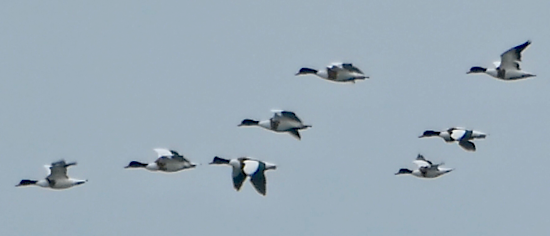
Shelduck 9 south
Shelduck heading out

The only insect seen was a single Silver Y moth

The Herring Gull nesting on one of the harbour platforms has one chick, but she has more eggs to hatch. After a brief break, she went back to the nest.

The youngster quickly rejoined mum.

Wednesday, 8 June 2022

Only Canadas really

The wind was fresher today and from SW. Overnight rain held off during the day, occasional sunny spells.

Canada geese 52 minimum - Janet saw these 52 flying south over Middleton Nature Reserve this morning, a little later (10:30) they had either turned round or a second large flock was heard over Heysham Village heading north.
52 Canada geese bringing this year's moult migration total to 143

Heysham skear - low water 13:00 (MD)
I didn't have much time today, it doesn't take long to check the skear on these neap tides. I wasn't expecting much and wasn't disappointed, for a while it felt like doing a stocktake on Noah's Ark, just two of everything! Eventually I managed to scrape a few extra Eider to add to totals.
Eider just 5 - 2 + 2 male and 1 female - the female flew off south these shots show some plumage detail.

Female Eider


Great Crested grebe 2
Little Egret 2
Curlew 2
Even the Oystercatcher weren't as abundant as typical but still c750.
Similar numbers of Herring gulls. The seed mussels are still forming, but are becoming increasing difficult to extract from in between the larger mussels. They prefer to be in shallow water, presumably to help remove any mud. Watch the bird with the weed, it ends up with a mussel, probably more by luck than sound tactics. This size of mussel is what I think is just about their size limit for eating whole.

I'll hopefully have more time tomorrow.

Tuesday, 7 June 2022

Insect day, but not as insectity as it could have been.

Light wind starting from east but moving to west by mid morning, then back east by evening. Mainly sunny during the day, but overcast by late evening.

Middleton Nature Reserve 
Janet took these shots this morning, all day flying moths.

Cinnabar moth

Silver Y moth

Burnet Companion moth


South shore (MD)
Rock Pipits minimum 7. I checked twice, in the morning there was one on Red Nab plus Two along the sea wall. There were at least 4 around the lighthouse area, but there were several visitors walking around, so it wasn't really possible to sort them out. 
In the evening I didn't see any on Red Nab, but they were everywhere from No.1 outflow, around the roundhead and as far as the waterfall (taking advantage of the gut of insects coming in off).
There were four feeding on the sloping wall near the lighthouse with the male standing guard. I took the four to be the female, two young birds and the long staying lame bird. This is the male standing guard.
The male, preferring to stand on one leg as the right foot is causing him problems 
But he still stands proud 

The young birds were feeding themselves, as it was easy pickings, but they took a rest. These are the two that I thought were the young ones (MD). If they are both young, they must both be from the lighthouse nest, I can't see the male tolerating one from another brood.

There was an adult with a young bird on the sea wall between No.1 outflow and the roundhead. There was also an adult with a young bird between lighthouse and waterfall, but I couldn't rule out them being the same two, or even if they were two from the roundhead sloping wall. But I didn't think so.
This is the adult along the inner harbour wall, it looks stressed, presumably as it didn't know where the young bird was. It flies off as soon as it hears it.

So, at least 5 birds around the roundhead, probably 7, possibly 9.

There are four local factors that attract insects in off the sea at the roundhead:
temperature - it was warm enough today. 
time of day - they need time to arrive from wherever they are coming from
wind direction - ideally an east wind or at least a wind with some east in it
tide - if the above three conditions are met insects will be drawn in off the sea, but if the tide is in, they can come in anywhere. When the tide is out, the roundhead is the only point where they can come in directly from the sea onto land.

Today was a frustrating mixture of mistimed factors!
The wind was from the east early morning, so I had a look at 10:30 to give any insects time to arrive. Unfortunately the wind swung towards the west just as I arrived, but there had been some movement and I just caught the end of of it.
Painted Lady plus Common Blue butterfly on Red Nab.
Another Painted Lady, 7 Common Blue and 2 "small" whites heading inland from the roundhead.
Painted Lady

The wind was forecast to shift back to the east by mid afternoon, but it stubbornly refused to move! I went back at 18:00, the tide was in and the wind still from the west, albeit a light wind. It started to shift to the north, then NE at 18:15, when a trickle of butterflies started coming in off (there were probably lots more but stretched all along the wall as the tide was in).
Painted Lady 4

Also seen on scrub near lighthouse 
Common Blue 2
Silver Y moth 2 - this one feeding on sea campion 

Although there were only a few butterflies and no dragonflies seen. There was all sorts of insects coming in, mainly small flies/beetles - hence the focused Rock Pipits. This Crane fly came in off and rested briefly on the sea wall. I think it is a Tiger Crane Fly (MD). The reference books say it's a common species. It's only the second one I've ever seen so they can't be that common locally.
Looks to be a Tiger Crane fly
Unfortunately resting with its wings over its body, hiding its black back markings


Monday, 6 June 2022

A bit warmer

North to NE light wind, mainly overcast with a hazy sun occasionally visible through the clouds.

First a Canada Goose moult migration record that almost fell through the net.
Canada Geese 5 north from Heysham Head 28th March, which makes this the first record for this year's migration - Thanks to David Kaye

Middleton Nature Reserve 
The Bee Orchids are out here too, joining the Spotted and Purple. This shot by Janet.
Bee Orchid 

I had a walk around this afternoon, it was warmer, I thought there might be a few insects around. And so it proved......just a few insects! (MD)
Mute Swan 2 adult 8 cygnet 
Coot 8 adult plus at least 3 chicks
Moorhen 3
Gadwall 1 male on Tim Butler pond
Mallard 4 male plus this female on the main pond with 9 young chicks - she's giving them a good work out!

Little grebe just one adult seen and another heard.

The warblers were more vocal today, but I didn't hear a Lesser Whitethroat or Grasshopper warbler.
Cetti's warbler 2 (central and western marshes)
Common Whitethroat 3
Willow Warbler several
Chiffchaff 3
Blackcap 2
Sedge Warbler 3
Reed Warbler 1
This clip is a Reed Warbler, unfortunately not singing, you can see it has been ringed.

Reed Bunting 4 singing males
House Martin 1 and Swift 2 feeding over the main pond.

Butterflies:
Small Heath 8
Green-veined White 6 (4 confirmed, 2 presumed)
Speckled Wood 3
Orange Tip 1 male

Moths
Burnet Companion 
Cinnabar 
Cinnabar moth

Dragonflies:
Four-spotted Chaser 1
Broad-bodied Chaser 1 male
Male Broad-bodied Chaser

This is a Tree Bumblebee. They have colonised from the continent, the first record in the UK was only 2001. Now, they are everywhere!
Tree Bumblebee 

Sunday, 5 June 2022

Freezing, not flaming, June!

A cold ENE wind, with no sunshine to warm the day. Some showers but thankfully, dry for most of the afternoon for Morecambe's street party along the promenade, but I bet they were cold!

Pete managed an accurate count of the gulls this morning:
865 immature herring gull, mainly 2cy
6 Great Crested Grebe 
2 Red Breasted Merganser  
The above on/around the skear
15 adult Black Headed Gulls on the outflows
Shag 2cy on wooden jetty

I also had a look on the skear at low water (MD).
I was back in full winter plumage, including woolly hat and fingerless mitts!
Apart from Pete's records there were:
Eider 44
Curlew 3
Whimbrel 1
Shag 1 - by this time resting on Conger rock with three cormorants, waiting for the tide to ebb a little further before feeding.

South Shore (MD)
Just an evening stroll along foreshore and sea wall.
Rock Pipits - none seen on the saltmarsh or Red Nab, but four near the lighthouse. But I could only find one juvenile. This is the female:

She is still feeding the youngster, but there were lots of small flies around so it was trying to catch its own supper:

Unfortunately, the Power Station was blowing off steam, otherwise you would have been able to hear the male trying to distract me in the above clip. This isn't the male, it is the lame bird that has been around all year. You can see its contorted foot as it scratches itself in this clip (wonder how it scratches its left side). But plenty of small flies this evening  making for easy pickings.

Linnet - a male standing guard next to the known nest site near the lighthouse. It saw off at least two other pairs.

Shag 1 2nd calendar year - showing well in the harbour.
2nd calendar year Shag 
All three of today's Shag records likely to have been this bird

In this clip an immature Great Black-Backed gull walks by. Not sure if it shows how slight shags are or how large Great Black-Backed gulls are:

One the way back through the Nature Park, this Blue Tit was having a bath in the rain.