Thursday, 15 September 2022

Curlew Sandpipers become more accessible

Almost calm first thing, the very light north breeze freshened slightly by the afternoon as it drifted to NW. largely overcast in the morning, but plenty of sunshine after lunch.

Pink-Footed Goose 2,630+
Jean had c1,900 over Middleton which will not overlap with
David Kaye's  check from Knowlys Road. 8.30-13.40  
730 in 14 skeins 

largest group 144 at 10.34.


I saw 9 skeins from the skear totalling 542 between 09:00 - 10:30 (MD). Many of these will be in David's total, but at least three skeins were high to the west and probably well out of David's range. What was interesting today, is that although most of the skeins were high and heading due south, three were low and were adjusting direction as if searching for a local landing. One skein of 17 headed due east overland.


Middleton Nature Reserve 

Report and pictures from Jean:

It seemed a quiet morning but in fact plenty of birds were moving quietly through and we caught and ringed 40 birds between 0700 and 1130 (see totals below). Moving through more noisily were flocks of Pink-footed Geese which came through from about 0730 to 1155hrs. Some were extremely high and almost all were heading due south, many were heard but not seen. There seemed to be a continuous stream between 1140 and 1155 but they weren't visible. In total, visible birds numbered 1410 but the 7 invisible flocks could well have brought the total to 1900. The geese seen over Middleton don't include flocks seen over the sea.

A typical "view" of the high Pinkfoot over Middleton 

Ringing:

Grey Wagtail 5

Meadow Pipit 12

Chiffchaff 9

Blackcap 3

Goldcrest 3

Great Tit 2

Blue Tit 1 (a retrap)

Long-tailed Tit 1

Treecreeper 1

Robin 1

Dunnock 1

Wren 1 (a retrap)


Ringing isn't just about catching and ringing birds, a lot of metrics are checked to ensure as much information as possible can be learned from the bird. Jean provides a couple of interesting examples here (MD)

Note how yellow this juvenile Grey Wagtail is suggesting it is a male. This was borne out by the wing length (87mm) - the average is 83mm and the maximum recorded is 89mm


On the continent you can find Eurasian Treecreepers and Short-toed Treecreepers. In the UK the latter is a rare vagrant, but it can occur. One diagnostic feature separating the two is the pale panel on the wing. Eurasian Treecreepers have a pronounced “step” in the pale panel (see red arrow) and square ended edges to the pale portion whereas Short-toed Treecreepers don’t have this step and the edges are pointed (see number 8 on the second photo). So the Treecreeper we caught today was definitely a Eurasian Treecreeper.

Today's Eurasian Treecreeper 

Reference picture of Short-toed Treecreeper 

Vis totals (including ringed birds):

Pink-footed Goose c1900

Swallow 47

Goldfinch 22

Liinnet 3

Meadow Pipit 15+

Grey Wagtail 12 

Pied Wagtail 1

Reed Bunting 1

Lesser Redpoll 1

Raven 2

Jackdaw 17

Carrion Crow 4

Starling 10


Heysham skear - low water 09:50

Eider 7 males

Great Crested Grebe 10

Red-breasted Merganser 15 (2, 3, 4 & 6)

This group were feeding, but one bird (mum?) looks to be on guard to keep the gulls at bay. One catches what looks like an eel, but is probably a Butterfish.


This Cormorant has caught a Flounder, but it is too large to fit down its gape so it discards it. I have seen them do this so many times, and it would seem so have the gulls! This Great Black-Backed calls for its youngster, who lands just in time to grab the fish. The Cormorant has a bit of a dig at it, but didn't really want the fish back.

The youngster took its prize ashore. A fish this size is too large for them to swallow too, but they will work on it over two or three days (they will leave it further up the beach later for the crabs and shrimps to nibble on between low waters) until eventually it is narrow enough to swallow. My observations in the past suggest that the youngster will do all the pecking and get all the bits it can, but when the time comes it will likely be the adult that swallows the remaining carcass.


Heron 1

Little Egret 5

Waders, just: Oystercatcher, Curlew, Redshank and Turnstone 


Wigeon flock of 23 seen from Whinnysty Lane by Kevin Singleton 


South shore - high water 15:10

I checked the beach out from the saltmarsh as the tide was pushing the waders up and to the south (MD)

On the waterline were many hundreds of waders including Bar-Tailed Godwit, Knot, Grey Plover and Dunlin most moved south, but the tide was lower today and came in more sedately so some just moved with it. These Grey Plover with a couple of Knot ended up just in front of the slipway.


It was time to leave, the tide here comes up behind you. As I headed back to the nearest crossing point towards the old Pontins, there was a feeding group of c20 Ringed Plover, 5 Dunlin and.....

Curlew Sandpiper 1 juvenile - they were not there when I walked out, so timing here is hit and miss. This clip pans out to show the location.


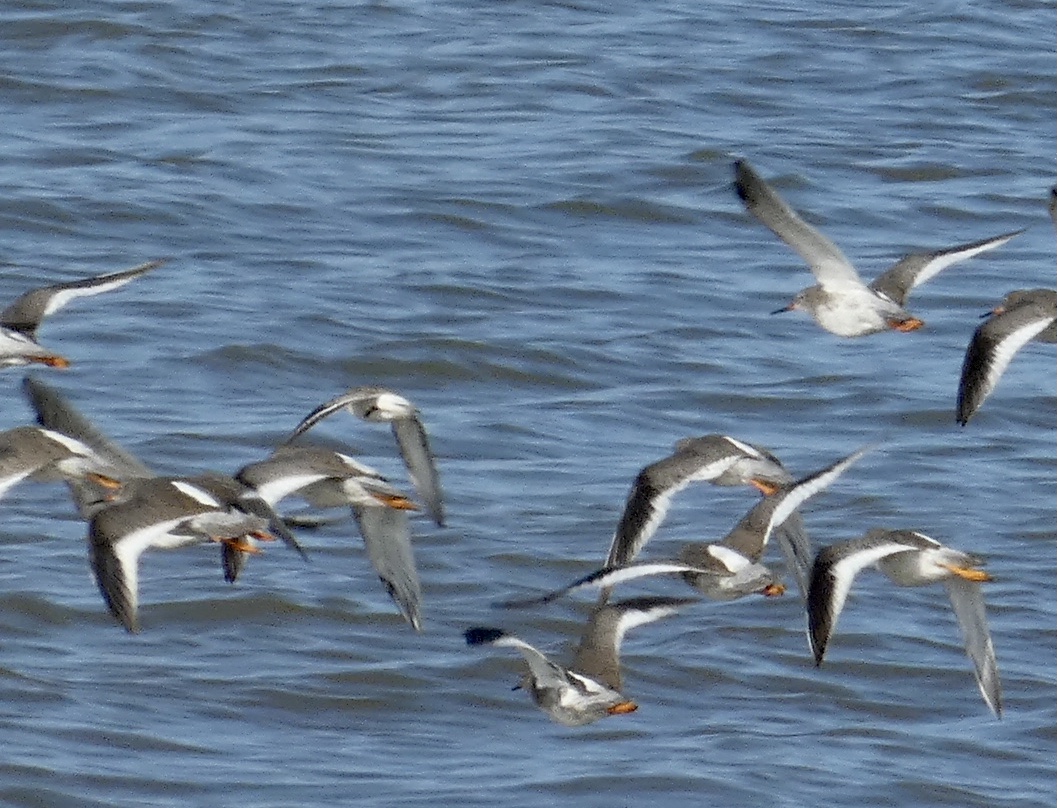
But the tide was making quickly and they soon left and flew towards Red Nab. I managed some nice diagnostic in flight shots


Curlew Sandpiper

The delay meant that I had to walk up as far as the faux castle before I could cross the quickly filling creek. The risk here is of getting wet feet, not really dangerous. This flock of mainly Grey Plover and Knot were on the southern extent of the recording area, until a juvenile Peregrine Falcon lifted them. You can see it zip through the flock in this clip


Juvenile Peregrine Falcon - failed again!
A walk to Red Nab located
Rock Pipit 6 (3 on rocky outcrop plus 3 Red Nab)
Lapwing 32 saltmarsh 
Linnet 33 saltmarsh 
Wheatear 3 foreshore 

The tide was still rising when I reached Red Nab, this means the waders need to keep moving. I quickly relocated the juvenile Curlew Sandpipier

When they weren't moving, the Dunlin and Sandpiper alike were resting with their bill hidden, it took a while before I realised that there was more than one. There were definitely two and I though possibly three. But checking my pictures I could only definitely see two. The only view I managed to get them both in, one had its head down.
Two Curlew Sandpipers - the two lower birds
Kevin Eaves checked Red Nab a little later, unfortunately by this time the tide was ebbing and the waders were resting. He did manage to locate both birds, but in 30 minutes failed to see a bill!
These tides are a good height, not too high to flush all the waders, but high enough to bring them close to the sea wall. About an hour before high water should be worth checking for the next few days.


Wednesday, 14 September 2022

Pinkfoot movement gains momentum

Light north to NW breeze, freshened slightly throughout the day. An overcast start then sunshine through the middle of the day, before ending up overcast again.

Report from Pete:
Curlew Sandpiper 1 juvenile was inshore feeding with just six ringed plover and three Dunlin. These were flushed and flew towards Potts corner.  Tide miles away at this stage so not with tideline waders
nearby 14  Mediterranean gulls (13 ad one 2CY)  ocean edge mudflats and Red nab.
There were still some Meds on mud out from the saltmarsh when I checked later  (MD)

Off heysham Head
Shag 1 x 2CY 
Great Crested Grebe 14

Heysham Nature Reserve 
Report from Jean:

There were classic conditions for Pink-footed Geese to migrate from Iceland as a cold front moved south on Tuesday night. A nice clear sky corridor formed with a north westerly airflow to bring the geese directly overnight to northern Scotland. At 5am many flocks were over Dumfries and Galloway and by 0930 several flocks had reached Heysham. By 5pm many geese had made it to Norfolk. More geese likely tomorrow.

Pink-Footed goose 597 high to the south 
7 skeins totalling 287 between 09:30 - 12:15, largest 85 at 10:00

6 skeins totalling 310 between 12:30 - 13:15, largest 120 at 12:50

Other than that the only vis was 5 Grey Wagtails, of which two were caught and colour-ringed


Ringing:

Grey Wagtail 2

Goldfinch 6 (one was a retrap)

Greenfinch 6

Chaffinch 3

Goldcrest 1

Chiffchaff 1

Willow Warbler 1

Blue Tit 4 (two were retraps)

Great Tit 1 (which may not be from Heysham - awaiting details)

Robin 1

Dunnock 3 (two were retraps)


South shore early afternoon (MD)
Red Nab 
Rock Pipits 3
Linnet 2
Grey Wagtail 1
Grey Wagtail 

Foreshore 
Wheatear 3
Robin 2
Everything seems to eat Blackberries!

Saltmarsh 
Starlings c120 on brambles
Linnet 18 on marsh

Shore out from the saltmarsh/foreshore 
70+ Ringed Plover and c40 Dunlin feeding close in but Curlew Sandpiper had not returned 
Dunlin resting in a shallow drain
The tides are dropping again now, but are still very high (9.1m). It comes in very quickly over the near flat shore. This clip shows a Bar-Tailed Godwit with Knot plus a Dunlin and Oystercatcher, running to keep ahead of the rising water.
They quickly get fed up of this and the beach was soon deserted.
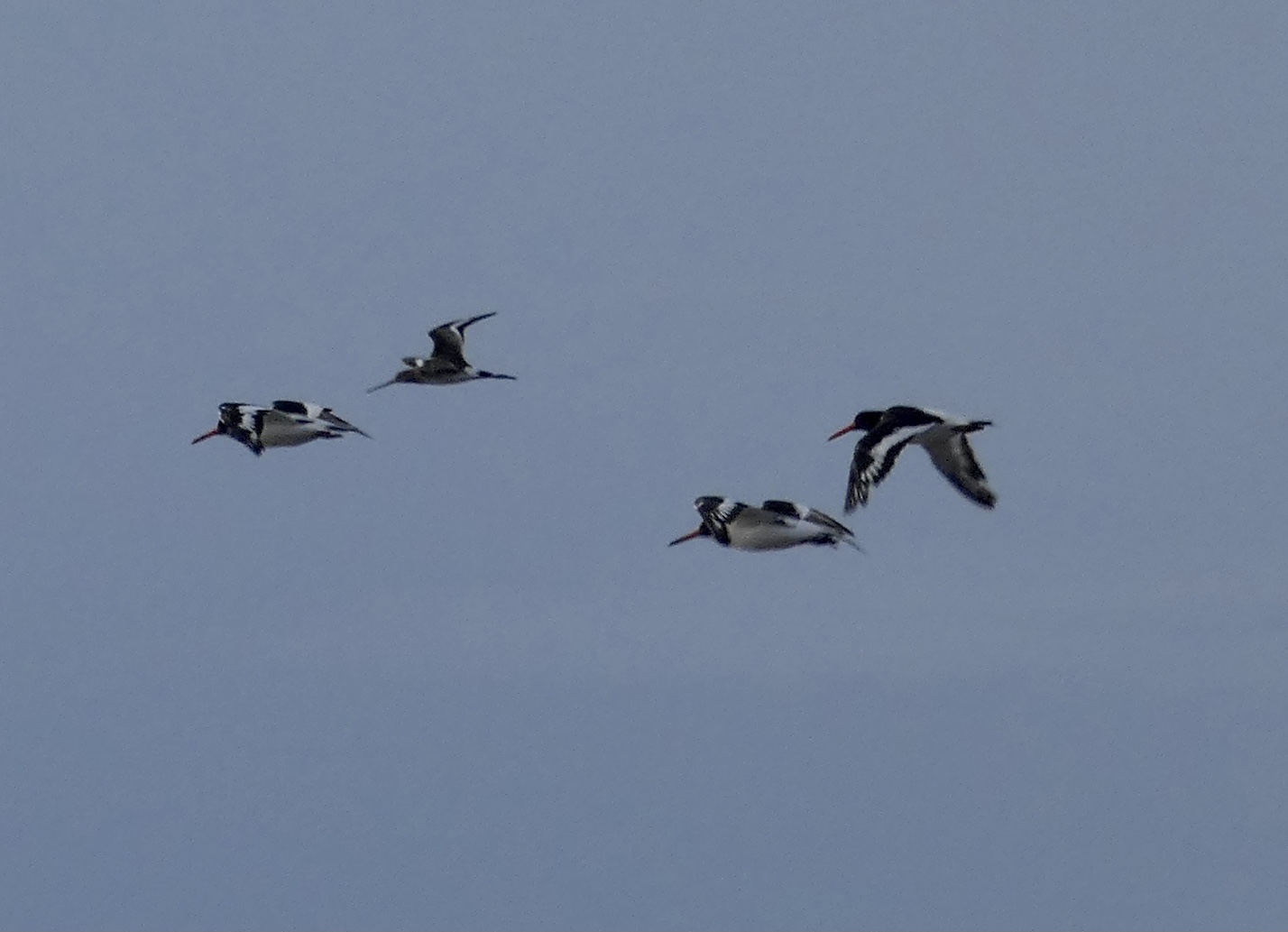
Bar-Tailed Godwit 1
Grey Plover 30
Knot 80
Dunlin 16 + the inshore birds


Tuesday, 13 September 2022

Pinkfoot start to return

Almost calm in the morning the very light north breeze freshened slightly as it shifted to NW. Sunshine for most of the day.

Heysham skear - low water 08:45 (MD)
Pink-Footed Goose 30 south at 08:35, I expected others to follow, but that was it!
Shag 1 x 2nd calendar year feeding
Great Crested Grebe 3
Red-breasted Merganser 8 (1, 2 & 5)
Grey Heron 1
Little Egret 6
This was strange. This gull dropped from the sky as if its wing was broken and flayed in the water. The other gulls thought it was strange too as they all took to the air above it. No sign of them being spooked by a predator, they just seemed curious. The large splash is from a dropped mussel, I think the smaller splashes are just "droppings". I couldn't see if the gull recovered, but the others quickly returned to their feeding.

Half Moon Bay 
Janet saw two Small Copper
Small Copper, looking very fresh

South shore  - high water 14:10 (MD)
Rock Pipit 5 on Red Nab
Wheatear 5 along foreshore 
Skylark 1 grounded on Ocean Edge playing field
Skylark 
It seemed to be finding plenty to eat

Linnet 15 on saltmarsh 
Lapwing 45 on saltmarsh 
Redshank c100 roosting on the eastern side of the saltmarsh till flushed south by tide
Curlew Sandpiper 1 juvenile in association with the Redshank 
Curlew Sandpiper, unfortunately with the bright sunlight behind it
This was a little later, but presumably the same bird, Curlew Sandpiper showing its white rump
Curlew Sandpiper (left of centre) with Redshank 
Ringed Plover 7, this one was particularly confiding 
Ringed Plover
There were dragonflies around the saltmarsh.
Common Darter 2 female
Migrant Hawker 1 female and 1 male
Female Migrant Hawker 


Monday, 12 September 2022

Rain (and pain) almost stopped play!

Quite a fresh SW wind in the morning eased and shifted to NW by the afternoon. The morning rain was steady but quite light, although it didn't feel light in the fresh wind. More infrequent showers in the afternoon.

South shore late morning (MD)
Every time I go for a walk, my wife gives me "advice" about falling over - Don't do it!
It's good advice, and normally I remember, but yesterday I must have forgotten and ended up crashing onto my hip. Didn't feel too bad yesterday, but could barely walk this morning. Fortunately it eased as I walked, and I probably ended up walking further than I should.
Not much of note along the sea wall, just
Wheatear 1
Rock Pipit 1

On the saltmarsh 
Lapwing 19
Linnet 6
Goldfinch 8 on teasel around saltmarsh edge.
Kestrel 1 male over and continued south

There was very little on the shore either, but at least I remembered not to fall over today!
Ringed Plover 3, were the only waders close to shore
Towards the waterline were
Oystercatcher c300
Curlew c30
Grey Plover 18
Knot 2
Grey Plover moulting from summer to winter plumage 

Near Naze
Wheatear gang of 7 late morning (Pete)

Middleton Nature Reserve (MD)
I couldn't resist a passing check of the two main ponds in the afternoon.
Mute pair plus 7 well grown cygnets 
Coot 2 - one on each pond
Moorhen 4 - two on each pond
Gadwall 4 (2 each male and female) "no swimming" pond
Shoveler 2 (male and female) "no swimming" pond
Female (top) and male Shoveler 
They might have been on the same pond, but showed no inclination to be together


Sunday, 11 September 2022

Pied Flycatcher

 Light east to SE wind with plenty of sunshine till late afternoon then overcast with light showers.

Heysham Nature Reserve 

Report from Jean:

The highlight of today was a female/imm Pied Flycatcher.

Small birds were flitting about in the bushes but the nets were too visible in the bright sunshine so only a few were caught for ringing:

Chiffchaff 4 (1 was a retrap from Middleton NR)

Goldcrest 2

Robin 1

Blue Tit 3

Long-tailed Tit 1

Greenfinch 1

Robin 1

Goldfinch 1


Vis was also low key:

Chaffinch 25

Great Spotted Woodpecker 2

Grey Wagtail 3

Sparrowhawk 1 (plus 2 others seen which may have been resident ones)

Raven 2

Swallow 4

Meadow Pipit 12 (one flock)

Tree Sparrow 2


Seven Jays were on the reserve.


Also, from Pete (M)

White Wagtail 1 adult male at Ocean Edge

Common Whitethroat by Heysham NR Office


Middleton Nature Reserve 
John's ringing today included:
Cetti's warbler
Chiffchaff 7
Blackcap 2
Grey Wagtail 5
Blue Tit 1
Robin 1
All new birds

South Shore
Report by Pete Crooks:

Morning incoming tide:

Wooden Pier – 1 2nd CY Shag, 125 Cormorant


Heysham Harbour South Wall – 2 juv. Wheatear, 2 Rock Pipit


Red Nab – 7 Mediterranean Gull (4 adult, 1 2nd winter, 2 1st winter),
2 Sandwich Tern (1 adult, 1 juvenile)
Oystercatcher – 3 colour-ringed (too distant for details) and 15+ metal ringed among large flock prior to Red Nab being covered by the tide.
Also: 2 Rock Pipit, 1 juv. Wheatear


I'd checked Red Nab earlier in the tide (MD), at that time a Kingfisher was feeding.


Another Goby, it seems to catch them readily. I suspect that after it has caught "enough", it flies off to wherever it is currently calling home, to rest.

Lapwing 26 flew south from saltmarsh long before the tide reached it.
Linnet c30 feeding on saltmarsh 

I checked the mud out from the saltmarsh. Once again the main large group of waders were along the water's edge moving south. Made up of, at least:
Curlew, Oystercatcher, Grey Plover, Knot, Dunlin and Bar-Tailed Godwit (just 4 seen)

There were 100+ Ringed Plover with c20 Dunlin feeding close to the shore.
This juvenile Ringed Plover found itself "left behind" and had to run to catch up.
This small mixed flock of Grey Plover and Knot landed along a drain.
Grey Plover and Knot in various stages of moult from summer plumage 
This is them landing

A  Curlew Sandpiper was also with the Dunlin close in. Unfortunately, the sun was not at a great angle, and I slipped in the mud as I tried to get a better angle. I went flying, and so did the waders!


Juvenile  Curlew Sandpiper


Saturday, 10 September 2022

Curlew Sandpiper plus quickest ever resighting

A light north wind to begin with, but it wobbled around from east to NW in the afternoon. Largely overcast with sunny spells 

Heysham Nature Reserve 
Report by Jean:
Fewer birds on the move today, the highlight being a small flock of Tree Sparrows:
Chaffinch 2
Goldfinch 7
Tree Sparrow 5 and possibly another flock of 6
Grey Wagtail 6
Pied Wagtail 1

3-4 Jays were squabbling in the trees

Ringing:
Grey Wagtail 4
Goldcrest 6
Blackcap 2
Greenfinch 2
Goldfinch 2
Dunnock 1
Blackcap 1

One of the Grey Wagtails that was colour ringed here yesterday at 08:55 was seen just over 90 minutes later at Bank End, 8km SE!

South shore 
First an update from yesterday:
Shag with at least 82 Cormorant on the wooden jetty (Pete)

I just checked from Red Nab to saltmarsh (MD)
It felt deserted today!
No passerines on Red Nab and none along the foreshore till right at the slipway end.....
Wheatear 1
No finches feeding around the saltmarsh edges, strange, perhaps a small raptor had flushed them.
Rock Pipit 1 on Rocky outcrop 
Lapwing, just 3 today, the Osprey would have been fine if it had showed, but it didn't.

I had a walk out onto the mud - not something you should do on a rising spring tide, without sound knowledge of the area and tides. Even then you get precious little time as the tide quickly covers this almost flat area of shore.
A large group of waders on the waterline were too distant to count but included Grey Plover and Knot. But the spring tides leave the mud wet and many small waders feed nearer the shore 
Ringed Plover 70+
Dunlin 10
Curlew Sandpiper 1 juvenile 

Juvenile Curlew Sandpiper with Ringed Plover
The sun was shining at this point, in the above shot its breast and throat are in the shade making its throat look a cold grey. The shot below half of the throat is in the light, revealing it to be a peachy shade.
Juvenile Curlew Sandpiper with Dunlin

Redshank 100+ on saltmarsh 
Little Egret 10 on saltmarsh 
Some of the Redshank, Lapwing and Little Egret on saltmarsh 


Janet took these shots at the north end of Moneyclose Lane
Painted Lady 

Painted Lady and Red Admiral 

Friday, 9 September 2022

A comedy of errors!

Light north to NW wind. Mainly dry but a few showers.

Heysham Nature Reserve 
Ringing report by Jean:
The main theme of ringing today was Goldcrests and Grey Wagtails:
Goldcrest 9
Grey Wagtail 8
Chiffchaff 4 (1 retrap)
Lesser Whitethroat 1
Blackcap 1
Greenfinch 4
Chaffinch 2
Goldfinch 4
Blue Tit 5 (2 retraps)
Great Tit 3 (1 retrap)
Wren 2 (1 retrap)
Dunnock 1 (a retrap)
Sparrowhawk 1

Jean took this shot of one of yesterday's Grey Wagtails, it has been colour ringed as part of the Observatory's ringing scheme (see scheme details on the side bar).
There have been several sightings locally as well as many around the country. If you do spot one, please record the rings colours and sequence (photo if possible) and pass details to Pete (or any other member of the team if easier) contact details are on the side bar. 

South shore - high water 11:25 (MD)
There were 50+ Linnets and Goldfinch feeding around the saltmarsh slipway
Reed Bunting 1 also near the slipway 
Reed Bunting 
Robins everywhere, there were 5 between the slipway and Red Nab.
Wheatear 5 - 2 on foreshore, 1 on sea wall and 1 near lighthouse 
Rock Pipit 5
Meadow Pipit 9 - none grounded just birds heading south
Swallow 2 south
Eider 2 near wooden Jetty 

I had done and timed everything just right this morning. I set off early and had a good check along the foreshore and sea wall, before returning to the saltmarsh for 09:20. This is what the creek (where yesterday's Osprey was feeding) looks like before it's filled.
I walked around to the east side and sat on a block. I could now look down the quickly filling creek with the light behind me, camera ready. After 5 minutes the creek wasn't as full as when I arrived yesterday, but would have been as full as when the Osprey started feeding yesterday. I have absolutely no patience! So I decided to edge my bets and walk out onto the mud to check the waders on the tide line. I would still be able to see the Osprey if it turned up. To get to the shore you have to cross a slippery section of mud, so I stashed my camera. 
It was 09:45, the Osprey turned up right on time! 30+ Lapwing immediately lifted from the saltmarsh and started harrowing it. I presumed it would chase them off and begin feeding, so I walked back to my block and got my camera out. But it had gone and the Lapwing were returning to the saltmarsh. Even so, I was sure it would return, but it didn't.
There were no Lapwing around yesterday, I don't know if it had cleared them or if they had already left.
Either way I missed out on filming today's bird (glad I got some decent shots on the two previous days). I have no idea if it is likely to return here tomorrow, but the tide will reach the creek about 10:00, if you fancy a look (let's hope it's not much ado about nothing tomorrow).

By this time the waders on the beach were already moving on, so missed out on them too!

Redshank c120 on saltmarsh 
Ringed Plover 12 Red Nab
Dunlin 2 Red Nab
Ringed Plover and a Dunlin

Howard took this nice shot of Eider climbing out onto the Near Naze rocks


Thursday, 8 September 2022

Osprey doesn't leave empty taloned today!

The wind swung round from the east in the morning to north by evening. After a dry start there was rain mid morning, but a bright evening for a change.

Middleton Nature Reserve 
Report from Jean:

Middleton NR was just on the cloud edge all morning with blue sky to the west and dark grey rain clouds to the east and almost overhead. At 10am the rain cloud was overhead and birds headed for cover in the bushes which is when a flock of Chiffchaffs was caught. Luckily the 'rain' at first was only very light and it was possible to wrap up the nets while they were dry. It was just in time because at 11am proper rain occurred but we were in the shelter of a car by then.


Vis before the (proper) rain:

Swallow 47

House Martin 6

A late SWIFT 1

Grey Wagtail - 26

Chaffinch 2

Linnet 1

Meadow Pipit 23

Goldfinch 13

Skylark 1

Goosander - 4 in one flock heading south

Gadwall 4


Ringing:

Grey Wagtail 13

Chiffchaff 8 (2 retraps)

Blackcap 1

Sedge Warbler 2

Reed Warbler 1 (a retrap)

Lesser Whitethroat 1

Meadow Pipit 1

Long-tailed Tit 2


South shore - high water 10:30 (MD)
No sign of the Kingfisher this morning 
Wheatear 8
Rock Pipit 3
Meadow Pipit c8
Swallow 2 south
Osprey 1 - the tide had barely reached the saltmarsh, even so it was hovering and diving towards the saltmarsh, unfortunately I was still at Red Nab. I "scampered" along the foreshore, stopping periodically to film a clip. All the birds were having a go at it, this compilation shows gulls and Carrion Crows mobbing it and Meadow Pipits (I think) zipping past.

By this time the rain had started and I was using my old (nearly worn out) camera, so struggled keeping it in focus for long. This clip shows it diving and then pans out to show location. At this point I was about half way along the foreshore. Even so enough detail was seen to see that it was an adult and not ringed.

This clip ends with its final, successful, dive. Unfortunately, I was still just too far from the slipway to see the water, perhaps as well as I lost focus during the dive anyway!

This last clip is only poor quality, but I'm posting it anyway as I like the Osprey's "shudder" to shake off the water. It is heading south with its catch, almost certainly a small Grey Mullet.

Twenty seconds later I reached the slipway and could see where it had been diving. The creek on the left hand side. We are moving back to spring tides now, and this will be be the first time in almost a week that the water will have reached this far. Plenty of time for mats of algae to form along the creek sides. A mullet shoal must have moved in to feed on it.
Grey Mullet would have been feeding in the creek on the left.
They still will be in this shot, but one less!

If the Osprey is still around and hasn't already caught something, there is a reasonable chance of an encore tomorrow. The tide will reach this creek between 09:30 and 09:45.

Heysham skear - low water 17:30 (MD)
Great Crested Grebe 5
Red-breasted Merganser 4
Eider 1
Mergansers and an Eider

Little Egret 6
Waders: Oystercatcher, Curlew, Redshank, Turnstone plus
Ringed Plover 13
Dunlin 2
Knot 2
Knot

Black-Tailed Godwit 1 (they have been very scarce here in recent years)
Black-Tailed Godwit with Oystercatcher