Tuesday, 7 February 2023

Finch day

A very light south wind, mainly overcast with some drizzle.

South Shore (MD)
A walk along the sea wall a couple of hours before high water.
Greenfinch 6 in the trees behind Red Nab.
Greenfinch 
Wigeon c250
Shelduck c50
Pale-bellied Brent goose 37- 30 arrived at Red Nab from the north side 90 minutes before high water. Later Howard saw 37 leaving towards Potts. Later still, Pete reported 37 heading back to Red Nab from Potts Corner.
Brent geese arriving at Red Nab, all seen were pale-bellied

Not long after them was another precession of Oystercatcher, the Heliport Sparrowhawk was active again. Not so many Oystercatcher today and no Knot with them, even so they piled through like this for over three minutes.

Kittiwake 1 adult plus 2 first winter on outflows. 1 adult plus 9 first winter in harbour 
Shag1 immature in the harbour. It kindly provided a nice display.


Rock Pipit 3 - 1 on Red Nab plus 2 together near the lighthouse nesting area. I had heard the male calling earlier, but can't be certain which of these, if any, is the male, but they were directly above last year's nest hole.

On the way back Red Nab was busy, the tide was pushing the Brent closer to the sea wall and the additional Oystercatchers added to the melee. 

One of the Brent geese had two white rings, but just beyond my reading range

Howard's shot of most of the Brent heading south (3 out of shot) with a famous
 landmark in the background (Blackpool tower for our overseas readers)

Nature Park
Bullfinch pair
Goldfinch 10+
Chaffinch 2 - this is the male. You can tell from the background twittering that there was a lot going on.

Middleton Nature Reserve 
A check of the two main ponds saw nothing new, but the Alders just south of the main pond were popular. A mixed tit (just Long-Tailed, Great and Blue) moved through, probably heading to the feeders at the feeding area.
Bullfinch 6 (3 each male and female)
Two of the male Bullfinch

Goldfinch 8, these are some of them teasing the seeds from the Alder cones. The humming is the sub station directly behind me.

Monday, 6 February 2023

Nothing new, but still plenty of interest

Another light overnight frost. A dry, often sunny day with very light southerly wind.

South sea wall (MD)
Just a lunchtime stroll around high water.
Pale-bellied Brent goose - Red Nab was almost covered and I just saw the "last" three heading off south.
Shelduck 23
Wigeon 200+
Kittiwake reducing numbers but still 2 first winter on No.1 outflow and 2 adult plus 8 first winter in the harbour - none behind the lunchtime ferry.
This is one of No.1 outflow's first winter birds with the wooden jetty in the background (plenty of Cormorants roosting but I couldn't locate a Shag amongst them).

These are two first winter around the secondary waterfall in the harbour and shows the variability of their plumage at this stage.

Rock Pipit 3 - 1 on Red Nab, 2 near the lighthouse including a male display calling, but not seen parachuting today, but he was strutting his stuff!
Male Rock Pipit (he had been display calling) above the nest area used for
the past three years. But this is a new male, the previous one was ringed.

There was a precession of Oystercatcher past the roundhead which lasted about 15 minutes. There were also two flocks of Knot c1,000 each. Richard saw a Sparrowhawk flush the birds from the heliport.
Knot zipping past the wooden jetty

Weasel 1 scurried across Moneyclose Lane

Middleton Nature Reserve (MD)
I'm still checking the two main ponds most days, but there has been little to report, just varying numbers of Gadwall (23 max) and Teal (6 max). Tufted Ducks sometimes 2 sometimes none.

North Shore (MD)
Just a quick afternoon check, mainly to count any Brent. There was only one smallish group of, but these did include the Canadian ringed birds.
Pale-bellied Brent Goose 13

Bar-Tailed Godwit 1
Dunlin 30
Knot c1,000
These are mainly Knot with a few Dunlin, looking brown in the low evening light. The Knot are finding and eating relatively large molluscs. You may need to watch the clip in slow motion to see the detail.

Solitary Common Snipe 

Sunday, 5 February 2023

Plenty of waders today

Light overnight frost. A dry day with some sunshine, particularly in the morning. Light SE wind.

South shore (MD)
A walk on the shore out from the saltmarsh was more productive today. I knew it was going to be as these Knot and Bar-Tailed Godwit were arriving as I arrived at the saltmarsh.
10 wader species counted, these are the minimum numbers within the recording area, there were many more to the south and easily visible.
Oystercatcher c40
Redshank 5
Lapwing 1 (just a solitary bird flying south!)
Common Snipe 3 (lifted from marsh grass just south of the saltmarsh)
Ringed Plover 13
Dunlin c2,000
Knot c3,000
Grey Plover 45
Bar-Tailed Godwit 170
Curlew c40
These are Bar-Tailed Godwit and Knot joining a mixed flock of Dunlin, Knot, Grey Plover, Bar-Tailed Godwit and Curlew.

Grey Plover, Knot and Bar-Tailed Godwit.

Bar-Tailed Godwit, Grey Plover (bottom) and Knot (Top)

Not so frantic, but I like this clip of a Redshank picking up small invertebrates in the rising tide - ending with a reflection of the Power Station.

Shelduck c150 - the shot below shows where one has been feeding in the soft mud. You can see its webbed footprints and the shallow scollops in the mud where it has filtered out any invertebrates.
Evidence of Shelduck feeding
Wigeon 200+ Red Nab
Pale-bellied Brent Goose 44 Red Nab
Pink- Footed goose 123 north in 3 skeins between 11:05 and 11:40

Skylark 3 together low to north, a little later 1 flew high to south
Reed Bunting 5

Rock Pipit 4 (2 together on saltmarsh, 1 each on foreshore and Red Nab)

Raven 1 on pylons Heysham Nature Reserve this afternoon (ref Jean)

Saturday, 4 February 2023

Better timing......better conditions.......shame about the birds!

A light SW wind, overcast all day with just a couple of light showers.

South shore - high water 10:50 (MD)
I was a bit late going down yesterday and the waders were already leaving. Today I timed it just right, 90 minutes before high water. This height tide (8.5m) is good too, not high enough to cover all of the shore but last night's tide was high enough to wet most of the mud providing more feeding options. There were several large flocks of distant waders on the wing, but the beach was deserted, and so it remained. The flying birds didn't seem to be being threatened by a raptor. For some reason today wasn't a good day to feed here after all.
Although the "beach" was deserted, there was this smallish flock of Dunlin, Knot, Grey Plover and Bar-Tailed Godwit feeding along the tideline.
They weren't there for long, this clip is just a minute later, you can tell that they are going to move on as even the Dunlin had stopped feeding.

This is the beach looking back to the saltmarsh, the avian equivalent of the Mary Celeste!
But the skies were still full of waders, they seemed to be heading for the estuary, they weren't even resting on the beach out from Potts Corner.
Mainly Bar-Tailed Godwit and Knot

Nearer to the saltmarsh the Black-Headed Gulls seemed to be finding plenty to eat. I can only think they were finding seeds of some sort in the flotsam.

Wigeon 150+ Red Nab
Eider 1 female Red Nab
Shelduck 128 shore and Red Nab
Pink-Footed Goose 131 north in 4 skeins, last at 11:30
Pale-Bellied Brent goose 37 at least on Red Nab.
This is only a short clip, but there is a lot going on. First it includes Eider, Shelduck and Brent geese for a nice size comparison. One of the Bernt is a Red/Blue ringed bird, almost certainly one of the Canadian pair, it sees off a Shelduck that presumably got too close to its mate.

Kittiwake 23 - 3 adult and 20 first winter, most in the harbour.
But this first winter was patrolling between Red Nab and No.2 outflow.

And this adult was one of two around No.1 outflow

The other one of two adult Kittiwake on No.1 outflow

Shag 1 immature resting on the wooden jetty
Rock Pipit 5 - 1 each saltmarsh and Red Nab, 3 near the lighthouse including a displaying male.

Carrion Crow with white chest under feathers. This one was on the south side of saltmarsh.
There were two like this last year, this is either one of those or a very close relation

Bullfinch 3 including 1 male near Nature Park newt pond (ref Angela)

Friday, 3 February 2023

Plenty of waders, but nothing different

The SW wind eased. Drizzle in the morning then overcast for the rest of the day.

South shore - high water 10:10 (MD)
I went on the shore out from the saltmarsh to see what the tide brought in. There were thousands of waders and many thousands more just a little further south. All just the regular birds though.
Shelduck 79 
One of several groups of Shelduck

But not all were happy to share space

Lapwing 260
Comment Snipe 3 flushed by the tide from the marsh grass on the south side of the creek
Curlew 120
Knot c1,000
Dunlin c1,500
Bar-Tailed Godwit 60+
This clip through the drizzle is rubbish (if I do say so myself!), but gives a sense of the activity. It's basically Lapwing in foreground, Curlew in the background and some of the Dunlin, Bar-Tailed Godwit and Knot flying around. 

By the time I'd got to Red Nab the tide was starting to ebb.
Pale-bellied Brent geese 28 including 2 separate birds, but they were not ringed. As the tide was receding they were swimming to the outer rocks to reach the newly emerging gutweed.
Wigeon c200
Rock Pipit 1

Thursday, 2 February 2023

Good news from Canada!

The west to SW wind continues. Showers with a few short sunny spells

First we have received details of another colour ringed Grey Wagtail (see scheme details on the side bar).
Record and picture from Gordon Taylor - Thanks
Ringed here last autumn - Present at Bootle 29-31/01/2023
North shore
Kevin Singleton checked the rocks out from the play area late morning. These two were apart from the rest of the Brent Geese.
This shot shows how difficult it can be to see, let alone read, rings in this terrain 
But Kevin nailed it with this shot
VTRB and VDRB (RB is just for the red and blue coloured rings)
Ringed as breeding adults - Axel Heiberg Island Canada 02/08/14 and have been seen here every winter since 2019. This is the first record this winter, and I was thinking that they hadn't managed the round trip again, so this was good to see. This is the third winter running when they have returned without any youngsters. But there are precious few youngsters this year (I haven't seen one MD).

I didn't have much time today, so just managed a walk on the skear towards low water - 16:15 (MD)
Pale-bellied Brent geese 67 in one flock feeding out from the play area, I suspected that there were more around.
Eider 4
Knot c750 Plus Oystercatcher, Curlew, Redshank and Turnstone 
Were my only company on the skear, and it rained almost constantly! These neap tides don't go out very far, but to someone viewing from the shore I must have looked a long way out (I'm probably not visible when I do go a long way) and reported me to the coastguard. I didn't know of course and probably made matters worse by sitting on a rock and probably looked dejected, but I was just waiting a while to see if the Brent flew to the waterline at low water (see yesterday's post). The tide had stopped going out and I could see, not hear, that the waves had changed, but it hadn't actually started coming in yet.......Then a "race" began. I saw a large group, of Brent waiting, not feeding but facing the sea from the rocks closest to the skear corner. These are some of them
They were about 150m from the skear corner, perhaps that was close enough for them to confirm that the tide was turning, but I was expecting them to fly to the corner any minute, but the other contestants in the race took effect. Two men in high visibility clothing and helmets (the coastguard). Unfortunately they spooked the Brent and they flew back to the rocks near the play area.
I was dumbstruck! I've walked here for over 50 years and this has never happened before. It seems they were going to launch the hovercraft but it was too windy. I explained what I was doing and that I do it regularly, they asked me to notify the Holyhead Coastguard when I plan to go out again, at least then if they receive a report they can reassure the reporter and not need to activate an "emergency ". I will do that in future. The coastguard do a vital job and I would not want to waste their time again.

The only other record was a Little Egret flying south, not much, but the first I've seen here since the cold spell in December. 

Wednesday, 1 February 2023

Are the Brents playing it by ear?

Strong overnight SW wind eased during the morning. Several showers but not too heavy.

South Shore (MD)
I went down relatively early to see if anything had been blown in. If there was, I missed it.
Rock Pipts, managed to hear two today. One on Red Nab and one near the waterfall.
Kittiwake 21 - 2 adult and a 1st winter on No.1 outflow. 3 adult and 17 x 1st winter in the harbour. This is a short clip of the birds on their pipe.

Redshank 235 gathering around No.2 outflow. This is some of them with Wigeon behind.

North shore - low water 15:15 (MD)
Writing last night's post got me thinking. It made perfect sense for the Brent to arrive in the skear corner, just as the tide had started coming in yesterday. But how would they know when the tide had turned when they were feeding over 400 metres away? The only solutions that I could come up with was, that it was just pure chance yesterday (and on Sunday), or perhaps they were using their ears. With these SW winds the waves change between the tide going out, when the water is moving in the opposite direction to the wind, and when it's coming in and moving in the same direction as the wind. In the latter, the waves break nearer the shore and the general sound of the sea is different. I am conscious of this phenomenon, but doubt if I could use it to confidently identify when the tide has turned. But when your whole life depends on the times and height of the tides it must be advantageous to be so well attuned (it would only need the group leader to be this aware).
So I went down again today to see what happened. Would the Brent again arrive for a drink and a bath at low water?
It was easy crossing the rocks today there was no one else around and two large groups of Bent were feeding some distance from me. Even so, looking back from the shore, both flocks had taken flight, nothing had spooked them, they just decided to move to a different feeding area. 

There is plenty of weed all around these rocks, so they can land and feed almost anywhere. There is no need to fly out to the waterline. On my way across the groundwater run off draining into the skear corner I tasted the water. It wasn't as salty as seawater, but too salty for my taste. I'm sure the water further up shore where it drains through the rocks would be less saline, so the Brent shouldn't need to fly here to drink.
I strolled around the skear till I could see the tide was just starting to come in. The wind had caused it to be a little early, it was 15:08. No sign of any Brent on the water. Then they arrived in two flocks, and settled directly in the run off channel in the skear corner.
There were 
Pale-bellied Brent 64
Dark-bellied Brent 1 at least
Although they hadn't landed in the water, they were at exactly the same place as yesterday, the tide had gone out further today. A few had a drink and they all has a preen. These are just some of them.
They stayed like this for about five minutes (enough to confirm that the tide was indeed coming in?) then flew back to the rocks to continue feeding, again in two separate flocks plus two birds together.
I now believe that they are deliberately arriving at low water, but perhaps the bathing and drinking is just a byproduct. They must have an internal clock that is roughly tuned to the cycle of the tides (it would be impossible to be accurately tuned, as the cycle varies and that variation is particularly acute during neap tides - it isn't just about the lunar cycle). Perhaps they did use their ears to identify a change in the tide, but turning up as they did would confirm it, and allow them to reset their "clock". It would also show them that today's tide went out further, which means we are moving back towards spring tides. All pure conjecture of course, and we would need several days of observation with no human disturbance to be more confident. But, I'll bear it in mind and note if future observations do or do not support this premise (MD)
As I was leaving, it was still quiet and both flocks had converged on the weed on the inshore rocks, where they had to feed last year as the outer rocks were weed free.

On the skear:
Knot c750
Redshank 81 in the stream where the Brent will later rest.
Eider 2 male
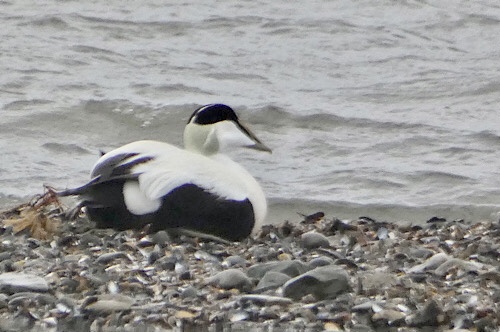
Male Eider resting on the skear pebbles


Tuesday, 31 January 2023

Wash and brush up

The fresh SW wind was even colder than yesterday, but it remained dry till late afternoon. The wind is increasing and the rain heavy as I type. 

South wall (MD)
Lapwing 154 out from the saltmarsh 
Shelduck 49
Wigeon c60. They were sheltering from the wind on the rocks of the lee side of No.2 outflow. They normally rest on the water in the channel here.
Wigeon and gulls sheltering from the cold SW wind

No Rock Pipit again, perhaps they too are sheltering from the wind, there are plenty of sheltered ares within the Power Station grounds.

Kittiwake 23 - 3 adult plus a first winter on No.1 outflow. 3 adult plus 16 first winter in the harbour

North shore
Late morning - Janet was exercising a friend's dog in the public field near the play area. She took this shot of Pale-bellied Brent geese looking for somewhere to land on the rocks.
45 Pale-bellied Brent geese over the play area rocks

I went down to check the skear at 14:00 - low water (MD)
Pale-bellied Brent goose 67 minimum 
Dark-bellied Brent goose 1
I went out from Four Lane Ends (Whinnysty Lane), which meant I had to cross the rocks. The bulk of the Brent Geese were further south, but a small group was just north of me. So, head down, I walked away and manage to pass them without disturbing them. This gave me the advantage of the sun behind me and being quite close. So I took a couple of shots.

While I was on the skear I kept looking back to the play area, a couple of times there was a group in flight, but they quickly landed again. Then, at low water 68 landed on the sea just behind me.
They may have been disturbed, or they may have decided that it was "the time", either way they made their way into the skear corner. There is no food for them here this year, but the fresh water does reach the sea here. Many drank and all of them washed in the brackish water (both the wind and the tide now, holding the fresh water in the corner).

The above clip begins with this Dunlin with the Brent, I was a bit surprised
how big it looked! It just shows just how small a goose Brent are (MD)
After  a wash and brush up, they rested a while. This is the dark-bellied bird. It seemed to be the one who decided that it was time to head back. They waddled to the shore then flew back to the rocks. It wasn't possible to see if any Brent had remained amongst the rocks.

Dark-bellied Brent centre

Knot c750 - when a wave passes through the flock, as it does early in this clip, it normally means that they are under attack, but I couldn't see a raptor and they quickly settled. If it was an attack it must have been quick and successful, as they soon settled again.


Monday, 30 January 2023

The same mix, but still of interest

Another mild day despite a bitterly cold west wind. Plenty of sunny spells.

South shore - lunchtime dog walk (MD)
Shelduck 96
Wigeon only c50 but the tide was out
Grey Plover 1 near wooden jetty
Kittiwake 22 - two adult and four 1st winter on the outflows. Another two adult and at least fourteen 1st winter in the harbour. There were at least two 1st winter behind the ferry, but couldn't be sure that they were new birds.
One of the adult Kittiwake on the outflows
This first winter Kittiwake behind the ferry already has a largely yellow bill

This first winter Kittiwake is more typical with a solid black bill

There is a honeycomb worm bed developing in front of the roundhead sloping wall. Always worth checking for Purple Sandpiper, but today only Oystercatcher and Turnstone 
The waders, or gulls for that matter, don't eat the worms, which will be safely resting several centimetres below the top of their tubes. But they find other invertebrates between the crevices.

This female Eider was just out from the roundhead too. She has a crab, and I suspect that she has already removed its claws, as she dives when the gull pounces and when she returns to the surface she has swallowed the crab.

Unusually, no Rock Pipits seen or heard today

North shore (MD)
Just a brief evening check of the rocks out from the play area.
Pale-bellied Brent goose 54 at least. They were feeding along the edge of the rocks as the tide reached them. This makes for easier grazing of the gutweed and sea lettuce. But this one finds a piece of brown seaweed (algae), it looks tempting, but is eventually discarded.

These were part of a group that were feeding amongst the more inshore rocks, 
but flew to the outer ones when the tide reached them

They were easily visible from the promenade as this clip demonstrates 

There was a large resting flock of Black-Headed gulls amongst the rocks, including one with a green darvic ring. Another 30 seconds and I would have been close enough to read it, when this commotion started above and they all took flight. I don't know what this Black-Headed gulls had, but the large gulls wanted it!
It managed to get away with its prize. The shot below is just a still from the clip.


Sunday, 29 January 2023

It's mainly just the Brents today

And increasingly fresh west wind as the day progressed. A warm night and a dry day after a morning shower.

South Shore
Pete Crooks checked the play area rocks, late morning:
Pale-bellied Brent 74
Dark-bellied Brent 1

I walked out to the skear towards 11:30 low water (MD). I don't know if something spooked the Brent or they just wanted a rest, but c70 flew from the play area rocks and landed in the sea. This is the main group (there was another 3 also on the water). You can see the green marker post behind these at the start of the clip.

They chose to come ashore at the mouth of a freshwater runoff channel, many having a drink and a bath, perhaps this was their objective? They may be a large group, but there were different factions amongst it and some disputes. I couldn't see the dark-bellied amongst them and suspect it was with the other three, that had now moved on/back.

When I looked back a little later, they were trying to find somewhere to land out from the play area, but with so many birds it seems to be difficult for them all to "agree". This attempt eventually saw them landing in the less populated (and less weed available) rocks out from the Sunnyslopes groyne. But a second check a bit later, saw them back in front of the play area, where there continues to be plenty of gutweed and sea lettuce.

Bar-Tailed Godwit 4 on the shore
Dunlin c30
Turnstone c40
Knot c500
Some of the Knot

I mentioned the other day how difficult it can be to read any colour ringed Knot. I scrutinised the resting Knot and eventually located one with an orange flag. Unfortunately, initially its legs were in the water, then flew out of sight at the back of the flock.

Eider 14