Tuesday, 27 June 2023

One out of three.........must try harder!

A fresh SW wind. It rained for most of the day, but with a fortunate break early evening.

South shore high water 18:50 (MD)
The plan was to get out on the shore and look back at the gulls on Red Nab. Unfortunately, it seems the gulls had the same idea and they were scattered all over the shore and several feeding on No.2 outflow. There had obviously been an influx of adult Meds, but it was very difficult keeping track of them as they, and the other gulls were highly mobile. The following are absolute minimum numbers.
Mediterranean Gulls 24 - adult 8, first summer 14, second summer 2
There hasn't been any feeding on No.2 outflow but this evening there were 3 adult, 2 x 1st summer and 2 x 2nd summer. This is a slightly different angle of the outflow as I followed an adult as it was feeding.

Two of the adults had white darvic rings, unfortunately I couldn't quite read them!
This is typical of how the birds were scattered around the shore.
Three adult and three first summer here, the middle bird is one of the white darvic ringed adults.

Later a few gulls, mainly Meds, settled on Red Nab
Adult, second summer and a green darvic ringed first summer
Fortunately, I did manage to read this one - details awaited

The main group of gulls was again out from the saltmarsh at high water with some still feeding on the outflow.
Curlew 100+
Cormorant passing over

I was anticipating rain today, so saved some shots over from yesterday, these from Janet:
Six-spot Burnet

and for comparison a Narrow-bordered five-spot Burnet 
albeit a smudged one.

And a couple of mine from the main pond at Middleton 
Summer plumage Little grebe

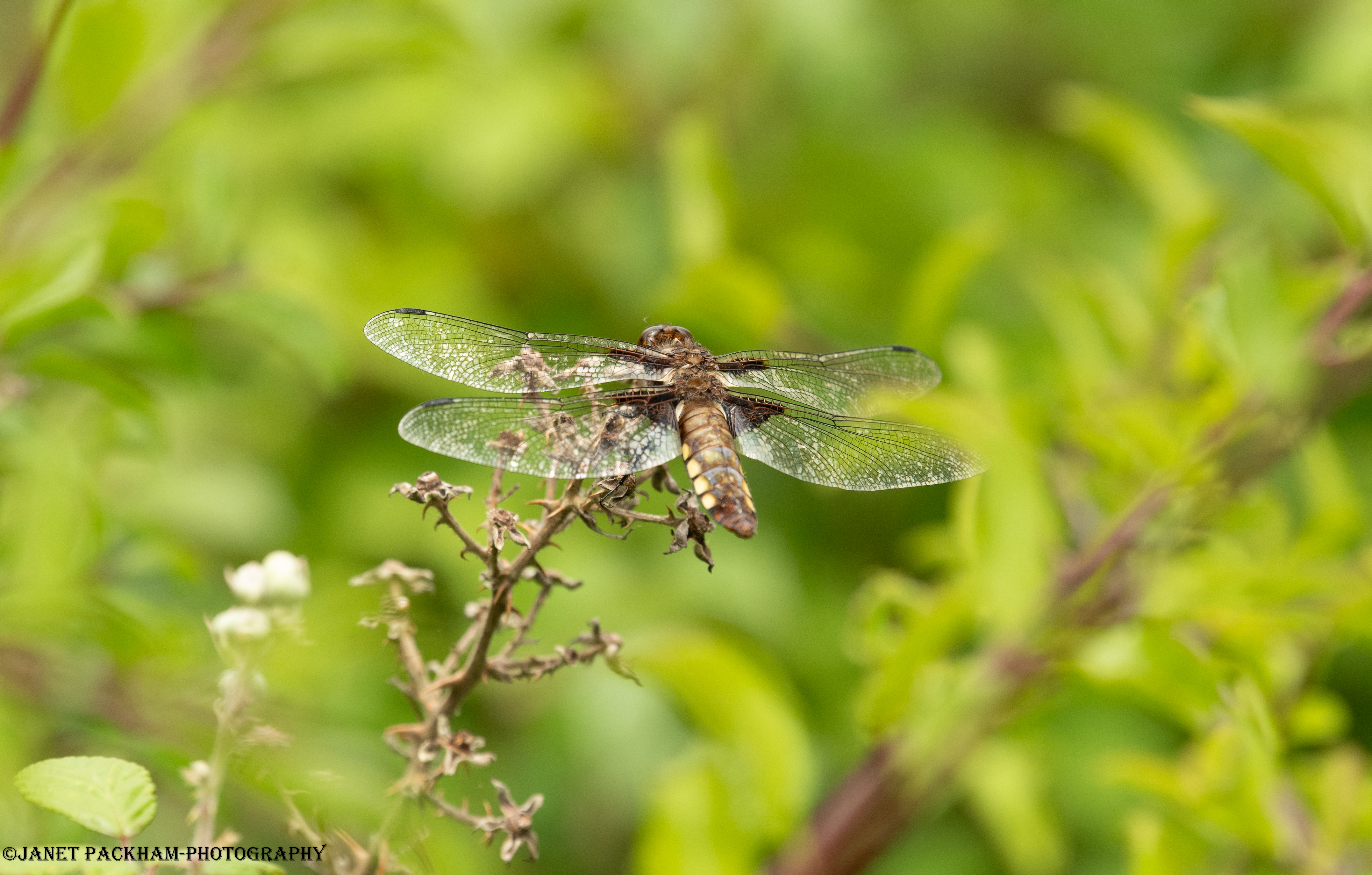
Four-spotted Chaser

Monday, 26 June 2023

More Meds, but still no rings.

A fresh west breeze. Dry with sunny spells.

South shore (MD)
I went along the sea wall on the ebbing tide, planning to walk out onto the shore for a closer look at the gulls feeding at the seaward end on No.1 outflow. But this morning there were hardly any gulls feeding. So I didn't bother.
There was the metal ringed adult and a first summer Mediterranean gull resting by the outflow - more on Meds later.
Mediterranean gulls resting in the lee of the stiff breeze
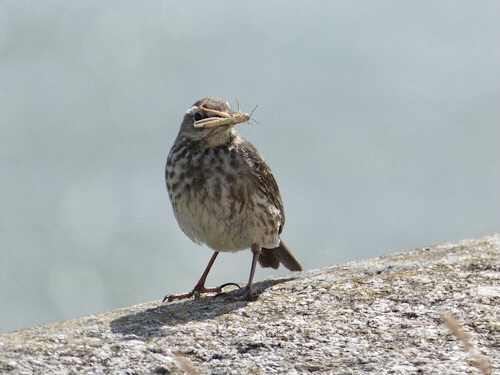
The Rock Pipits are still taking food to the nest hole near the lighthouse. The grasshoppers are getting bigger!
The young must be getting quite large now
There were more gulls feeding on No.1 outflow on my return, at least 3 first summer Mediterranean gulls on the seaward end. But I'd already decided not to walk out to check. Apart from the lack of gulls the beach mud is thicker and stickier than usual and latticed with drains. 
The beach between the outflows - not an easy walk!

This was a bit puzzling in the Nature Park on the way back. This very fresh looking Chiffchaff was preening in a bush, meanwhile a Common Whitethroat was calling whilst holding a spider. I couldn't see any young Whitethroat nearby.

I returned to Red Nab towards high water at 17:50. It's only 7.2m and barely reached Red Nab. Still the majority of the Black-Headed gulls moved to the saltmarsh area,  which made spotting the Meds easier.
Mediterranean gull 24 at least. 4 adult, 2 second summer and 18 first summer - unfortunately none with darvic rings.
Many are in this clip. Try watching in slow motion, it is an option.

This is the new second summer Mediterranean gull
There were 300 gulls on the shore out from the saltmarsh mainly Black-Headed. 
Some of the gulls on the shore out from the saltmarsh 

Another 50 gulls on the saltmarsh included 3 adult/second summer Mediterranean gulls, it wasn't clear if these had moved from Red Nab or were additional.
Curlew 100+

Middleton Nature Reserve 
Janet had a look in the morning.
Male Large Skipper

Female Small Skipper

Blackneck moth

Female Broad-bodied Chaser

Janet also confirmed the Ringlet are now abundant along the eastern boundary of the recording area.

I did a couple of circuits of the main pond early evening, but failed to locate any Red-Veined Darters. There were Black-Tailed Skimmers, Four-Spotted Chasers and a few Common Darters. (MD)

Sunday, 25 June 2023

Meds feeding on No.1 outflow

A light breeze starting in the east but gradually moved clockwise to the north then back to the west again. Sunshine in the morning but heavy showers began after lunch continuing all evening.

South Shore (MD)
I went down to check the beach next to the wooden jetty. The few gulls were mainly Herring.
The beach next to the wooden jetty as it became exposed.
The Herring gulls were clearly expecting to find something to eat

Mediterranean Gulls 11 at least. Both the metal ringed adult and a first summer visited the beach briefly.

You can see the tips of the sandmason worm tubes just above the surface 
The metal ringed bird definitely, and the first summer probably, had been feeding on the seaward end of No.1 outflow. There were 2-3 adult, 1-2 second summer and at least 7 first summer Meds feeding there.
From top to bottom:
First summer, second summer and adult Meds
On the seaward end of No.1 outflow

This is the metal ringed adult heading back to Red Nab

Sandwich Tern one south along the shipping channel
Redshank 1 
Summer plumage Redshank

Shelduck 2 on Red Nab
Rock Pipit 2 near lighthouse, 1 with food in its bill, but made no attempt to take it anywhere.
Linnet 5 near waterfall 6 on west side of saltmarsh 

Janet spotted these Cinnabar moth caterpillars on Moneyclose Lane

Just out of the recording area - shoreline just south of the recording area.
These also from Janet

Meadow Pipit

Lapwing

Saturday, 24 June 2023

First summer Med numbers continue to grow

A couple of overnight showers but dry all day. Overcast till after lunch then some sunny spells. A light SW to south wind.

Red Nab - high water 16:10 (MD)
At 7.7m high water barely reaches Red Nab. I walked out onto the shore and looked back at Red Nab rocks.
Mediterranean gull 18 - 2 adult, 1 second summer and 15 first summer 
Second summer Mediterranean gull

Five of the first summer Mediterranean gulls

I almost certainly missed some, this clip shows about half the gulls, but most of the Meds were in this section. There was at least one adult Med in the remainder. 
The tide was just behind me at this point, so time to leave. As the tide got higher, many of the Black-Headed gulls flew to the beach out from the saltmarsh, but the Mediterranean gulls remained on Red Nab.
Curlew 72
Lapwing 2

Middleton Nature Reserve 
Janet had a quick look this morning.

Male Black-Tailed Skimmer

Narrow-bordered five-spot Burnet

I just checked the main pond this evening (MD)
Red-Veined Darter 2 male
This one was resting on the western bank, just before the large reed bed begins.
A second was cruising in over the water so this one flew out to challenge it.

One flew out to the middle of the pond and this one returned to the bank, but c30m away, where the first reed bed ends.
Pretty sure this was the other male. Apart from returning to a different territory,
its veins looked redder and the dark markings on its abdomen darker.

Friday, 23 June 2023

The silent skear

 A light east breeze till mid morning, then a freshening south to SW wind. A few light showers in the morning with heavier ones late afternoon.

Heysham skear - low water 10:00 (MD)
There wasn't likely to be much around at this time of year, but what struck me, as I walked out, was how quiet it was. Not a single Oystercatcher to be heard. There were a few Curlew calling (ended up counting 24), and at least 1 Whimbrel calling.
I presumed the Oystercatcher were elsewhere, but then I started seeing them spread around the skear edges, c100. It then dawned on me why they were so quiet, there was nothing to squabble over. The skear is covered in mussels this year and at the moment, most are the ideal size for Oystercatchers.
It is this size of mussel that the Oystercatcher seek out amongst the larger ones later
in the year. Often when they find one they fly off with it so as not to be robbed

They must be an ideal size for them to open easily, but large enough to contain plenty to eat. So, no need to squabble, all the food they need for the day is readily available. 
Oystercatchers just standing around. Literally, fed up.

Little Egret 6
Great Crested Grebe 5 individuals 
Red-breasted Merganser 1 male
Eider 3 male together and 1 female - these are the three males, watch the gull in front of them. You can see when it spots a small crab, it watches for a couple of seconds then times its leap to perfection. 
It seems there is plenty of food for all at the moment

This smallish Barrel Jellyfish, c30cm diameter, was stranded in a pool. At least like this they show that in the water, they are actually quite graceful.
Barrel Jellyfish, about to be freed by the rising tide

Middleton Nature Reserve 
Ringing report from John for yesterday:
Not the best conditions for ringing, bright and warm from early.
Three nets set on Thursday morning.
Only twenty birds caught and processed, but a few more young birds evident.
Blackcap          3 juveniles
Reed Warbler    1 juvenile and 1 retrap adult
Whitehroat       2 juveniles and 1 adult
Great Tit          1 juvenile retrap and 1 adult
Cetti's Warbler 2 adults with one a retrap
Blue Tit             2 juveniles and a retrap adult
Chiffchaff           1 juvenile
Willow Warbler    1 juvenile
Lesser Whitethroat  1 juvenile
Sedge Warbler    1 juvenile
Goldfinch             1 adult

I just had a quick look on my way home (MD). No sign of the Red-Veined Darters, but Common Darters were emerging in numbers.
Female Common Darter, one of ten female/immature seen
The ducks have done very well rearing their young this year. There were 3 female Mallard with a total of 21 quite large young. Originally there were 22 chicks (8, 8 & 6). A significant improvement on last year's 100% mortality. This must be the female who lost one of her chicks as she is giving 7 young "up ending" lessons.

Unfortunately, a Coot believes that the patch of weed they were practicing on belongs to it, and sees them off.

The female Gadwall still has five growing chicks. An eclipsed male is also around.

These shots are from Peter and Rosemary from yesterday:
Mute Swan

Male Black-Tailed Skimmer

Female Common Blue Damselfly 

Male Common Bluetail Damselfly

Froglet being returned to safety 

South shore - high water 15:25 (MD)
Mediterranean Gull 13 - 2 adult plus 11 first summer 
Three of the first summer were on Red Nab. This one had a striking black head and quite a red bill.
First summer Mediterranean Gull
the small dinosaur on the left is just a distant descendant, a female Eider.

The rest were with 250 gulls resting on the mud out from the saltmarsh.
Gulls resting on the mud out from the saltmarsh 

The metal ringed adult Med landing with the gulls

Just out of the recording area
Mark Jones took this clip of a Barn Owl flying around the marshes at Potts corner, unfortunately turning back short of the southern boundary of the recording area.
It came up the coast from Sunderland point and quartered right around me then headed back off inland towards Sunderland point

Thursday, 22 June 2023

Solstice over.....Autumn passage commences!

Almost breathless till mid morning then a light west breeze for the remainder of the day. Sunshine all day.

Heysham Nature Reserve (Janet)
This female Ringlet was just enjoying the sun

Then this male turned up to "pester" her

Common Green Grasshopper

Common Field Grasshopper 

Pellucid Hoverfly

Well developed Moorhen youngster 

South Shore (MD)
I went down while the tide was still out to check the beach next to the wooden jetty. All there was to see, was another layer of silt, not a single gull. The only Mediterranean gull seen was the metal ringed adult resting on the beach between the outflows.
Eider 1 female between the outflows 
Rock Pipits 2 at the lighthouse are still taking food to the nest and becoming ever more frantic. This one dropped down to the hole when it knew I was watching, something they never normally do. Unfortunately the hole is pretty much under where I was stood so the pipit disappears when it drops down.

Linnet 4 near lighthouse 
Starling 6 near waterfalls, this number will soon increase significantly.
A measure of just how low this month's tides have been and how calm the sea
has been, is this, albeit stunted, sunflower growing at the base of the sea wall.

I returned when the tide was almost full to check Red Nab.
Mediterranean gull 6 - 2 adult, 3 first summer, 1 second summer - there probably were more as the light was awkward and many were resting with their heads down, but there definitely wasn't anything like the numbers seen yesterday.
There were 4 juvenile Black-Headed Gulls today
Common Sandpiper 2 - this is the "autumn passage" from today's title. Presumably they are returning from their breeding grounds rather than heading to them. They made no attempt to feed, just rested.
Off passage Common Sandpiper 

Saltmarsh 
Linnet 10 
Greenfinch 2 - this male was feeding on the seeds at the edge of the saltmarsh.


This male Drinker moth had managed to get itself trapped in a cage of sedge stems on the saltmarsh. It graced me with its presence for a couple of seconds after I freed it.
Male Drinker moth

Middleton Nature Reserve 
No Red-Veined Darter records received today.
This is an interesting piece from Peter and Rosemary Silvester, based on pictures they took of Common Blue damselflies on Middleton Nature Reserve yesterday, you will have to open the images to see the detail referenced in the narrative.

This one comes with a modesty warning: "Not to be viewed by those likely to be offended by some rather explicit shots of damselflies coupling and uncoupling." 

We came across these two on our way out and Rosemary just kept popping away at them because they were particularly well placed to photograph. When we looked through them at home we realised that, when they are zoomed in on, they contain remarkably fine detail of the secondary genitalia of the male during the mating process.


We came across information recently that male dragonflies and damselflies can actually use their sexual organs to remove a rival's sperm from the body of a previously mated female and wonder if this might have been going on before our very eyes!


Scarily, yesterday was the longest day for 2023! Kevin Eaves condensed it into a nutshell, "as seen from my south-facing weather station webcam"