Wednesday, 21 July 2021

By popular demand.......Red jelly blobs!

The day started with a light south breeze, but it soon swung back to the west and freshened. Still very hot and sunny.

Ocean Edge and Red Nab - high water 09:25
There were 525 gulls roosting on the mud just out from the saltmarsh 
There were 525 gulls in this first wave of gulls, there was a smaller
roost further out and the dark line in the distance are Curlew 

The gulls were mainly Black-Headed but also included:
Mediterranean gull 10 - 8 adult, 1 x 3rd calendar year and 1 juvenile. There were also 2 additional adult on Red Nab
Sandwich Tern 5 - there were two adult and 3 juvenile flying around.
Four of the Sandwich Terns

Wooden Jetty area - early evening.
No.1 outflow was exceeding busy with feeding gulls. 
It looked promising, not just for this evening, but for the future, this outflow has not been attracting many gulls for a while. It was mainly Black-Headed gulls today but within 5 minutes all feeding had stopped!
Whatever had caused the feeding frenzy, it was over,
and the gulls rested on the beach on either side of the outflow

The water jet dredger was operating in the harbour, I suspect that it either drove a surge of small fish and/or shrimps through the intake, or possibly it stopped the feeding by causing suspended silts to colour the outflow. While I'm on the subject of dredging (MD), the mud level on the beach next to the wooden jetty is about 15cm higher than normal, likely caused by the long spell of calm weather and continuous westerlies, but I suspect the dredging operations make a contribution.
In theory rising mud height shouldn't make much difference to the sand mason worms, they can easily extend their tubes. But it might make a difference to how easily they can be caught, possibly they can retreat further and the soft nature of the mud may give them advanced warning of approaching webbed feet!
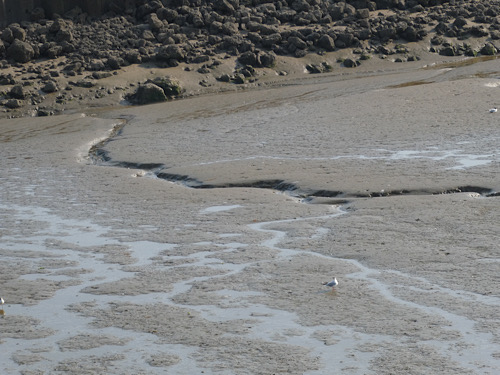
This drain through the mud shows the extra depth,
the normal level is the bottom of the drain

This is a shot of the mud just below the sea wall
You can see the tips of the sand mason worm tubes, but only just

This is the same area of mud on 19 July last year

Whatever the cause, there were only 4 Mediterranean gulls on the beach this evening and neither they or the resting BHGs were trying to feed on sand mason worms,

Heysham skear - low water 16:30
Great Crested Grebe 1
Little Egret 4
Curlew c60
Turnstone 7 on mid skear plus 14 on inner skear
Redshank 150+ the largest flock was 140 and there were smaller flocks and individuals around
Knot 1 in partial summer plumage with largest flock of Redshank.
Again the Redshank and Kont headed off east.

Whenever I meet someone who routinely reads these posts they tend to comment as to how they find the more unusual stuff the most interesting, and "green jelly blobs" are often quoted as an example (see post 6/03/21 MD).
As I approached the very edge of the inner skear today I came across this red blob of jelly.
It wasn't obvious what it was so I lifted it out for a closer look
The water was extremely warm, it was only a shallow pool and probably not been covered by the sea for a couple of days. When I had it out it was obvious that it was a Beadlet Anemone, it had been upside down in the water. I carried it back to a deeper pool further out, it repaid the jesture by sticking to my hand like a leach.
Beadlet Anemone 

I found a deeper pool with moving water, even that was warm, but not as hot as the shallow pool. I placed the anemone on the smoothest stone I could find, it isn't as level as it looks on this picture, probably about a 20 degree incline. Even so, I was disappointed when it "fell over". The tiny crab just to the top left of the anemone as it fell over, had a lucky escape!

So I replaced it in the bottom corner of the same stone, this time success. Its tentacles opened immediately and it appeared to be fine, although not yet securely anchored.


Tuesday, 20 July 2021

First juvenile Med arrives

Still hot and sunny with west breeze.

Heysham skear - low water 15:20
Oystercatcher large numbers as ever, Curlew c50
Turnstone two lots of 10 and 2 on middle skear, probably passage. Another 14 on inner skear, possibly resident.
Redshank at least 150, largest flock 100. Smaller flocks between 6 - 30 seemed to be everywhere. All the birds I saw leaving flew east overland.
Little Egret 4

South shore 4 hr before high water
Rock Pipit 1 on Red Nab
Plenty of Black-Headed gulls on both outflows, although No.2 is still only 50% volume
Mediterranean gulls 12 - 10 adult, 1 x 3rd calendar year and 1 juvenile. Four hours before high water there were only 4 Meds on the beach by the wooden jetty, but as the tide moved up the beach more arrived, including this adult with a juvenile.
Adult Mediterranean gull with a juvenile 

Some detail of the juvenile Mediterranean gull 

This clip I actually took yesterday. Watch the Cormorant flying low over the water, it startles surface feeding fish (almost certainly Grey Mullet), some jump clear or the water, which in turn startles the Cormorant. This wasn't a fortuitous clip. This happened every time a Cormorant flew past.


As promised, these are the picture of the moths from Kevin's overnight light trap, from a couple of days ago. Each of these is a new record for the Heysham area.

Scalloped Hook-tip

Scarce Silver-lines

Scarce Footman

While I was on the skear, there were two people push netting for shrimps, but on the far side of the Kent channel. They have probably come from Grange area. Originally shrimpers from there came with a horse and cart, but always in twos, just in case a horse died. The oft quoted anecdote is that the tide could come in faster than a horse can gallop. And so it can, but only because there are miles of mud with almost no gradient. The tide can cover miles of it almost instantly, but this is only a danger if there are hidden gullies between you and safety, you make sure that there are not. When I started push netting in the 1970's the Grange lads were using tractors, but again always at least two in case one failed (they did, more so than the horses!). But these two today had only one vehicle, probably a modified quad bike. They must have some trust in it! The tide had already been coming in for an hour when I took this clip. They would have no chance of getting back if the quad bike failed, but I suppose they have a back up support that can be summoned by mobile phone, I hope they get reception there. It's much further out than it looks. At the end of the clip I zoom out to give an indication of scale (MD).


Monday, 19 July 2021

Meds mystery

And, so it continues, hot, sunny and SW to W breeze.

South shore as tide was leaving the sea wall.
Large gulls juveniles - there were 25 between Red Nab and No.2 outflow plus another 7 between No.2 and No.1 outflow.
Rock Pipits 3. 2 together on Red Nab plus this one feeding on top of the sea wall near the lighthouse. It appeared to have turned vegetarian, but it must have been finding small invertebrates or possibly eggs in the sparse flora.

This is a still from the above clip, you can just make out a small morsel in its bill
Rock Pipit - Pete advises that it is a worn adult in moult.

The Rock Pipit wasn't the only bird feeding like this, a young Linnet was too, and being watched over by dad.
Male Linnet

Mediterranean gulls 5 - on this date last year, on a similar height tide, there were 40 Mediterranean gulls feeding on the beach next to the wooden jetty. Today I got there before the mud was exposed. These two 3rd calendar year birds were waiting for the sand mason worm beds to become available.
3rd calendar year Mediterranean gulls

Later they were joined by two adult and a third adult was making its way to the beach as I was walking back. It wasn't the unavailability of sand mason worms keeping the meds away, they seemed to be finding them easily enough. This 3cy catches a worm at the start of this clip.
Perhaps the sand mason worms have just started to become available, I'll have another look in the morning (MD)

I couldn't work out what was "wrong" with this cormorant's bill. But it was only feathers, presumably after a good old preen.
Cormorant 
There were quite a few butterflies around the scrub near the lighthouse.
Meadow Brown 6
Gatekeeper 4
Common Blue 2
Small White 2
Small Tortoiseshell 1 (this seen to come in off the south wall)

Heysham skear - low water 14:00
Great Crested Grebe 1
Little Egret 4
Curlew c80
Turnstone 10 scattered around inner skear.
Redshank 81 - three lots 16, 3 & 62
Knot 6 partially summer plumage birds with the 62 Redshank. - I could see they were ready to move on so took this clip. Another Juvenile Oystercatcher was the last to leave (I did know that young birds have a white ring around the throat, I just hadn't realised how wide it can look - see yesterday's post).

This is still from this clip as they were taking off.
Knot in partial summer plumage

The flock flew off overland to the east. I haven't pre compressed this picture, so if you open it you should be able to see enough detail to pick out the six Knot
Redshank plus six Knot crossing the shoreline
before heading east overland


Middleton Nature Reserve 
Just a very brief check of the main pond mid afternoon 
Only dragonflies were:
Emperor 
Brown Hawker 
Blak-Tailed Skimmer

Swift 2
House Martin 2
Swallow 4

Kevin has had some more top moths in his overnight light trap a couple of days ago. Scarce Silver Lines, scarce Footman the best. I'm just waiting for more details and the images, so I'll either add later, or put on tomorrow's post


Sunday, 18 July 2021

Knot back!......well, a Knot about

Light westerlies and hot sunshine continues, although there were some clouds around today.

South shore mid morning 
Rock Pipits 2 on Red Nab
Mediterranean gulls 5 adult plus 1 x 3rd calendar year, on the beach next to the wooden jetty, the tubes of the sand mason worms are becoming more prominent, hopefully the worms will become accessible to the gulls soon. In this distant clip there is an adult and the 3cy Med, plus a juvenile Black-Headed gull. None of the gulls were finding worms, but the Oystercatchers were catching them by digging down. You can see the end of the sand mason worm tubes protruding out of the mud.

There is a significant crèche of young Herring and Lesser Black-Backed gulls developing on the beach just north of Red Nab. There were 14 this morning.
Part of the crèche of large gulls just north of Red Nab

There were not just young gulls on the beach this morning. This Oystercatcher puzzled me with it having so much white on its throat and neck, until Jean showed me that this is typical juvenile plumage. You learn something new, most days. (MD)


Heysham skear - low water 13:00
No Great Crested grebe seen
Little Egret 6
Curlew c80
Redshank 6
Dunlin 14 - one flock south
Turnstone 52 - one flock of 35 plus 17 scattered around the inner skear.
Knot 1. There was one with the Turnstone flock.
Knot resting with Turnstone flock

They were temporarily spooked by a passing helicopter allowing in flight views.
Revealing that it was still in partial summer plumage.


Saturday, 17 July 2021

Some, but not many, like it Hot

Light west breeze sunny and very hot (30C car temperature at 14:00)

South shore 
A check 4 hours after high water
Mediterranean gull 2 adult on waterline next to the wooden jetty 
The Black-Headed gulls were feeding on No.1 outflow again, presumably it's back on line.
Rock Pipits 2 - one young bird on Ocean Edge foreshore a second along the sea wall looked to be a youngster, but didn't see plumage clearly enough to be certain (MD)
Young Rock Pipit on Ocean Edge

Grey Seal 1 at sea end on No.1 outflow.

Middleton Nature Reserve 
I was planning on keeping out of the sun till evening, but at midday it was cooler out than indoors, if you could find shade. Even so, there was only me out, fortunately no mad dogs! (MD)
Mute Swan the Tim Butler pair had both cygnets on show today, plus a single female on the "no swimming" pond. The pair with 9 cygnets still on the main pond.
Mallard 17 juvenile 
Gadwall 1 female plus 3 young - they were having to work hard to reach as deep as mum, but on a day like today it looked very refreshing.

Little grebe 2 adult on the "no swimming" pond. This clip shows the number of damselflies around today. The grebe make a half hearted effort to catch one.

There were plenty of warblers calling and feeding, but only the Chiffchaffs were singing.
Swift 4
Swallow 10

Butterflies were plentiful and I didn't attempt to count, but in some areas Ringlet are the predominant species, Meadow Brown and Gatekeeper are the most common in other areas. Also around today: Small and Large Skipper, Red Admiral, Speckled Wood, Small White and Comma.

Dragonflies: Emperor, Brown Hawker, Black-Tailed Skimmer, Broad-Bodied Chaser and Common Darter.
Black-Tailed Skimmer

Broad-Bodied Chaser

Grasshoppers are everywhere and have been for some while, but for some reason this one decided to rest on the concrete road. Not an obvious resting place in today's temperatures.
Common Field Grasshopper 

Ringing and Moth report from Pete
Ringing - Eight species of warbler caught including two unringed juvenile Grasshopper 

Overnight light trap on Middleton - Best moth was Agonopterix conterminella but unfortunately  picture was  rubbish also very worn Grass Emerald and Eucosma tripoliana wandering from the saltmarsh as they often seem to do. Also:
Southern Wainscot

Agapeta zoegana

6 Lunar Hornet Moth at Heysham NR today4 at SD407 600 and 2 on Landscape strip at the gate SD 407599 and 1 halfway down back fence at SD407594 ref Linda Renshaw

Friday, 16 July 2021

Bit of a mixed bag

The west breeze and sunshine continues 

Heysham skear - low water 11:00
Just a quick check.
Great Crested Grebe 1
Little Egret 8
Grey Heron 1
Redshank 3
Turnstone 2
Curlew c80

Middleton Nature Reserve 
Janet took these Common Darter shots in the morning

Common Darter

I had a quick check of the three main ponds in the evening 
The Mute pair on Tim Butler pond only had one cygnet with them today. The rest of the wildfowl was as yesterday.
Not a lot of dragonflies.
Emperor 6
Black-Tailed Skimmer 3
Brown Hawker 1
Common Darter 1

Still a good variety of butterflies around, but no Ringlet seen today.

It tends to be noisy around the main pond, mainly as there is usually someone feeding the swans and ducks. The gulls call in anticipation and during feeding sessions. This Grey Heron was chilling out, resting on the sloping east bank. Interestingly, it reacted to the gulls falling "silent". Incidentally, this is the same heron that was seen swimming a couple of weeks ago. It seems to have its own ideas as to how a heron should behave.

Probably the best record of the day was on my Beech hedge as I was getting in my car this evening (MD). 

Magpie moth


Thursday, 15 July 2021

Good, and not so good, recognition skills

The trend of fresh west breezes and sunshine continues.

Not a great deal today, plenty of butterflies everywhere but little else.

South shore 
A check mid morning at low water.
Rock Pipit 3. One juvenile on Ocean Edge foreshore, a bird flying along the sea wall towards Red Nab and this juvenile near the lighthouse.
This is the good recognition 
Juvenile (I think (MD)) Rock Pipit catches a Ladybird 

Then it remembers just how bad they taste, and lets it go again.

Mediterranean gulls at least 3. There was an adult and a 2nd calendar year on the water's edge near the wooden jetty, later two adult flew south along the sea wall. 

There were lots of butterflies near the newt pond behind Red Nab. 
Red Admiral 3
Meadow Brown 10+
Gatekeeper 10+
Ringlet c6
This is the not so good recognition, or perhaps just extreme optimism.
This Ringlet attracted a male Gatekeeper.
 Perhaps he was trying to chase her away, but he looked very friendly.

Two eye spots on wing........near enough.

Heysham Nature Reserve 
Janet took this shot of a Brown Hawker. Quite an unusual shot and a reminder of how appearances can be deceptive.
Male Brown Hawker - but they have yellow stripes on the thorax,  these
stripes appear blue, presumably an effect of the light through the foliage


Middleton Nature Reserve 
A check mid afternoon 
Not a lot of dragonflies around
Emperor 3
Black-Tailed Skimmer 5
Brown Hawker 1

Plenty of butterflies, in order of abundance:
Gatekeeper 20+
Meadow Brown 20-
Small Skipper 10+
Ringlet c4
Large Skipper 3
Speckled Wood 3
Red Admiral 2
Large White 2
Small White 2
Comma 2
Silver Y moth 1
Silver Y


Mallard - it was nice to see the 10 young birds on Tim Butler pond. This is the first sighting since they were tiny. The Tim Butler pond is becoming increasingly difficult to view more than just a few patches. There were also 10 young birds on the main pond and a further 8 on the "no swimming" pond. So 28 1st calendar year birds!

This is a nice group shot of the Mute family, some of the Mallard and a Moorhen, on the main pond. This is unlike previous behaviour of the aggressive male Mute, who normally chases everything. 
This reminds me of a school photograph (yes we did have cameras when I was at
school, albeit black and white). Smallest at the front please and the tall ones at the back.

This tiny (c4mm) moth, Grapholita compositella, was one of several on the Bird's-Foot Trefoil near the lighthouse. To the naked eye they just look like pieces of dandruff flitting about, but it is actually quite a striking moth. A common species, but this is the first record for the whole of the 10 x 10 kilometres of SD35, although, hardly surprising as about 99 square kilometres of SD35 is sea or mud, with the Fluke Hall area being the only other dry land.
Grapholita compositella


Wednesday, 14 July 2021

First Wheatear of..........Autumn!

The west breeze becoming fresher, mainly sunny.

Heysham skear - low water 09:30
Shelduck 2 over to the south
Great Crested Grebe 1
Little Egret 14
Redshank 51 in two flocks of 30 and 21
Turnstone 15
Curlew c70
Plus the ever present Oystercatchers

South shore 2 hr before high water
Large Black-Headed gull roost on Red Nab, not checked for Mediterranean gulls 
Rock Pipit 1 on Red Nab
Northern Wheatear 1 juvenile on Ocean Edge foreshore.
Juvenile Northern Wheatear 

Not a plumage often seen at Heysham 

But the tail always helps.
I often tell visitors how the Wheatear came about its name, but perhaps not appropriate 
to post the explanation. If you are interested Google it, and imagine speaking the words 
in a strong north eastern accent (MD)


Heysham Nature Reserve early afternoon 
Kevin did a circuit and reported that there were plenty of butterflies active today, including:
Small Copper

Meadow Brown

A particularly large and bright Comma

Small Skipper

Kevin also had another moth new to Heysham in his light trap a couple of days ago. Suspected 
Suspected 

Another good moth, Lunar Hornet moth was reported from the Tim Butler pond on Middleton Nature Reserve by Linda Renshaw today.

Early in the spring I showed a clip of a Beadlet anemone taking hold of a small piece of barnacle (see post 2/04/21 MD). In the areas around here where I walk, Beadlet are not only abundant, but the only anemone normally seen. This one is different. It was on the middle skear, in a pool where the water was draining off the skear. This area of shore is so dynamic in changes in formation that you do not normally see any anemone. This one was only small, undoubtedly young and has taken advantage of the relatively calm period we have had for a couple of months. I'm not an expert, but believe it to be a young Dahlia anemone, if anyone has other thoughts, please let me know.
This first clip you can see some of the tentacles reacting as suspended particles in the draining water touch them.

Even on the above clip you can see that this species is much more reactive than a Beadlet. In the clip below I provide it a small piece of mussel shell. It was obvious that this species could easily, and almost certainly does, catch shrimps and small fish. The adult Dahlia can grow to 10cm diameter, this one was less than 2cm.
The anemone quickly recognised that the shell was inedible and at the end of this clip you can see it starting to discard it.

Tuesday, 13 July 2021

Both Meds and wader numbers increasing

Quite a fresh west wind, mainly sunny.

Red Nab
Pete Woodruff spent a pleasant 2 hours in the sunshine, towards high water. Sat on the wall with his scope he managed:
Mediterranean gull 16 - 15 adult one with a green ring, plus one sub adult.

Ocean Edge
Common Sandpiper 1 flew out from foreshore rocks then south.
Dunlin 12 - again, initially on foreshore then south
Redshank 36 - 26 flushed from Red Nab joined another 10 to roost on the saltmarsh 
Some of the Redshank landing on the saltmarsh 
Lapwing 7 on saltmarsh 
Linnet 9 around saltmarsh 
Mediterranean gull at least three adult roosting with the Black-Headed gulls on the saltmarsh, almost certainly some of Pete's earlier birds from Red Nab.

I don't know if it is the correct name for these flies, but I've always called them Seaweed Flies. Most of these are mating and the mud and rocks were covered with them (they must have been breeding like flies!). The returning waders, particularly the plovers, will reset the balance.


Middleton Nature Reserve 
Janet checked the east side in the morning and I had a quick look at the west side in the afternoon.
Shaded Broad-bar moth

Two Narrow Bordered Five-spot Burnet moth

There were plenty of Common Darter on the wing 

In contrast, I think for the first time ever during summer walks, I didn't see a single dragonfly in the afternoon and only one Common Blue Damselfly. The only water bodies I checked were the small scrapes on the west side, even so I would have expected some. (MD).
Even though there were plenty of butterfly species, again the numbers were lower than I would expect.
Red Admiral 1
Comma 1
Ringlet 1
Meadow Brown and Gatekeeper - several of each
Large White 1
Small White 2
Speckled Wood 4
Burnet Companion moth 2

Only four warbler species heard: Chiffchaff, Willow warbler, Blackcap and Common Whitethroat 
At least this Wren was finding plenty of invertebrates