Monday, 23 August 2021

Ten warbler species ringed!

Light westerly breeze varying slightly. Long sunny spells.

Middleton Nature Reserve 
Ringing report from Jean:

RINGING

10 species of warbler caught today:

Whitethroat 10

Lesser Whitethroat 5

Willow Warbler 8

Chiffchaff 1

Sedge Warbler 6

Reed Warbler 2

Grasshopper Warbler 1

Cetti’s Warbler 2 (1 was a retrap from 10/7)

Blackcap 1 (retrap)

Garden Warbler 1


Odds n ends

House Sparrow 1

Great Tit 1

Dunnock 1

Wren 1


Almost all were young birds. Just 2 adults - a Lesser Whitethroat and a Sedge Warbler


VIS

Almost non-existent:

Chaffinch 4

Goldfinch 6

Swallow 5


OTHERS

Great Spotted Woodpecker 2 

Green Woodpecker 1 - only the second record this year

Tree Sparrow - uncommon here

Mediterranean gull 1 to east


I had a stroll around mid morning (MD)

Gadwall 5 - these appeared to be the female with her three young plus a male. There were 19 yesterday evening, obviously there are some transient birds.

Teal 1 - first this autumn 

Teal - there was one in spring whose speculum always looked blue

Jay 3 together

Cetti's warbler - one in the corner of the bottom car park (where the fridges have been dumped), going through its repertoire of songs and calls, albeit quite quietly. This is the first time that I have heard one here. Pete advises that it is too early for a general dispersement, so it probably wandered from one of the local breeding territories. It was still singing on my return 90 minutes later, so may hang around here.


Butterflies - not large numbers. These in order of abundance:

Meadow Brown 

Common Blue 

Speckled Wood 

Small White 2

Large White 1

Red Admiral 1


Dragonflies more plentiful 

Common darter 20+

Brown Hawker 5

Emperor 4

Black-Tailed Skimmer 1

Migrant Hawker 1


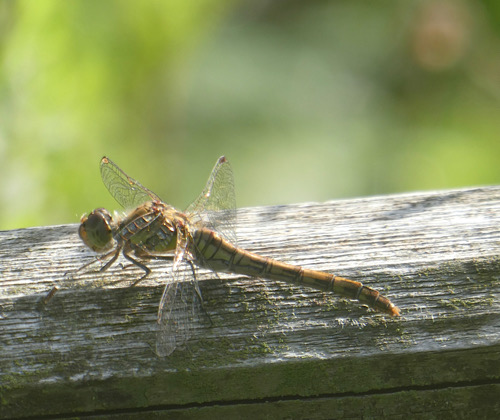
This is a rubbish record shot of a male Common Darter, but I like the picture.
This is looking down on to the "no swimming" pond. The sky is just a reflection.
Slightly more informative, this clip shows a pair of Common Darter ovipositoring, until chased off by a second male.

South shore
Just a quick walk with my daughter's dog.
Wheatear 7 on Ocean Edge foreshore 
Rock Pipit 3 on Red Nab.

Plenty of insects near Buddleia in the Nature park
Red Admiral 5
Brimstone 1 male
Peacock 1
Comma 1
Speckled Wood 3
Common Blue 3
Meadow Brown 3

Common Darter dragonfly 2

It was just after high water when I was at Red Nab, there were only a few rocks exposed with a few Oystercatcher resting on them. A juvenile Peregrine Falcon decided this was the time to hunt. This clip shows its approach. Towards the end of the clip, you can hear the waders reacting.

It selected one of the Oystercatcher to chase. No chance! Not only does the Oystercatcher get away, but it circled round and chased it off. 

As the juvenile Peregrine flew away, it was followed by an adult (presumably mum, heaving a sigh! (MD))

Sunday, 22 August 2021

Purple Sandpiper tops the bill

The light NW breeze freshened slightly and moved to the west. The sunny periods increased as the day progressed.

Pete and Jean conducted their Webs survey today the highlight being,
Purple Sandpiper 1 on sloping heliport wall
A summary of the other Webs records from Jean:

This is the count from Heysham Village Bay to Ocean Edge saltmarsh:

WADERS

Oystercatcher 5854

Redshank 761

Turnstone 96

Lapwing 1

Knot 2

Bar-tailed Godwit 1


GULLS

Black-headed Gull 120

Mediterranean Gull 2

Lesser Black-backed Gull 58

Herring Gull 85

Great Black-backed Gull 3


OTHER

Cormorant 93


Other stuff from south shore
Pied Wagtail 25 on Ocean Edge field in the morning
Linnet 12 on foreshore before moving along sea wall to join the resident 5 near lighthouse 
Rock Pipit 3
Wheatear 1 - none in the morning but one came in near the lighthouse in the afternoon then moved to Red Nab.
Bar-Tailed Godwit 2 
Whimbrel 1
Both the above on the beach near wooden jetty in the afternoon.
Mediterranean gull 4 on the beach near jetty in the morning 3 arrived shorty after it became exposed again in the afternoon plus 1 juvenile on sea out from the harbour

Insects near Buddleia in Nature Park behind Red Nab
Common Darter dragonfly 1

Red Admiral 7
Large White 1
Comma 2
Small Tortoiseshell 8
Meadow Brown 4
Speckled Wood 1
Common Blue 2
Red Admiral and Meadow Brown 


Middleton Nature Reserve 
Just a very brief check of the two main ponds
Mute Swan pair plus 9 cygnet
Coot 4
Moorhen 4
Mallard 7
Gadwall 19 

Swallow 15 SW in 15 minutes 
House Martin 2 also SW

Dragonflies :
Brown Hawker 1
Black-Tailed Skimmer 1 
Still at least one male Black-Tailed Skimmer can be found on the main pond peninsula.

This very worn Gatekeeper was the only one seen in a brief visit


Saturday, 21 August 2021

A mixed bag in the drizzle

Today's forecast was for light showers. Unfortunately, just one light shower, but it lasted all day. Light breeze from SSE.

First Alan's ringing report from yesterday morning from Middleton Nature Reserve:

John and I set nets on both east and west sides this morning. Conditions were good with no breeze. 55 birds were captured and processed:

Wren 5 + 1 retrap

Robin 4

Sedge Warbler 2 + 1 retrap

Lesser Whitethroat 5 + 1 retrap

Common Whitethroat 10

Blackcap 3 + 1 retrap

Chiffchaff 1 + 1 retrap

Willow Warbler 6

Blue Tit 4

Great Tit 1

Greenfinch 1

Goldfinch 7

Reed Bunting 1


c25 Swallows passed through the site but none were caught. No Grey Wagtails were caught or seen/heard.


South shore

Pete checked Red Nab this morning.

Mediterranean gull 22 - 24

Sandwich Tern 5

Most of the above flew off south as the tide reached the rocks, unfortunately not to the beach out from saltmarsh, where three large dogs were being exercised.


I was a bit late on the scene, but probably didn't miss much, if the beach out from the saltmarsh had been cleared (MD)

Rock Pipits 4 together on the tide line of the beach between Red Nab and Ocean Edge foreshore.

Wheatear 7

Lapwing 8

Redshank 150 on the saltmarsh 

Common Sandpiper 3 together 

Three Common Sandpiper
 Making these the largest "flock" of this species recorded in the Observatory area!

Originally near the rocky outcrop on the east side of the saltmarsh,
then flew to this small island.

Heysham skear - low water 18:15

Great Crested Grebe 6

Eider 20

Little Egret 7

Grey Heron 1

Mediterranean gull 1 - again on the northern side. It had an island all to itself and seemed quite content (who wouldn't be!). It seemed to be finding plenty of food, in this clip it catches a small crab.


Earlier this week Howard sent me these splendid Great Crested Grebe pictures. These were taken from the northern side of the Observatory area, but probably were two of the six seen this evening. Either way they are great pictures and definitely worth opening the images to appreciate the detail.

Great Crested Grebe 

Juvenile Great Crested Grebe 

Friday, 20 August 2021

More movement - both ways!

Very light SSE breeze initially, then moved more due south. Mainly overcast with the odd sunny spell in the morning, light showers started by evening.

So far, just my morning check of the south shore just before high water (MD).
Not quite true now, there was a ringing session on Middleton this morning, 31 warblers caught, I'll post details tomorrow.

Mediterranean gull 6 (4 on Red Nab plus 2 on beach out from the saltmarsh)
Wheatear 5 minimum, probably 9 (2 on Red Nab, 2 on foreshore and 1 on saltmarsh, all seemed to be moving through quickly, but on return 4 together on foreshore, probably new birds)
This morning's Wheatear were moving through quickly,
but plenty enough time to grab a quick snack

Rock Pipits 3 minimum 
Sandwich Tern 23 - 15 of them in this clip, the others were resting in ones and twos with the gulls.

There were lots of small waders feeding on the mud out from the saltmarsh 
Ringed Plover 48
Dunlin 36
Plus larger flocks further towards Potts corner.
Dunlin moulting to winter plumage.
The beaches that have not been covered for a while become rich feeding grounds
after the first tide to cover them. Every speck on this image is a potential source of food 

This clip demonstrates the different feeding techniques of these two species.

Swallow 19 - they didn't start moving south till 10:30, the 19 were in 30 minutes. They were flying low over the mud picking flies of it as they went. Some did a few circuits before continuing south. A couple were doing circuits around this Dunlin as it hopped away (The Dunlin were either feeding or preening. All the preening birds were on one leg and opted to hop, until they started feeding again).

Insects:
As I was on the beach there were several "small" white and Small Tortoiseshell butterflies flying north with the light breeze. Also two dragonflies. One large one probably an Emperor the other an immature/female darter sp.
On return to the saltmarsh, the Sea Aster had held a lot of the butterflies. The small white ones revealed themselves to be Small Whites. There were 8 on a small patch of Aster, with 2 Small Tortoiseshell, plus another 4 and 2 respectively coming in off Red Nab.
Small White on saltmarsh Sea Aster

There were also plenty of butterflies on the Buddleia in the nature park.
Red Admiral 11
Brimstone 3 (2 male 1 female)
Large White 1
Small White 1

The only dragonfly was a Migrant Hawker.

Finally, this is another juvenile bird being encouraged to fend for itself. I don't know, and probably don't want to know, what this Carrion Crow was pulling apart, but it wasn't for sharing it with the juvenile.


Thursday, 19 August 2021

Movement increasing

Very light breeze mainly from the south. Mainly overcast, with light showers from mid morning.

Middleton Nature Reserve 
Ringing report from Jean:

Warblers on the move this morning. 35 birds caught between 7am-10am and 31 of these were warblers. 

Sedge Warbler 7, 

Whitethroat 7, 

Willow Warbler 7, 

Blackcap 4, 

Garden Warbler 2, 

Chiffchaff 2, 

Reed Warbler 1 retrap, 

Lesser Whitethroat 1. 


Non-warblers included 2 Wrens, 1 Robin and 1 juv Dunnock. 

Almost all birds were this year’s apart from 2 adult Whitethroats.  


Swallows: 2 heard pre 7am (possibly ex roost?)Vis: Grey Wagtail (1).


South shore

Three checks today

First just a quick check of Red Nab and foreshore (MD)

Foreshore:

Grey Wagtail 2 together before heading off east

Wheatear 2

Rock Pipit 3


Red Nab

Mediterranean gull at least 8

Sandwich Tern 1

The Sandwich Tern is preening on the rock. There are five meds in this clip, although you only get a brief glimpse of one of them on far left at the start of the clip.


Kevin had a check at lunchtime:
Ocean Edge foreshore:

Wheatear 3
Rock Pipit 2

In the scrub near the lighthouse:

Two Willow Warblers.

I went down in the evening to check the beach near the wooden jetty (MD)
Mediterranean gull minimum 10 - the sun chose this point to make its only appearance of the day, making it impossible to tell if the distant gulls were meds or Black-Headed gulls. The gulls tonight were just stood on the beach, not feeding. I don't think it was the lack of opportunity, I just think they had already eaten enough (the timing of these tides allows them a morning and evening feeding opportunity). The white ringed bird was present again this evening. I was wrong yesterday thinking it was a new bird for the area. It was seen once last year, and that was the first record for this bird: 

Ringed as an adult 11/05/2019 at Total Antwerp Belgium.

Sand Martin 2 south
Swallow at least 13 feeding in Power Station grounds, 10+ south between Red Nab and small anemometer. A late evening check of the potential roost site at Middleton found 11 (6 + 5) birds still moving west, but no obvious roost.

Just some clips from today showing two common feeding behaviours of the large gulls.
First a very serene looking Lesser-Blacked back with a crab, I'll spare you the dismemberment. Or, you may wish to check out the other birds in the clip including a Sandwich Tern and Mediterranean gulls. The green ringed Med is the long staying German bird.

This Herring gull is opening a mussel, by dropping it on to the harbour wall. I once watched a Time Team episode where the "expert" declared, on finding a mussel shell on top of a rocky sea cliff: "the only way this shell got up here is by being carried up here by humans"......Really!

Unfortunately for the young gulls, they are a long way down the pecking order. This Carrion Crow was next up. they will soon learn to open their own mussels.


Wednesday, 18 August 2021

At last! The sand mason worms start providing

West light wind all day. Mainly overcast with light showers.

Middleton Nature Reserve 
Wildfowl unchanged except an additional male has joined the "no swimming" pond birds (now 8). He has joined the female with the three young (bet he got an earful).
House Martin 2 feeding over main pond.
Two small mixed tit flocks seen.
Very few butterflies, just. Meadow Brown, Gatekeeper and Speckled Wood.
Migrant Hawker Dragonfly 2

There were three rocks on the edge of the main pond marked with both fresh and old droppings consisting of broken crayfish shells. I am satisfied that they are Otter spraints, they are supposed to smell "oily", so I had a go. I suppose it could have been described as oily, the best I can say for it was that it didn't smell like what it looked like (thankfully MD) 

South shore 
Wheatear 2 ( one on foreshore plus one on Red Nab)
Rock Pipit 3 
Mediterranean gulls 20+ on beach between wooden jetty and No.1 outflow - no juvenile 
This is what today's title refers to, two things have changed.
1. For the first time, that I've witnessed, this year the meds were catching the sand mason worms all over the dry beach.
2. The worms that they were catching were much larger than the ones they have been catching up to now.

There were two colour ringed birds amongst them, one a regular and long staying green ringed German bird, the other a new white ringed bird. Details awaited.
This clip shows three things. The white ringed bird, how easy it was finding sand mason worms today and how much longer these worms are compared to the others I've shown being caught this autumn. 

When the meds are feeding like this each tries to defend their own patch of beach. Black-Headed gulls are also feeding, but they try and muscle in on other birds. 

Just a still of a sand mason worm being extracted from its tube

I suspect that when the worms are easily available like this, it relates to their breeding cycle, i.e. the worm has to at least partially leave the safety of its tube to deposit milt, presumably into an adjacent tube, or perhaps just onto the beach as lugworm do.

Tuesday, 17 August 2021

Gannet bonus

The wind was fresh but mainly from WNW, although it shifted slightly to west in the evening. Largely overcast with rain showers easing during the day and a bit of evening sunshine.

Heysham skear
We are back to neap tides, so the tide didn't go out far enough to uncover the outer skear.
Great Crested Grebe 2 (1 + 1)
Eider 4
Little Egret 4
Oystercatcher <500
Turnstone >100
Redshank c50
Ringed Plover c30
Curlew c30
The shrimps are getting bigger now, not quite as big as you see in fishmongers, but getting there. The west wind colours the shallow water providing feeding opportunities for the shrimps, which in turn provides a feeding opportunity for the birds. All these birds, apart from the Oystercatcher, are after shrimps in their own way. The Little Egret is most successful, but will need lots of them. Whereas one will be a decent snack for a Redshank. One of the Redshank catches one towards the end of this clip. Too valuable a prize to lose, so it runs to the mud on the right, before eating it.

South shore
This felt like a bonus walk, the sun was shining, the wind had freshened and shifted to the west.
Plenty of insects around the nature park
Butterflies:
Brimstone 1 male
Red Admiral 2
Painted Lady 1
Large White 2
Green-Veined White 1 (very worn)
Speckled Wood 
Common Blue 

Dragonflies 
Common Darter 2
One of two female Common Darter catching the evening sun on the wooden fence.

Rock Pipit 2 on Red Nab.

Kittiwake 1 2nd calendar year 
Pete advises that this will be the same one that I photographed on 8th August 
as - "there won’t be another with moult so retarded"
It does look a bit of a state, even the top of its feet appear to be peeling.

It was clearly itching to get into adult plumage.

Mediterranean gulls 5 - at least 4 adult/3cy plus I juvenile on the sea out from the harbour mouth.
Gannet 2 - when I reached the roundhead the wind was at its peak for the day and pretty much due west, but I couldn't see anything moving. Then at 17:45, one swept out from the north wall gained height and shot off south, directly over my head, unfortunately it caught me by surprise and my camera wasn't set ideally for a bird so close, still, better than average record shots for here (MD).

So encouraged, I hung around as long as my rumbling stomach would allow. But no more passage birds seen. Unfortunately the second bird was the "sickly" bird first seen on Saturday. It was hunkered down in a hollow on the sea wall between the outflows. Easy to see from the wooden jetty area, but hidden from view from anyone passing above. At least it seemed comfortable, but the prognosis isn't good.
Location of the sickly Gannet between the outflows 


Monday, 16 August 2021

Just a bit of movement

There was a bit of north in the wind today, mainly WNW. Light showers with the occasional sun.

South shore
First an update from Saturday when Richard reported a "sickly" looking Gannet resting in the harbour.

Today:
Rock Pipits 5 (2 on Red Nab 1 + 2 on the foreshore - the 2 could have been passage)
Wheatear 4 at least - at 09:00 there was 1 near lighthouse, 1 + 2 on foreshore. The lighthouse bird appeared to have moved on, but Kevin also saw one here at lunchtime.
This morning's Wheatear near the lighthouse 
Whimbrel 3

Mediterranean gull 10 (1 juvenile)
The beach near the wooden jetty was checked as it became exposed at 09:00. Initially only 4 adult/3cy and a juvenile turned up. None seemed to be catching any sand mason worms, although the juvenile was still at the "try everything" stage.

By 09:30 numbers had grown to 9 adult/3cy plus 1 juvenile. By this time the tide was quite a distance out but the gulls were still paddling but at least here catching some worms. There are three Black-Headed gulls and three Mediterranean gulls in this clip. Watch the med on the right, it catches a sand mason worm early in this clip.

Surprisingly, there was just a single Starling near the lighthouse, and that looked like it wanted to be a Black-Headed gull.
Starling with Black-Headed gull

Kevin checked out the Buddleia in the nature park:
Small Tortoiseshell 
Red Admiral 
Comma
Plus also in the area - Common Blue and Meadow Brown

Middleton Nature Reserve 
First some bad news, I was wrong yesterday assuming that the Tim Butler cygnets would be around. Janet advises that one has been missing a while and the remaining one had recently been killed by a dog. The incident was witnessed and has been reported.

Wildfowl as yesterday 

Insects
Not large numbers, but a reasonable variety.
Dragonflies:
Brown Hawker 1
Migrant Hawker 3
Common Darter 5

Butterflies in order of abundance:
Gatekeeper 
Speckled Wood 
Meadow Brown
Large White 2
Red Admiral 1
Painted Lady 1

Finally this bird was a puzzle. There was a Jay and a Carrion crow calling. Then this bird flew off in silence. It looks like a moulting Raven, but suppose it could be a carrion crow with a tail moult going on. Ravens do normally call as they fly off (MD).


Sunday, 15 August 2021

First diving duck returns

A fresh west breeze mainly overcast with light showers.

Not a lot today.

Just a quick sweep by Pete from Ocean Edge 90 minutes before high water, located:
Mediterranean gull 10 (3 juvenile)

Heysham skear - low water 11:20
Great Crested Grebe 5 (2 + 1 + 1 on the water plus 1 flying south)
Eider only 4 today
Little Egret 13
No sign of any Mediterranean gulls. Waders similar to yesterday, minus the off passage flock of Redshank.

Middleton Nature Reserve 
Just a quick check of the three main ponds in the afternoon 
Mute Swan pair plus 9 cygnets on main pond, pair on Tim Butler, the 2 cygnets not seen but they would have been somewhere nearby. 
Mallard 5
Gadwall 7 - female plus 3 young and a male with 2 female/immature 
The male Gadwall, in the foreground of this clip,  is still in eclipse.

This is one of the female/immature Gadwall having a bath

Tufted duck 1 male.
Male Tufted duck, in at least, partial eclipse.
It was being very secretive.

Little grebe 1 adult on Tim Butler 

No dragonflies seen and the only butterflies were a few, Meadow Brown, 1 Gatekeeper, 2 Large White and a Peacock.

Saturday, 14 August 2021

The Lion lies down with the.......mussel

The westerlies continues. Overcast for most of the day with light showers in the afternoon.

The only records so far are from my check of Heysham skear at low water (MD)
Great Crested Grebe 5 (2 + 3)
Eider 34
Little Egret 15
Grey Heron 1
Oystercatcher c500 on the middle skear - outer skear not checked
Curlew c50
Redshank c150 - including a presumed off passage flock c100 in an area where they do not routinely feed.
Turnstone c50
Juvenile Turnstone 
Ringed Plover 25
Mediterranean gull 1 - This looks like the same bird that I posted yesterday flying to the harbour mouth from the north. I can't recall ever seeing one on the skear before, hopefully the start of a new trend, there appeared to be plenty to eat. This first clip it was on the water on the north side of the skear. It seemed to find something to eat both times that it landed. It then flew to the skear.

It started feeding as soon as it landed on the skear, and certainly found a couple of morsels to eat. 

Today's title refers to Lion's Mane Jellyfish. There were several stranded on the beach, but this small one had dropped lucky and ended up being stranded in a small pool, just large enough for it to retain its form.
Lion's Mane jellyfish stranded in a shallow pool
It was pulsating, you can see the resultant indents in the surrounding mud

I've not had an active but captive Lion's Mane before, so I thought  I'd see how it reacted to a piece of broken mussel. This wasn't easy, mussel in left hand and camera in right, binoculars held between teeth! So I missed the actual encounter. No matter, the interesting thing happened afterwards. As soon as it "realised" that it was in contact with food, the pulsating stopped.

I know very little about jellyfish behaviour, but it makes sense to not swim away from an area that has just provided a meal. Jellyfish can't really dictate where they go, the pulsating will just allow it to rise higher in the water. So stopping pulsating would cause it to drop lower in the water. Or, perhaps, the energy used to pulsate is redirected to the tentacles to retrieve the food. They don't have to move quickly as any prey should be paralysed. Either way it started pulsating again and it definitely took hold of the mussel.

It hadn't long to wait, the incoming tide was only a few minutes away. I would have waited and recorded its release, but the tide would have silted the area up leaving visibility too poor to see anything. Hopefully it will be lucky, but the prevailing west winds will make it difficult. Just another reminder, these do sting, both the short red and long white tentacles have stinging cells. They will not harm you, but the sting isn't pleasant (I have been stung several times whilst  shrimping in the dark).