Thursday, 16 December 2021

Is, or are, the Shag becoming predictable?

Very light SW to WSW wind, low cloud all day but it remained fine.

Heysham Head - high water 09:30 (MD)
Rock Pipit 2 - 1 Half Moon Bay 1 below the high cliffs 
Red-breasted Merganser 2 (pair)
Shag 1 juvenile feeding just out from the rocks.
This is it diving:

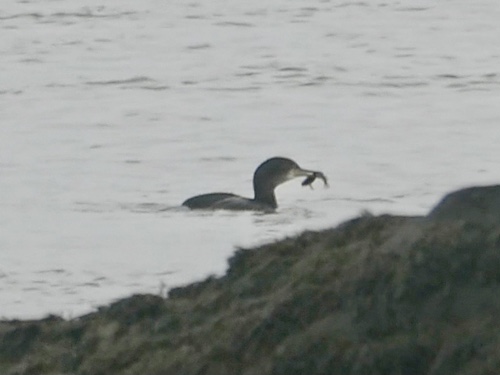
It managed to catch a Common Blenny. It didn't seem overly proficient at handling it, but eventually managed to swallow it. This clip starts almost a minute after it first surfaced with the Blenny.

This is just a zoomed in still from the above clip

In this clip it has moved out a little further, so gives an opportunity to show the location a bit better.

These rocks are part of a group called Throbshaw Point. If you are not familiar with their location a Google search will pinpoint it. The answer to the question in the title is, yes it it is predictable, as I am about to make a prediction. The real question should be, how accurate will the prediction be?
I am confident that it will return to this general area sometime around high water tomorrow, but exactly when and for how long I couldn't say. The clips above were approximately 45 minutes after high water, but I don't know when it arrived, or if it left just after. In theory it could be feeding at any point 2 hours each side of high water. Common Blenny are a resident fish, in that they seldom move more than 10m from their home. When the tide goes out they stay in rock pools, so they will be available as soon as the tide reaches the rocks. I'll probably have a look at some point, but if you go and see one, or possibly more than one, then please let me or Pete know.

Red Nab to saltmarsh mid morning (MD)

Just a quick check of the foreshore really. Not much around except plenty of Wigeon and Shelduck around Red Nab, but a high count of:

Lapwing 220 - there were about 100 resting on the mud out from the saltmarsh then another flock came in from the NE, I thought they were going to join those on the mud, but instead the resting birds joined the new birds. After flying around a while they eventually settled again but much further out. This is the arrival of the second flock.


Common Snipe - slightly unusually, Janet flushed one from grass at the junction of Meldon Road and Kingsway.


Middleton Nature Reserve 

Just a quick look at the two main ponds in the afternoon 

Mute, Coot and Moorhen unchanged 

Gadwall 36

Mallard 5

Tufted 1 male

Shoveler 1 male


Heysham skear - low water 16:20

The light was already fading as I walked out, still it was nice to see a bit more of the skear exposed. The clamour was even more pronounced than yesterday, at times almost deafening. This clip shows the Eider joining in, as new beds become exposed. This year, the mussels eventually won out over the honeycomb worms, on the west side of the middle skear where this clip was taken.


Eider c170
Great Crested Grebe 4
Red-Breasted Merganser 2 (pair, probably the same two out from the Head earlier)
Pale-belied Brent goose 37 at least. As I was walking out I saw a flock of c30 fly from the rocks out from the village to closer to the play area. At 16:00 a flock of 3 flew off west. As I was coming off the skear, now quite dark, I could see a number in the skear corner, although there is very little for the Brent to feed on there at the moment. This clip gives an idea of how dark it was getting, I was impressed at how light my camera made it look.

I could see there were more Brent further up the shore, but couldn't make out how many. I was just wondering how to get past them without spooking them, when they all took flight. Nothing spooked them, it was just "time".

There are 34 in this flock (don't they sound nice). I assumed that they were heading back to the west side of the bay to roost, but instead they circled round and landed on the water on the north side of the skear. I'm not aware of any weed in that area, available for them on this height tide, but, much as it pains me to admit it, they know the area much better than I do! (MD)


Wednesday, 15 December 2021

Brent appear to be getting desperate!

Light SW wind largely overcast but with a few sunny spells

First of all, a somber note. I do try to keep this post as light as possible, but the shortening days are causing a significant conflict between feeding/resting birds and people exercising their dogs. One key area is the old Heliport. This area is private property and anyone walking on there is trespassing and could be prosecuted. But more importantly this is a high water roost for thousands of waders. They don't want to roost in daylight during these short days, they need to feed, but feeding opportunities on the upcoming spring tides are very limited for them. The last thing they need when they are trying to conserve energy is to be flushed from their roost, sometimes repeatedly. I know none of the regular post readers would go onto the Heliport, but if anyone knows someone or sees someone that does please pass on this concern. We are not just talking about the health and survival of the birds, there is also a potential health risk for the dogs. As Pete points out, so far this year, there have been c4,000 Barnacle Geese known to have died of the highly transmissible Avian Flu on the not too distant Solway. And we already have more than enough transmissible viruses around!
The second area is the current feeding area for the Brent Geese around the rocks near the children's play area. This area is open for people to exercise their dogs, and dogs do need to be exercised. But the geese again today were regularly scattered, but they kept returning, closer and closer to the wall. This goes against all the instincts of a wild goose, particularly ones that spend their summers in the wilderness of the Canadian Arctic! To venture so close to the sea wall, and brazen out walkers passing so close by, indicates just how scarce their food is this year, and they need all the time they can get to eat it during these short days. If you exercise your dog(s) around this area, or know someone who does, please suggest that in the vicinity of these rocks could they walk their pets on a lead. I have regularly seen walkers with dogs to heel pass within 10m of the Brent without them taking flight. And don't forget the concern about the Avian Flu!
The third area is the other main wader roost on the Sunny Slopes groyne, this was again flushed of all birds today. It's only the occasional frantic dog, so again, keeping your dog to heel in this area is all that is required, there is plenty of beach to go round. Thank you (MD)

Middleton Nature Reserve 
I managed a decent circuit today, but saw little more than I do during my regular 5 minute checks! (MD).
Mute swan 2 adult 9 cygnet
Moorhen 6 (none in field to east of Tim Butler)
Coot 1
Mallard 11
Gadwall 29
Tufted duck 1 male
Shoveler 1 male
Sparrowhawk 1
Kestrel 1
Redwing 1 - I saw a Redwing and a Blackbird between my car and the main pond, so I started a tally sheet! Didn't see another Redwing and the few Blackbird were probably resident.

North shore 
Pete and Jean had a look, report from Pete:
Shag 1 juvenile, north side Heysham head close inshore 
Pale-bellied Brent goose Circa 40 off play area north of Heysham head including Canadian ringed pair and presumably the same intermittently recorded white ringed bird we haven’t been able to obtain a life history of

Later, I had a look on the skear and saw the groups of Brent flying out from then returning to the children's play area (MD). This first clip shows three things.
1. It starts with the white ringed bird
2. It shows the location, this is a third choice area along the groundwater run off, the slipway in the background is the one out from Rydal road.
3.it shows the point I made on Saturday about how, at range, the Brent can be confused with the Oystercatcher. This is particularly evident towards the end of the clip when the birds are more distant.

As I was leaving, I noticed a small group really close to the sloping wall between the children's play area and Heysham village. You can't really see much on this clip, other than how desperate the Brent must be!
N.B. You wouldn't be able to see any Brent here from Knowlys Road.

I like these tides, we are moving away from the neap tides, this means that each tide goes out a bit further than the last. Which in turn means that each tide exposes a bit of shore, that hasn't been exposed for a week or so. The waders and gulls clamour to be the first to exploit the new food sources. In this c5m band along the south side of the skear there was
Oystercatcher c2,000
Redshank c200
Turnstone c30
Curlew 15
Knot 10
Dunlin 5
The sun made a brief appearance, so I took this clip, not all the waders are represented, but there are Oystercatcher, Redshank, Turnstone and Curlew.

When the tide stopped ebbing, the clamouring ended.
They seemed to have found enough food for another day.
Left to right: Dunlin, Redshank and Knot

Eider 100+
Great Crested Grebe 2
Shag 2 juvenile, presumably one was the same bird seen feeding earlier off Heysham Head. This short clip shows one of the Shag diving, with an Eider diving behind it.


Tuesday, 14 December 2021

60 Ducks a-dabbling

The light wind started SE before swinging round to SW. A bright start but becoming overcast later in the morning, some sunny spells in the afternoon.

Red Nab and Saltmarsh 
Just a short check along the shoreline 
Greenfinch 4 on Red Nab
Shelduck 85 feeding on mud out from foreshore
Common Snipe 27 among the small tussocks of sea grass out from the saltmarsh 

Middleton Nature Reserve 
A look at the two main ponds saw a lot of new ducks in.
Mute Swam 2 adult, 9 cygnet
Moorhen 7
Coot 1 - first record since 1st November
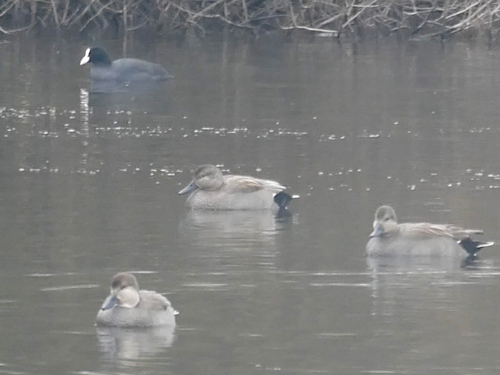
Coot with male Gadwall

Mallard 26 on "no swimming" pond plus 3 on main pond
Gadwall 30
Shoveler 1 male
57 ducks on the "no swimming" pond! Although all dabbling ducks, most were either resting of adjusting their feathers. These are just some of them:

North shore 
Pale-Bellied Brent geese 15 at least - looking back from the skear there were at least 9 visible close in near  the children's play area. Later, they must have been spooked and moved away, there were at least 15 amongst the rocks high up the shore from the SE skear corner. Unfortunately an especially nuisance dog flushed them from here too, after clearing the skear.
Shag 1 was resting on Conger rock with 2 cormorants, before flying off to fish about an hour before low water.
Great Crested grebe 2
Eider 100+

Monday, 13 December 2021

Brent numbers increase with neap tide

Very light S to SW breeze, overcast al day with the occasional light shower.

Middleton Nature Reserve 
Just the briefest check of the two main ponds
Mute and Moorhen unchanged 
Mallard 2
Gadwall 24
Tufted duck 1 male
Shoveler 1 male

North shore
Pale-bellied Brent goose 39 - these 37 flew from the furthest rocks out from the children's play area to their preferred feeding spot close in to the north of the play area. There were another 2 in the skear corner that joined them later.
Today was the lowest tide in the current neap tide phase. With so much less shore exposed on these tides, many of their other feeding options will not be available (MD).

Shag 1 juvenile - I could see it feeding near conger rock while I was still a long way from the water's edge. I just managed this short clip of their classic feeding dive.
By the time I'd reached the water's edge, it must have just caught and swallowed something, wish I'd checked earlier. It must have been a quite large fish, as it spent the next few minutes fidgeting around and looking a bit uncomfortable. When I looked back later there was no sign, so presumably it had flown back to the harbour area.

Great Crested grebe just 1 seen, but suspect there were more further out
Eider c150
That's about it really, a walk back along the shore side of the sea wall failed to locate yesterday's Black Redstart, perhaps it's moved into our area, I'll have a look tomorrow.

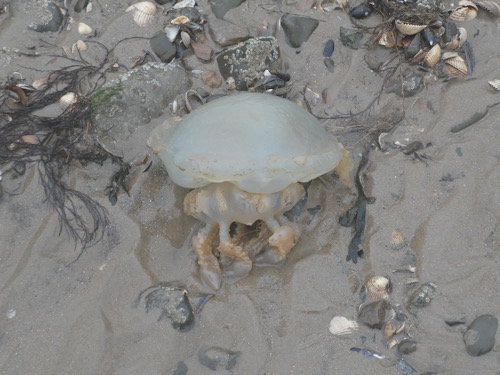
This is a Barrel Jellyfish, not unusual here, but quite late in the year for them.
Barrel Jellyfish......

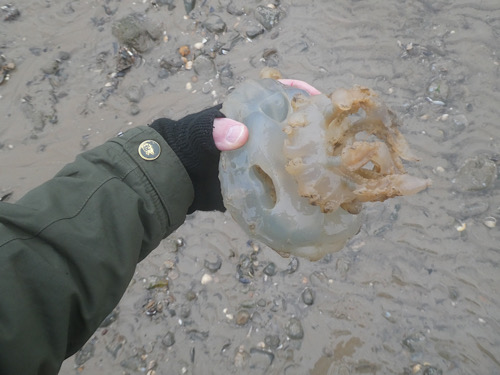
When I have seen late ones before they have been quite large, they for less than a year in their adult form. But this one was quite small. I returned it to the water, but no obvious signs of life.
.........I think its jellyfishing days are done!


Sunday, 12 December 2021

Duck diversity improving, but still no Pochard (plus BRS just OOA)

 Light wind from SSW, very low cloud and rain for most of the morning, brightened up in the after lunch.

Middleton Nature Reserve (MD)
Just a quick check of the two main ponds, hoping for an, increasingly scarce, Pochard. We've managed at least one annually until 2020, this would be the second blank year, unless we get a late arrival.
Getting closer today, two diving ducks (Tufted) appeared on the "no swimming" pond.
Mallard 3
Gadwall 6
Shoveler 1 male
Tufted duck 2 male
The Shoveler was trying to steal the show, again. The Tufted didn't seem impressed. Sorry about the soft focus but there was a lot of very fine rain.

Heysham Harbour 
From Kevin Eaves
The R-t Diver still in the harbour.
The dredger wasn't active so it was in the waterfalls area.

North shore
Pale-bellied Brent geese 16 - just north of the children's play area, no reports yet from any close observers, this count was looking back from the skear.
No Great Crested Grebe seen
Red-breasted Merganser 1
Eider 89 in one close inshore raft
No Knot, but small flock of 14 Dunlin, plus Oystercatcher, Redshank, Curlew and Turnstone 
Carrion Crow - there are always plenty on the skear, and they are largely indifferent to me (MD). But today particularly so, I was less than two metres from these two groups of two birds.
This first clip shows one bird select a suitable mussel then fly off to a rockier area to drop and open it. But this must be its feeding spot as when it flies off, its companion finds the remnants of its last meal and manages to find some morsels.

In contrast, these two were prising barnacles from a rock, don't know if they wanted the small amount of meat inside, or the shell for their crop, or both. You can see the rain dripping from their backs, it was that fine stuff that gets you wet! You can tell just how close I was, as you can hear the barnacles breaking off. I also like, that when it hears an alarm call, it looks to me for reassurance.

This is slightly unusual, and I don't really know why. It is the imprint left in the mud where a Thornback Ray has been resting, on the ebbing tide. I know it was the ebbing tide as fish always rest facing the water flow direction. I say unusual as Thornback are quite common here, but I think this is only the second time I have seen an imprint. Partly today, that will be because the waves were slight so not so likely to smooth the imprint out, but I also think that the ray must have left it late in the tide to leave its resting place, perhaps it was injured or unwell, or just lazy!
Clear and unmistakable imprint of a Thornback Ray left in the mud


Just out of the recording area:
Pink-Footed goose "thousands" feeding in fields between Oxcliffe Rd and Heysham Moss Nature Reserve.
Ref Dave Tregidgo

Black Redstart 1 female/immature on fishing platform at the end of Rydal Rd. - Pete let me know that one had been recorded there today, originally seen by Nick Godden, the sun had just come out so I went for a look (MD), and was later joined by Jonathan.
Unfortunately, by the time we had relocated it the sun had gone. I had already checked the area thoroughly, but no sign, then it suddenly turned up, so if you go for a look, hang around for a while.
Female/immature Black Redstart 

This clip isn't great, but shows the location, the railings at the end of the clip are at the very end of the Fishing Platform. Unfortunately two cyclists arrived just after this and flushed it to the south side, where we only managed a couple more glimpses in the quickly fading light.


Saturday, 11 December 2021

Brent still providing easy viewing

The SE wind shifted more to south during the day, overcast with showers pretty much all day. 

North shore (MD)
Pale-bellied Brent goose 29 minimum - I walked out to the skear from from Four Lane Ends. Looking back to the children's play area there were at least 26 amongst the rocks in front of the play area. Not very close in today, as all the dog walkers were getting in their walks in before the rain started. Even so they were still easily visible from the promenade or Knowlys Rd. there were 3 more feeding in the SE skear corner.
These shots are from Kevin Singleton and were taken from the same location yesterday.
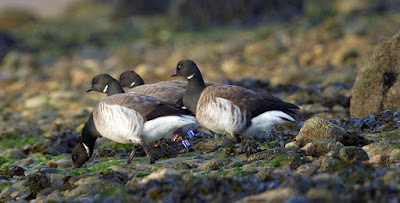
A nice shot showing the D and T blue rings of the Canadian ringed pair
Some returning to the feeding area after being spooked, they tend not to fly far
 away now. You can see the wing bars on the middle bird showing it to be juvenile. 
Clearly not a Brent Goose - but it can be surprisingly 
difficult to locate distant Brent geese feeding among Oystercatchers.

Eider c60
Great Crested Grebe 5
Red-breasted Merganser 3

Heysham Harbour 
On the way back I checked the inner harbour from the end of the single track road.
Red-Throated Diver 1 - still on the gas offices side

Middleton Nature Reserve 
Just a brief check of the two main ponds
Mute and Moorhen unchanged 
Mallard 3
Gadwall 11
Shoveler 1 male
I would normally say, a good comparison clip, but no one is ever going to mistake a male Shoveler in breeding plumage, for anything else.


Friday, 10 December 2021

A lot going on again

A light WNW wind in the morning with sunny spells, showers developed by the afternoon.

North shore
Pete and Jean managed a mid morning check from Knowlys Rd. 
Great White Egret on skeer edge about 1.5 miles to the north

Pale-bellied Brent 26 off play area close inshore 

Later in the morning, more had come in resulting in a total of 32 near the play area - ref Kevin Singleton 


I checked the skear at low water 10:20 (MD)

Eider 50+

Great Crested Grebe 10

Red-breasted Merganser 2

Knot c500

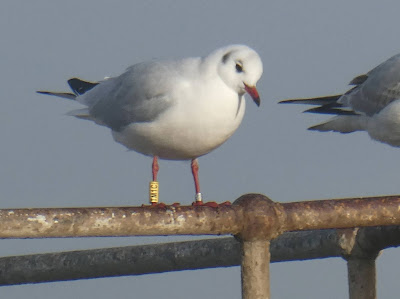
No Brent feeding in the corner, so I had a look at the birds near the play area, where this white ringed Black-Headed Gull was resting.

Black-Headed gull. Ringed in Germany as an adult 22/03/13
Seen in Heysham each winter since 2018-19


Middleton Nature Reserve 

Just a quick look at the two main ponds

Mute and Moorhen unchanged 

Mallard 4

Gadwall 21 all on "no swimming" pond

Shoveler 1 male - showing well today, but no sign of a female


South shore mid afternoon 

Shelduck 32

Wigeon c120

Pale-bellied Brent goose - these 27 flew from the north side at 14:30 and landed on Red Nab, they were still feeding there at 15:30, including the two Canadian ringed birds. This is them coming in.

Rock Pipit 2 on Red Nab
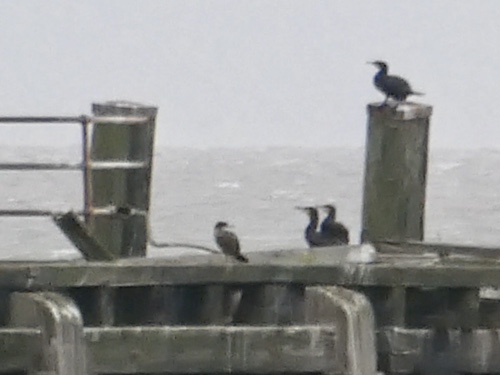
Shag - 2 birds roosting on wooden jetty with the Cormorants looked likely candidates, but they steadfastly refused to show their profile..........and I have no patience! (MD)
Red-Throated Diver 1 - still in the harbour but on the far side today, away from two active dredgers.
First, these excellent pictures of it from yesterday by Dave Tregidgo:


Red-Throated Diver

Yesterday it was constantly diving, today it was much more relaxed and was just preening, I suspect that it had already eaten.


Thursday, 9 December 2021

What a difference a day makes!

After yesterday's washout, today was very pleasant with a moderate WSW wind, largely overcast to start with, but some sunny spells later. A little light rain by evening.

I managed two nice walks and a detour today, nothing else so far  (MD)

Heysham skear low water 09:20
Great Crested Grebe 15
Red-breasted Merganser 2 (pair)
Eider 100+
Pale-bellied Brent goose 19 (at least) - at 09:15  these 15 flew in from the west and landed quite high up the shore to feed. You can hear their soft "grunts" as they fly towards me.
There were also 4 feeding in the SE skear corner, these included the two Canadian ringed birds. On the return leg, the 4 were still in the corner plus 4 feeding close in just north of the children's play area, and another 2 further out on the outer rocks. Don't think I missed the 15, I assumed they had moved on, but perhaps not, more later.

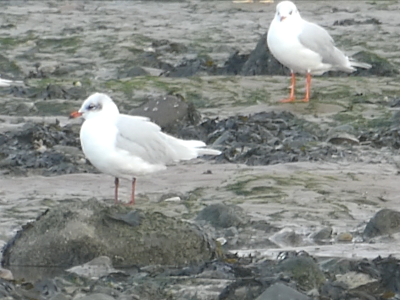
Mediterranean gull 1 also just north of the play area resting with Black-headed gulls. In this short clip there are three species of gull (Med first, then BHG and Lesser Black-Backed) plus 4 Brent Geese. Not a bad selection so close to the promenade.

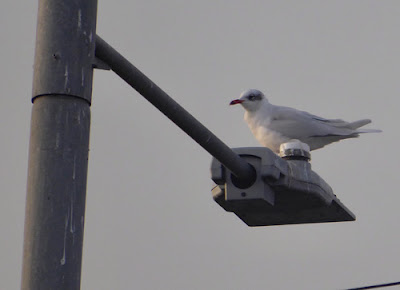
The face mask and bill pattern on today's bird looks very similar to the one that over wintered here last year, and was regularly seen on the lamppost just past Four Lane Ends traffic lights. These are today's bird and the lamppost bird for comparison.
Last winter's overwintering Mediterranean gull 

Today's Mediterranean gull


Middleton Nature Reserve 
Just a quick look on my way home provided three "surprises":
1. Only the Mute and Moorhen on the main pond, no ducks, not even a Mallard.
2. Perhaps, this wasn't really a surprise - the water level was higher on the "no swimming" pond, not by much, but enough to make reaching the weed difficult for the Gadwall, so most had gone, only one bemused looking male remained.
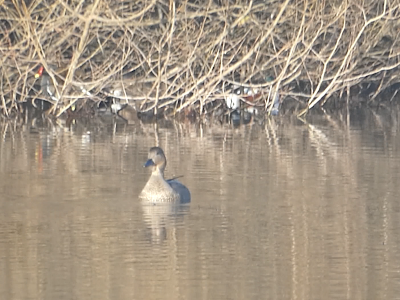
3. Shoveler - I could make out the unmistakable marking of a male amongst the margin vegetation, there was a female with it, but it wasn't possible to tell if it was a Shoveler or a Gadwall. So this picture shows the sum and total of todays ducks, 1 male Gadwall, you can just make out the colours of the male Shoveler, top right, there is a Moorhen there too, but you can't really make out the female bird, my guess is that it was a Shoveler too, hopefully see it tomorrow.
Today's duck tally!


South shore early afternoon 
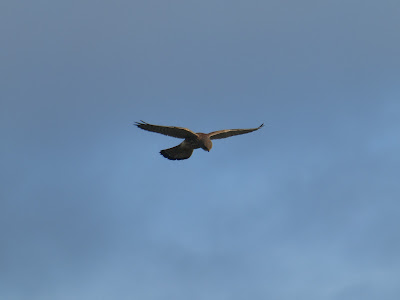
Kestrel 1 on saltmarsh, I was thinking the other day that I hadn't seen it here for a while, presumably it has expanded its territory.
Kestrel hunting over the saltmarsh 

Common Snipe 2 on saltmarsh 
Rock Pipits 3 - Red Nab, waterfall area and sea wall
Wigeon c120
Pale-bellied Brent goose 23 - here they are flying from the north side past the wooden jetty towards Red Nab. They were not on Red Nab on the return leg, but a passing birder confirmed that they did land there (thanks Dave).

Shag 1 juvenile resting on the end of the wooden jetty.

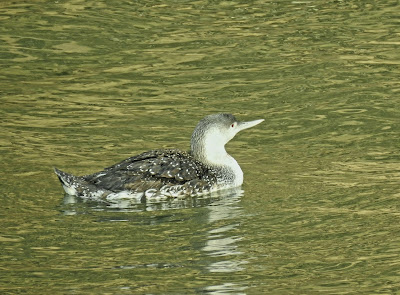
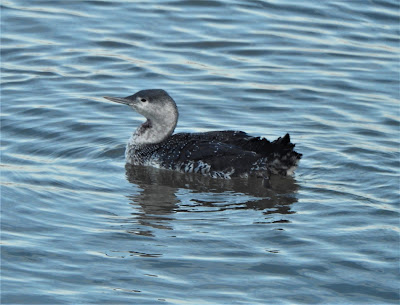
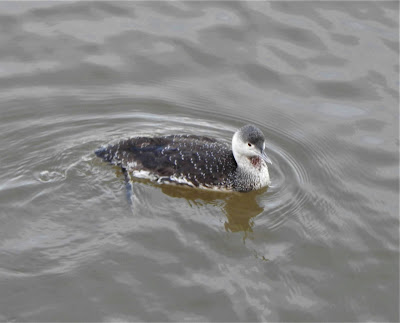
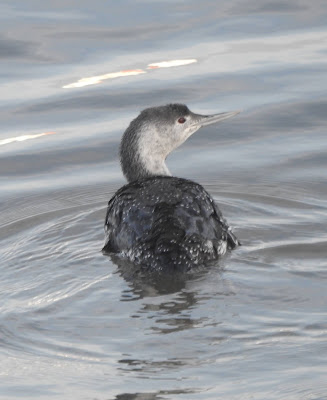
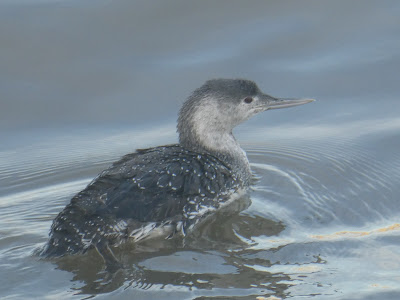
Red-Throated Diver 1 adult moulting from summer plumage was showing well in the harbour.
Red-Throated Diver
I haven't pre sized any of my pictures today, so more detail is visible if you open them.

I'm not very familiar with divers (they are not often close in enough for me MD), so it took me a bit to be sure, but the remnants of a red throat and constant diving were pretty good clues. Although, to be fair, the throat wasn't obviously red from a distance.

And a close up.....

They are an elegant diver aren't they! But it didn't catch anything in the dives I watched.

Finally, it was a good day for ringed gulls in the harbour. This is a Black-Headed gull ringed in Poland as a nestling 13/06/17, and has been recorded in Heysham ever winter since
Black-Headed gull ringed in Poland

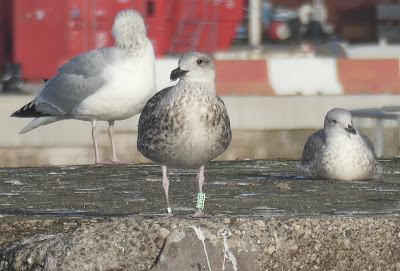
This next one puzzled me, I knew by the ring format that it was part of the North West England Gull project, but I didn't think the project included Great Black-backed gulls. But on checking their webpage they were pleased to have ringed some nestlings for the first time this summer.
First calendar year Great Black-backed gull - details awaited
You will be able to see the ring details if you open these images

There is a link to the North West England Gull project on the side bar, but I've also put it here. If you open it, there is their 2021 ringing report of where and how many of each species of gulls were ringed. 500+ ringed this year, so there should be plenty around.


Wednesday, 8 December 2021

It rained....so a bit of erosion "news"

Very heavy overnight rain continued all day driven by a strong west wind which only started to ease by late afternoon.

I tried a walk along the south shore, but there was little to see in difficult viewing conditions (MD).
Shelduck 11 braced against the wind on the mud. The rain had eased slightly and I thought at the time, this might be my only photo opportunity today - I was right!
Shelduck 
Wigeon 95 on the lee side of No.1 outflow on the way out, there seemed more on the way back, but the rain was particularly harsh then, so not counting weather.
Rock Pipit 1 on saltmarsh 
Greenfinch 3 on Red Nab
Shag - a small pot bellied bird flying out of the harbour was almost certainly a shag, but didn't get a good enough look to be sure.

Blackbirds 5 particularly plump birds were catching worms on the water logged grass in the Nature Park. They were briefly joined by a 
Redwing, don't know if it was also after worms or just seeing what was going on.

That's the end of the bird news, unless someone else was daft enough to be out today. The rest of this post is just a bit of skear history. I've been saving the pictures for this article for a rainy day, not done bad, it's over a year!
On 12th October 2020 I explained how the skears were once two tree covered islands on top of boulder clay, left from the last ice age (if you want to read any historic posts there is a date selection option on the side bar to the right). The islands were still there in the late 17th century, possibly lasting as late as the great storm of 1703. 
Today, I want to demonstrate, that without any historic records, it is still easy to deduce that the islands have not been gone for long.
Boulder clay as the name suggests is a collection of rocks and clay amassed together by a glacier. When the islands were destroyed the surface clay would have been washed away, leaving the rocks and boulders to rest on the current surface. This first shot is of the inner skear, you can see a range of size and shaped boulders resting where they settled.
Boulders on the inner skeer
Although the inner skear is covered by the sea twice a day, and is subjected to weathering due to rough seas, it is a slow and pretty much a random process.
It's a different story on the outer skear, there are no large rocks present at all. The difference is the speed and power of the, particularly ebbing, tides has completely eroded any large rocks. But, to me, the interesting area is the middle skear, where the erosion can be seen in progress. 
There are still a lot of large rocks on the middle skear, but at they all appear to be a similar shape, triangular. This is a typical middle skear rock, when it's not encrusted with honeycomb worms or mussels.
Middle skear rock, the clue to its shape can be seen at its base where it is eroding
This is not the shape of the rock that first settled here. You can see at its base the fast tides are driving stones and mussels against it and undermining the rock. This has already happened to it at least once, the peak at the top was once its side. This next picture shows one that has just toppled over.
Recently toppled middle skear rock
You can see how the undermining has caused it to be top heavy and it has fallen on its side. The process begins again immediately. 
Sometimes the base gets so thin that they end up, upside down, as these three.
Three recently toppled middle skear rocks, now upside down
The process is surprisingly quick, I have walked on the skear for many years and have watched them erode and topple (although you never actually see them topple, the currents do that). I'm not talking months, but definitely decades not centuries. It is easy to see that in a few hundred years there will be very few large rocks on the middle skear, as is the case now on the much harsher environment of the outer skear.
There are exceptions of course, the rocks above are sandstone, there are also limestone rocks whose erosion is somewhat more erratic. A few granite rocks showing no obvious sign of erosion and the largest rock of all Conger. This is also sandstone, I think, but its huge size makes the process relatively slower. Even so, you can see the undermining process at the base of conger, but I'll not see it topple!
Conger rock, not ready to topple yet.

Hopefully a bit more wildlife news tomorrow 

Tuesday, 7 December 2021

Sheltered from the storm

It was wild today with very strong SE winds, but winds in this direction do not have the same impact in Heysham as those coming in off the sea. Occasional showers.

South shore
Saying we are somewhat sheltered from SE gales doesn't mean the going was easy, although the battling against the wind was for walking back along the wall, not heading out.
I had a quick look on the rising tide mid morning (MD)
Wigeon 100+
Still no Shelduck seen
Rock Pipit 1 on Red Nab
Kingfisher 1 - it looked like it had been fishing in the pool directly below the sea wall at Red Nab. Plenty of small fish get trapped there on spring tides. But it flew off when I became visible to it.
Shag 1 juvenile preening on the wooden Jetty
Juvenile Shag centre, with Cormorants on wooden jetty 

It's a little easier to see in this clip, sorry about the rolling, but it was quite blustery on the round head.

Janet had a quick look this afternoon and took these shots:
Male Wigeon battling against the wind

These Ringed Plover sheltering behind the foreshore,
add a nice bit of colour to an otherwise grey day.